


For fifty-three agonizing years, being a fan of the New York Knicks was a masterclass in patient heartbreak. Generations of New Yorkers grew up on stories of the legendary 1973 championship team, watching as subsequent decades brought brilliant near-misses, painful rebuilding projects, endless coaching carousels, and the nagging sense that glory might never return to Madison Square Garden. But on a sweltering Saturday night inside the Frost Bank Center in San Antonio, Texas, that half-century of basketball frustration evaporated into pure, unadulterated joy. With a gritty, soul-testing 94-90 victory over the San Antonio Spurs in Game 5 of the NBA Finals, the Knicks captured their elusive third franchise championship. Though the historic clincher took place over fifteen hundred miles away from the hallowed floors of Midtown Manhattan, the sheer volume of traveling New York faithful who invaded the arena made it sound as if the final whistle had blown right in the heart of the Big Apple. It was a poetic end to one of the most grueling and memorable campaigns in franchise history, proving that when a championship finally returned to the city, it would be secured through the same relentless, blue-collar toughness that defines New York itself.
The path to glory, however, was paved with the kind of early-game disaster that has historically haunted the franchise. From the opening tip-off, Game 5 seemed primed to slip away as the young, athletic San Antonio Spurs came out swinging, capturing the first-quarter lead for the fifth consecutive game. The Knicks’ offense was frozen in place, producing a dismal first-quarter performance where they converted a shocking 4-of-22 field goals to score a measly 13 points—one of the worst offensive opening quarters in modern NBA Finals history. Facing a double-digit deficit almost immediately, New York looked like a team suffocating under the immense pressure of the moment. Yet, true to the identity they forged all season, they refused to shatter. Behind Jalen Brunson’s steady hand, who kept the offense afloat with 16 first-half points, and a fortuitous flagrant foul by Spurs guard De’Aaron Fox that triggered a five-point possession, the Knicks clawed their way back. Despite Victor Wembanyama’s towering physical presence nearly yielding a double-double by halftime, New York trimmed the halftime deficit to a manageable five points, setting the stage for an emotional roller coaster of a second half.
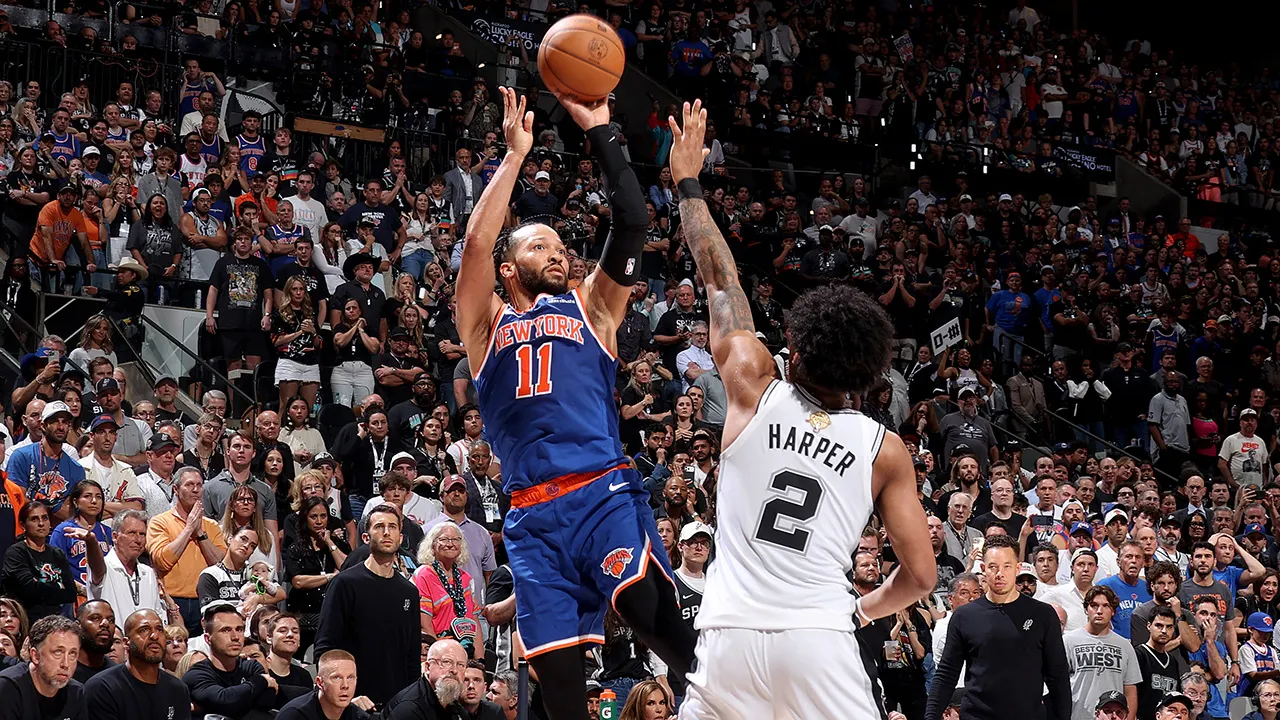
If the first half was a test of resilience, the third quarter was a descent into absolute chaos. Just fifteen seconds after the break, the Knicks’ primary defensive anchor, Karl-Anthony Towns, picked up a devastating fourth personal foul, forcing him straight to the bench. The consequences were instant; his replacement, Mitchell Robinson, committed a flagrant foul that gifted San Antonio a demoralizing six-point sequence to push the lead back into double digits. Then, the collective heart of New York stopped: with just over five minutes remaining in the period, Jalen Brunson landed awkwardly on Wembanyama’s foot after sinking a three-pointer, visibly rolling his ankle. The court became a theater of high-octane frustration as Brunson and Knicks head coach Mike Brown vehemently lobbied for a dangerous closeout flagrant foul call that never came. With the refs swallowing their whistles, the Spurs capitalized, executing a swift transition that culminated in a Devin Vassell three-pointer, widening the gap to a scary 15-point lead fueled by a red-hot 25-point performance from rookie Dylan Harper.
It was in this darkest hour, when an agonizing Game 6 back in New York felt almost inevitable, that Jalen Brunson cemented his name alongside the pantheon of Gotham sports legends. Shrugging off the searing pain in his ankle and refusing the safety of the bench, Brunson put the entire city of New York on his back. With Towns sidelined by foul trouble, Brunson orchestrated a breathtaking individual masterpiece, pouring in 14 points in the third quarter alone to narrow the gap to seven. He played with a furious, artistic intensity, cutting through San Antonio’s length, driving fearlessly into the paint, and refusing to let his team’s dream die on Texas soil. By the time he hit a contested layup with under five minutes left in the game, he had tied the score at 83 and reached the 40-point milestone. Moments later, showing the poise of a seasoned champion, Brunson drew a clever foul on a perimeter shot, calmly sinking three consecutive high-pressure free throws to give the Knicks their very first lead since the opening minutes of the game.
The game’s final minutes descended into a frantic, nerve-wracking scramble of tactical chess and raw physical determination. Towns fouled out, forcing New York to defend their fragile lead without their premier big man, while the Spurs threw everything they had at the basket, with Stephon Castle converting a high-flying putback dunk to bring San Antonio within two points with only sixteen seconds left on the clock. After Mikal Bridges split a pair of free throws to give New York a precarious three-point lead, the climax boiled down to a high-stakes coaching decision. Rather than allow the Spurs to possess the ball and launch a potentially game-tying three-pointer, Coach Mike Brown instructed his players to foul intentionally. The gamble worked beautifully: Dylan Harper, feeling the unbearable weight of the moment, missed both free throws, allowing the Knicks to secure the final, championship-clinching rebound as the buzzer sounded, igniting an emotional celebration decades in the making.
When the dust settled on the historic night, Brunson’s final stat line read an astonishing 45 points—putting him in elite company with the third-highest scoring output ever recorded in an NBA Finals-clinching game. While the basketball world will undoubtedly spend the coming days analyzing what this valiant effort means for the incredibly bright future of Victor Wembanyama and the young, resilient San Antonio Spurs, this moment belonged entirely to New York. For over half a century, Knicks fans had endured the endless punchlines, the agonizing playoff exits, the draft lottery disappointments, and the heavy burden of longing for the glory days of Walt Frazier and Willis Reed. On this night, all of that cynicism was washed away under a confetti rain of orange and blue. The relentless waiting, the generation-spanning hopes, and the heavy weight of 1973 were finally over, replaced by the permanent realization that the New York Knicks were once again the undisputed champions of the world.