


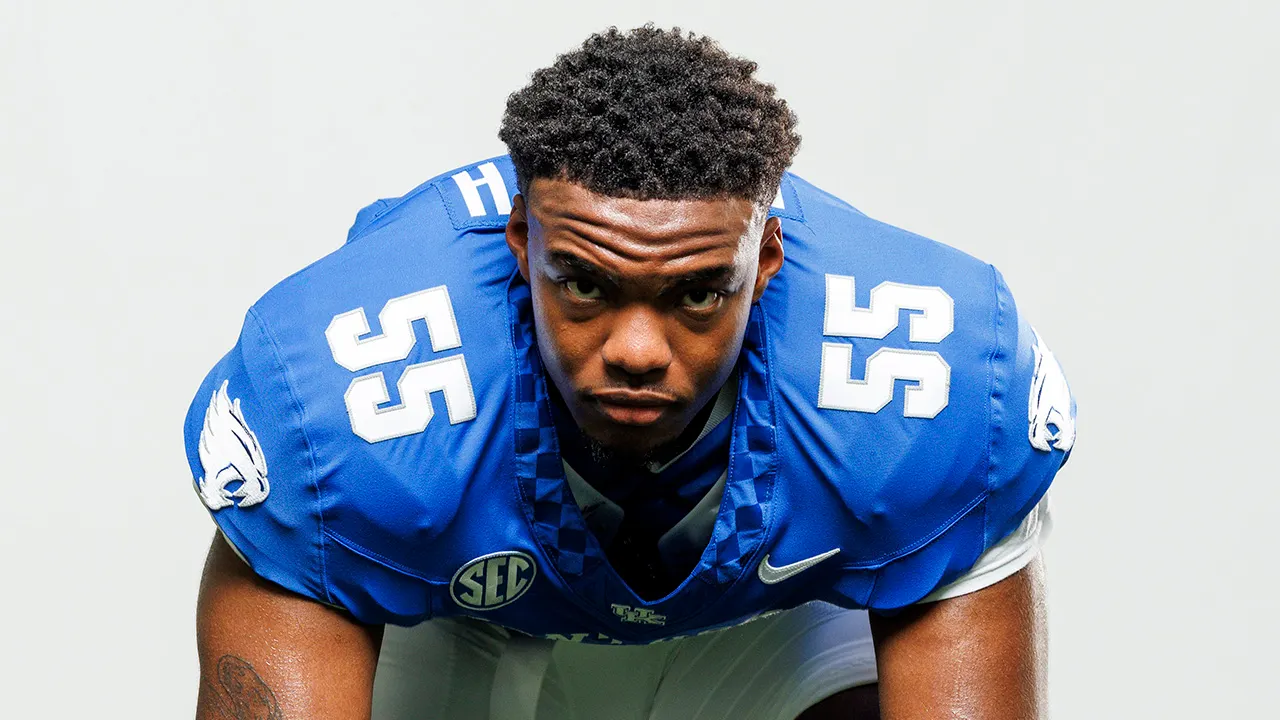
The quiet rustle of autumn leaves on a collegiate campus is usually filled with the anticipation of Saturday game days, the hum of student chatter, and the vibrant promise of youth. Yet, a heavy, suffocating silence descended upon the University of Kentucky community this week as the devastating news broke that Nic Smith, a promising 20-year-old defensive lineman for the Wildcats football program, had passed away. For a young athlete who stood as a physical testament to strength, discipline, and potential, his sudden departure has left an unimaginable void that stretches far beyond the boundaries of the football field. The announcement, released by the athletics department and echoed in a deeply emotional social media post by Kentucky coach Will Stein, shattered the hearts of classmates, coaching staff, and the passionate Big Blue Nation. In his poignant statement on X, Coach Stein captured the raw, paralyzing grief of the moment, writing, “Today our hearts are broken. Our thoughts and prayers are with Nic’s family, friends, teammates and everyone who knew and loved him.” This sudden tragedy serves as a stark, heartbreaking reminder of the fragility of human life, even when housed in the formidable frame of a Division I collegiate athlete, leaving a community struggling to reconcile the loss of a young man who had so much left to give.
The sequence of events that led to this grim realization began on a quiet Monday, a day normally reserved for meetings, classes, and game preparation. According to university officials, campus police received a distressing call requesting a welfare check at an on-campus residence hall, leading to the discovery of a non-responsive body. The University of Kentucky Police Department immediately initiated an investigation, working in close tandem with the Lexington-Fayette County Coroner’s office to determine the circumstances surrounding the young athlete’s passing. While the sterile, clinical language of official press releases confirmed that initial investigations did not indicate any signs of foul play, the lack of violence did little to ease the blinding ache felt by those who shared a dorm, a classroom, or a locker room with him. There is a jarring, surreal contrast when a residence hall, typically a sanctuary of late-night study sessions, laughter, and high-fives, suddenly becomes a solemn scene of flashing emergency lights and yellow tape. For the students who watched the tragedy unfold from their windows, the reality of mortality hit home in the most unforgiving way, transforming their vibrant living space into a landscape of collective mourning and quiet tears.
To truly understand the depth of this loss, one must look beyond the jersey number and the statistics to the vibrant young man who lived beneath the helmet. To his teammates and close friends, Nic was affectionately known by his nicknames, “Happy” and “Big Happ”—monikers that spoke volumes about his infectious energy, his ready smile, and the warmth he exuded despite his imposing physical stature. In a sports culture that often demands fierce aggression and emotional stoicism, Nic’s ability to bring joy and lightheartedness to his peers was a rare and precious gift. He was a sophomore pursuing a degree in the community leadership and development program within the Martin-Gatton College of Agriculture, Food and Environment. This academic pathway was not a casual choice; it was a direct reflection of his character and his desire to uplift those around him, focused on learning how to foster growth, coordinate community resources, and lead with empathy. Nic was someone who wanted to build bridges, cultivate opportunities for others, and use his platform to create positive change, making his transition from this world an even more profound loss for a society sorely in need of leaders with his generous spirit.
Before making his home in Lexington, Nic’s journey of athletic excellence and personal growth began in Loganville, Georgia, where he was a standout figure at Walnut Grove High School. In his hometown, he was remembered not only as a formidable defensive lineman on the football field but also as a dominant force on the basketball court, showcasing a rare blend of agility, power, and competitive drive. The transition from a local high school hero in Georgia to the pressure-cooker environment of Southeastern Conference (SEC) football is a grueling test of resolve, and Nic faced that challenge head-on. He spent the previous season as a redshirt freshman, a demanding period of development where athletes work tirelessly behind the scenes—lifting weights, studying playbooks, and practicing against the starting lineup—without the immediate reward of Saturday glory. In the unforgiving trenches of SEC gridirons, a redshirt year is a true test of character, requiring a player to invest their sweat and blood for the collective good of the team, and Nic embraced this grinding process with the same quiet determination and trademark positivity that defined his entire life.
In the wake of this devastating loss, the University of Kentucky athletic department and the broader academic administration have rallied to wrap their arms around a grieving student body. Grief has a way of exposing the deep connectivity of a university community, revealing that a blow to one segment is felt deeply by all, from the professors who sat with Nic in lecture halls to the fans who cheered his name from the stands. Coach Stein emphasized this commitment to collective healing in his public address, stating, “This is a tremendous loss for our program and university community. We will continue to support one another and honor his memory.” The university has deployed grief counselors, sports psychologists, and pastoral care resources to help the football team, the athletic staff, and Nic’s fellow students navigate the complex, non-linear pathway of trauma and loss. It is during these dark hours that the true definition of a “program” is revealed; it is not merely about wins, losses, or lucrative television contracts, but about acting as a surrogate family that holds its members close when the weight of the world becomes too heavy to bear alone.
As the days turn into weeks and the initial shock slowly gives way to the long, quiet process of remembrance, the legacy of “Big Happ” will continue to cast a long, protective shadow over the Kentucky football program. We often measure the impact of college athletes by the championships they win, the tackles they record, or the professional contracts they secure, but Nic Smith’s life reminds us that a person’s true value is measured by the love they leave behind. The memory of his smiling face, his gentle giant persona, and his dedication to community leadership will remain etched in the hearts of his family in Georgia, his brothers-in-arms in the locker room, and the university that was proud to call him one of their own. Across social media, in quiet prayer circles on campus, and in the private tear-stained moments of those who knew him best, the message remains clear: Nic “Big Happ” Smith may have left the field far too early, but the light he brought into this world will never be extinguished. Our thoughts remain with the Smith family and the entire Wildcat community as they begin the difficult journey of carrying his spirit forward, honoring a young life that was, above all else, a source of genuine happiness.