





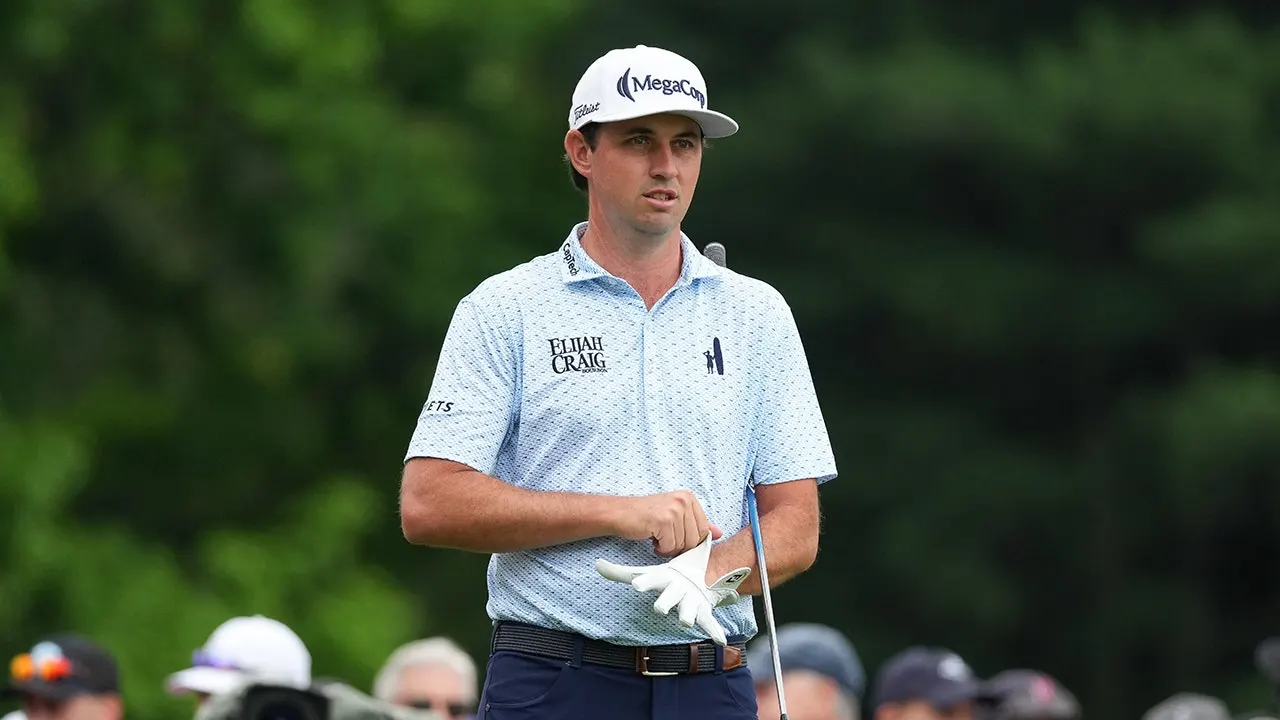
Golf is a game that possesses an almost cruel capacity for humility, showing absolutely no regard for status, past triumphs, or world rankings. On any given Sunday, the sport can transform a seasoned professional into a bewildered spectator of their own misfortune, a reality that J.T. Poston experienced in agonizing fashion during the final round of the Travelers Championship. As the world No. 32 in the Official World Golf Ranking, Poston walked onto the course with the quiet confidence of an elite athlete who has spent a lifetime mastering the microscopic margins of the game. He was not realistically in contention for the trophy, but he was comfortably positioned to secure a respectable finish, far away from the dreaded basement of the leaderboard. Yet, the beauty and terror of golf lie in how quickly a routine afternoon can disintegrate, and for Poston, the picturesque par-5 13th hole would become the stage for an absolute competitive nightmare—a sporting meltdown so complete that it rewrote his entire weekend and left him finishing the tournament in a humbling 69th place out of 72 competitors.
The tragedy of the 13th hole was that it began with such promise, illustrating the thin line between a potential birdie and absolute disaster. Standing on the tee box, Poston executed a flawless, textbook drive that split the center of the fairway, putting him in a perfect position to attack the green under regulation. His second shot was bold, soaring toward the flag before settling into a greenside bunker. While amateur golfers view sand traps with genuine dread, elite professionals like Poston often prefer them to thick rough; their highly refined short games turn bunker shots into routine up-and-down opportunities. With the ball resting in the sand, Poston was actively visualizing a soft splash of sand, a gentle roll toward the cup, and a straightforward putt to card a birdie on the par-5. Instead, the universe of golf began to shift on its axis as his third shot came up unexpectedly short of the green, leaving him with an awkward, delicate chipping scenario where precision was absolute, and the margin for error was non-existent.
What followed was a slow-motion unraveling that captured the terrifying psychological isolation of professional tournament golf. Standing over his fourth shot, Poston tried to manufacture a recovery, but disaster struck as the club face made contact, sending the ball blazing entirely across the putting surface and straight into the waiting water hazard on the opposite side. At this moment, the mental tax of the game doubles; the pressure of the gallery, the cameras, and the internal voice of doubt begin to loud. Now playing his sixth shot after assessing a penalty drop, Poston found himself trapped in a localized hell of sticky grass, slope, and water. He faced a agonizing dilemma: the lie was resting against the grain of the grass, a physical setup that virtually guarantees the club will grab and twist. Under the intense heat of the moment, the calculations a golfer must make become incredibly heavy, and Poston decided to trust his wedge, believing he could get just enough clean contact to lift the ball safely onto the green and escape the water’s gravity.
Unfortunately, physics and the turf had other plans, creating a repetitive loop of heartbreak near the water’s edge. Poston watched in disbelief as his chips repeatedly failed to hold the slope, gravity and the false front of the green ruthlessly sending the ball rolling back down into the hazard. He had to take a penalty drop not once, but three separate times, a sequence that felt less like a professional sporting event and more like a Sisyphean punishment. When asked later if he had considered putting the ball through the rough to avoid another chunked chip, Poston explained the cold geometry of his choice, noting that trying to putt through that specific grass would cause the ball to hop, instantly killing all its momentum and leaving it short of the steep incline. Armed with that rationale, he kept trying to hit the perfect chip, but it was only on his 10th stroke that he finally managed to stop the bleeding and locate the putting surface. By then, the damage to his scorecard and his psyche was already catastrophic, leaving him to desperately seek a close to the madness.
Even when the ball finally arrived on the green, the agony was not quite finished, as the psychological shockwave of the debacle lingered over his putter. Poston lined up his 11th stroke, only to watch it slide past the cup, before finally tapping in for a staggering 12 on the scorecard. The crowd, which had watched the entire routine fold in stunned silence, could only offer polite, sympathetic applause as a highly respected world-class athlete carded a score more commonly associated with weekend public courses. The emotional weight of such an experience is nearly impossible to shake off immediately; indeed, the hangover followed Poston to the very next hole, where he carded a double-bogey on the par-4 14th to further compound his misery. By the time he walked off the 18th green with a final-round 76, his tournament score had ballooned to 1-over par, a harsh reminder of how a single bad hole can completely erase four days of highly technical, physically demanding labor.
As Poston navigated the quiet disappointment of his post-round interviews, the rest of the Travelers Championship raced toward an entirely different kind of drama, showing the vast spectrum of the golf experience. While Poston was wrestling with the emotional wreckage of a 12, Scottie Scheffler and Viktor Hovland were locked in an elite duel at the top of the leaderboard, ultimately finishing deadlocked at 21-under par to force a Monday playoff. This juxtaposition highlights the essence of golf: one man’s administrative tragedy exists on the very same grass as another’s historic triumph. For Poston, the day will live on as a painful lesson in golf’s unpredictability, a reminder that the line between a routine birdie and a double-digit score is incredibly thin. Yet, it is precisely this raw, unscripted humanity—the reality that even the very best in the world can find themselves utterly defenseless against a patch of grass and a body of water—that makes the sport so enduringly compelling to those who watch it.