





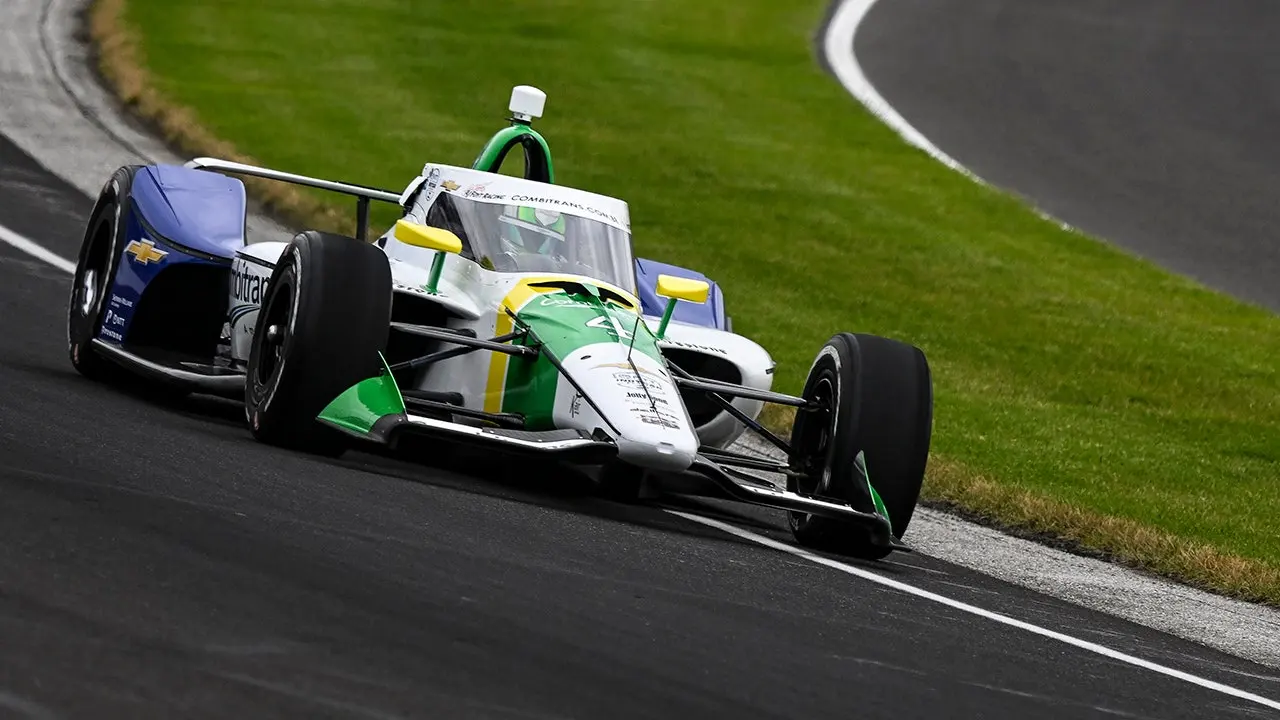
The Indianapolis Motor Speedway is a place where history, adrenaline, and danger coexist in a delicate, high-velocity dance, and the closing laps of the Indianapolis 500 are always a pressure cooker of unmatched intensity. As the sun began its slow descent over the iconic 2.5-mile oval, casting long, dramatic shadows across the historic bricks, the atmosphere in the grandstands was absolutely electric, thick with the collective nervous energy of hundreds of thousands of passionate fans who had gathered to witness greatness. Up front, a furious, breathtaking battle was raging between Felix Rosenqvist and Pato O’Ward, two world-class drivers deeply desperate to etch their names into racing immortality. Every single turn was a high-stakes game of chicken at speeds exceeding 220 miles per hour, with the slipstream acting as a physical slingshot. But just as the tension reached its boiling point, the focus of the motorsport world shifted from the battle for the lead to a terrifying, heart-stopping scene unfolding in Turn 2. Brazilian rookie Caio Collet, navigating the turbulent, chaotic air of his first-ever Indy 500, found himself fighting a losing battle with his machine. The treacherous nature of the speedway’s second turn is legendary, requiring absolute, razor-sharp precision; even a fraction of a second of dirty air can instantly destabilize a vehicle’s balance. As Collet swept into the turn, the rear end of his A.J. Foyt Racing Chevrolet snapped loose on the asphalt. In a desperate, split-second human reaction, the young rookie tried to catch the sudden slide, but he overcorrected just enough to send the car spinning violently into the unforgiving outside barrier. The massive impact, which briefly knocked the wind out of the young driver, sent shockwaves through the carbon-fiber chassis, ripping away bodywork as the right rear of the car immediately ignited into a terrifying plume of fire. For several agonizing seconds, the crippled vehicle skidded helplessly down the track, trailing sparks and smoke, before finally spinning to a halt on the safety of the infield grass.
The physical violence of a high-speed motorsport crash is incredibly difficult to comprehend, as forces multiple times the strength of gravity rip through the driver’s body in a fraction of a second. As Collet’s burning car finally ground to a halt on the safety of the infield grass, a heavy, breathless silence suddenly fell over the massive, ordinarily roaring crowd. In these terrifying moments, the focus of the event instantly shifts from competitive sport to the raw, visceral reality of human survival and the fragile nature of life at the absolute limit. Fortunately, the unsung heroes of IndyCar—the highly trained specialists of the AMR IndyCar Safety Team—were already moving with athletic precision before the damaged chassis had even come to a complete stop, as these elite professionals train year-round for precisely these critical split-second scenarios. Arriving at the scene of the wreck in a matter of mere seconds, these brave first responders immediately ran toward the rising flames and thick smoke, wielding fire extinguishers to systematically douse the blaze. Inside the cramped cockpit, surrounded by the chaotic aftermath of the impact, Collet performed the quick mental inventory that every racing driver fears, checking for injuries and ensuring he could still move his limbs. To the immense relief of his crew and the anxious spectators holding their breath worldwide, the young Brazilian was able to unbuckle his safety harness and climb out of the shattered wreckage entirely under his own power. Though physically shaken and undoubtedly bruised from the extreme G-forces of the collision, he walked away from the devastating crash, a true testament to the incredible advancements in modern safety engineering. The sight of him standing tall and waving to the worried crowd sent an immediate wave of relief through the entire pit lane. However, with carbon-fiber debris scattered widely across the high-speed racing lane, officials called for a red flag, halting the competition and setting up an agonizing, high-stakes final shootout.
To understand the tragic weight of this premature exit, one must look closely at the remarkable, inspiring journey that brought Caio Collet to the starting grid of the Indianapolis 500. Hailing from Brazil, a nation with a rich and sacred motorsport heritage that has produced legendary champions like Ayrton Senna and Emerson Fittipaldi, Collet carried both the dreams of his country and the immense pressure of historical expectation. Rather than being intimidated by the shadow of these giants, he drew inspiration from their legacy, hoping to add his own chapter to Brazil’s racing history. He had earned his way to the pinnacle of open-wheel racing through sheer talent, making a massive statement during his time in the Indy NXT Series. His magnificent 2025 season was a masterclass in consistency, featuring three spectacular victories and a runner-up finish in the championship standings, which paved the way for his anticipated graduation to the NTT IndyCar Series. Joining A.J. Foyt Racing was a monumental honor; driving for a living legend like Foyt, the first driver to ever win the Indy 500 four times, brings an unparalleled level of prestige but also an unforgiving, intense spotlight. Sitting in a car emblazoned with the famous Foyt nameplate means carrying the weight of decades of racing lore. Heading into this crown jewel of the calendar, Collet had experienced a challenging rookie campaign, sitting twenty-first in the championship standings with seventy points through six starts and still searching for his first elusive top-ten finish in the highly competitive series. This race was supposed to be his breakthrough moment, the grand stage where a young driver could prove their worth against the greatest in the world. Instead, the unforgiving concrete walls of the historic Brickyard delivered a brutal reminder of how quickly triumph can turn to disaster, leaving the talented rookie to watch his name fall down the final leaderboard.
A late-race red flag at the prestigious Indianapolis Motor Speedway is a unique, agonizing kind of mental torture for the drivers who must sit and wait in their stationary cars. When the screaming, high-rpm engines are finally silenced and the dust settles, the intense physical exertion of driving at its absolute limit is replaced by a deafening, highly psychological quiet. The silence during a red flag is almost physical; you can hear the distant murmur of the crowd, the wind, and the frantic pounding of your own heart inside the carbon-fiber shell. Drivers are left entirely alone with their own thoughts, strapped tightly into their cockpits, slowly baking under their heavy fire suits as the warm afternoon heat radiates off the dark asphalt. For the frontrunners, Felix Rosenqvist and Pato O’Ward, this unexpected intermission was not a welcome rest, but rather a mental pressure cooker where every second felt like an eternity, knowing that a lifetime of work would be decided in the next ten minutes. The human mind naturally begins to wander in the silence, visualizing every possible scenario for the impending green-flag restart, anticipating exactly where rivals might attempt a daring pass, and calculating the precise millisecond to make their own decisive move. Crew chiefs, strategists, and engineers spoke in hushed, tense whispers over the team radios, discussing last-minute aerodynamic adjustments and critical fuel management, but the ultimate execution on the track rested solely on the shoulders of the athletes behind the wheel. The physical tension on pit lane was palpable, as mechanics worked frantically in the background on the remaining cars, and fans stood absolutely transfixed by the giant video boards. Every competitor knew that when the green flag waved once more, there would be no room for hesitation; it would be a flat-out, maximum-risk dash to the finish where a single mistake would mean disaster.
The 2026 edition of the Indianapolis 500 was already destined to go down in the history books as one of the most competitive, breathtaking, and fiercely contested spectacles in the century-long narrative of the historic speedway. Long before Collet’s dramatic crash, the race had treated the captivated global audience to an absolute masterpiece of strategic driving, high-speed drafting, and sheer bravery, boasting an astonishing tally of over fifty lead changes that kept the massive crowd on the edge of their seats. It was a high-stakes chess match played at over two hundred miles per hour over several hours, where drivers had to think three moves ahead while reacting to changes in wind speed, track temperature, and tire grip. No single driver had been able to truly break away from the pack, as the advanced aerodynamic layout of the sleek Indy cars allowed trailing vehicles to suck into the slipstream of the leader and execute daring, wheel-to-wheel passes into the turns. When the track clean-up crew finally finished clearing the debris from Turn 2 and the red flag was replaced by the green, the engines erupted with a deafening, earth-shaking roar that reverberated through the grandstands. The final shootout was nothing short of a modern-day gladiatorial arena, where the remaining drivers threw all leftover caution to the wind in a desperate, final bid for motorsport glory. Rosenqvist and O’Ward, alongside a handful of other elite competitors who sensed that destiny was within their grasp, traded the lead multiple times over the frantic final laps in a mesmerizing display of precision and guts. They utilized every single inch of the historic racetrack, running inches away from the concrete walls at speeds that blurred the vision of onlookers. On the very final lap of the race, when the pressure was at its absolute peak, Felix Rosenqvist executed a daring, surgically precise maneuver to seize the lead, holding on to cross the finish line first.
The aftermath of the Indianapolis 500 always presents a profound and deeply poetic study in human emotion, beautifully highlighting the stark, bitter-sweet duality that defines the absolute heart of motorsport. In the legendary Victory Lane, Felix Rosenqvist was bathed in the traditional cold bottle of milk and showered with a cascade of colorful confetti, his face permanently etched with a mixture of sheer physical exhaustion and euphoric, tearful joy as he celebrated a career-defining triumph that will forever cement his legacy on the famous Borg-Warner Trophy, which silently awaits its new engraving. Meanwhile, in the quiet, solemn shade of the garage area, young Caio Collet began the somber, difficult process of processing his devastating crash, reflecting on a dream debut that ended in shattered carbon fiber, fire, and an official “did not finish” on the scoring sheets. This dramatic contrast is precisely why millions of passionate fans remain endlessly fascinated by this dangerous pursuit; it is a discipline where the line between ultimate victory and crushing heartbreak is paper-thin, and where drivers willingly risk their lives for a single chance at racing immortality. While Collet’s rookie appearance did not yield the fairy-tale ending he had worked so tirelessly to achieve, the immense bravery and speed he displayed on that legendary oval will undoubtedly serve as the strong foundation for his future endeavors in the sport, as he will return to the track stronger and with an unbroken spirit. As the sun finally set over the empty grandstands of the Indianapolis Motor Speedway, the echoes of the roaring engines faded into the warm Indiana night, leaving behind the memory of a historic race defined by relentless competitiveness, the unbreakable spirit of its competitors, and the timeless, magnetic allure of the Brickyard, a place where legends are born through both victory and survival.