





The night of the highly anticipated match was charged with an electric energy that reverberated through the modern Los Angeles Stadium in Inglewood, California. As thousands of fans filled the packed arena under the twilight Southern California sky, there was a profound sense that this was not merely another international fixture, but rather the dawn of a monumental new era for soccer across the United States. Under the strategic guidance of their world-renowned, newly appointed manager, Mauricio Pochettino, the United States Men’s National Team (USMNT) took the pitch ranked seventeenth in the FIFA World Rankings, carrying the heavy burden of national expectations and the promise of a bright future. The atmosphere inside the stadium of Inglewood was a vibrant, sprawling kaleidoscope of red, white, and blue, with supporters roaring in anticipation of a defining group stage matchup against a resilient and historically dangerous Paraguayan squad. When the referee’s whistle blew to signal the kickoff at nine o’clock Eastern Time, the collective breath of a nation was held, waiting to see how this newly reimagined team would handle the immense and unforgiving pressure of the World Cup stage. What followed in the opening minutes of the match was nothing short of a dream start, a sequence of events so sudden and dramatic that it instantly ignited the home crowd into a state of absolute euphoria. In only the sixth minute of play, a fierce and relentless American attacking sequence forced the Paraguayan defense into a state of utter panic deep within their own penalty area. In his desperate attempt to clear a dangerous, low-driven cross coming from the wing, Paraguay’s midfielder Damián Bobadilla unfortunately misjudged the trajectory of the spinning ball, inadvertently deflecting it past his own diving goalkeeper and directly into the back of his own net. This unexpected, stunning own goal gave the United States an instantaneous, crucial lead, setting a chaotic, thrilling, and highly emotional tone for the rest of an unforgettable evening of world-class soccer.
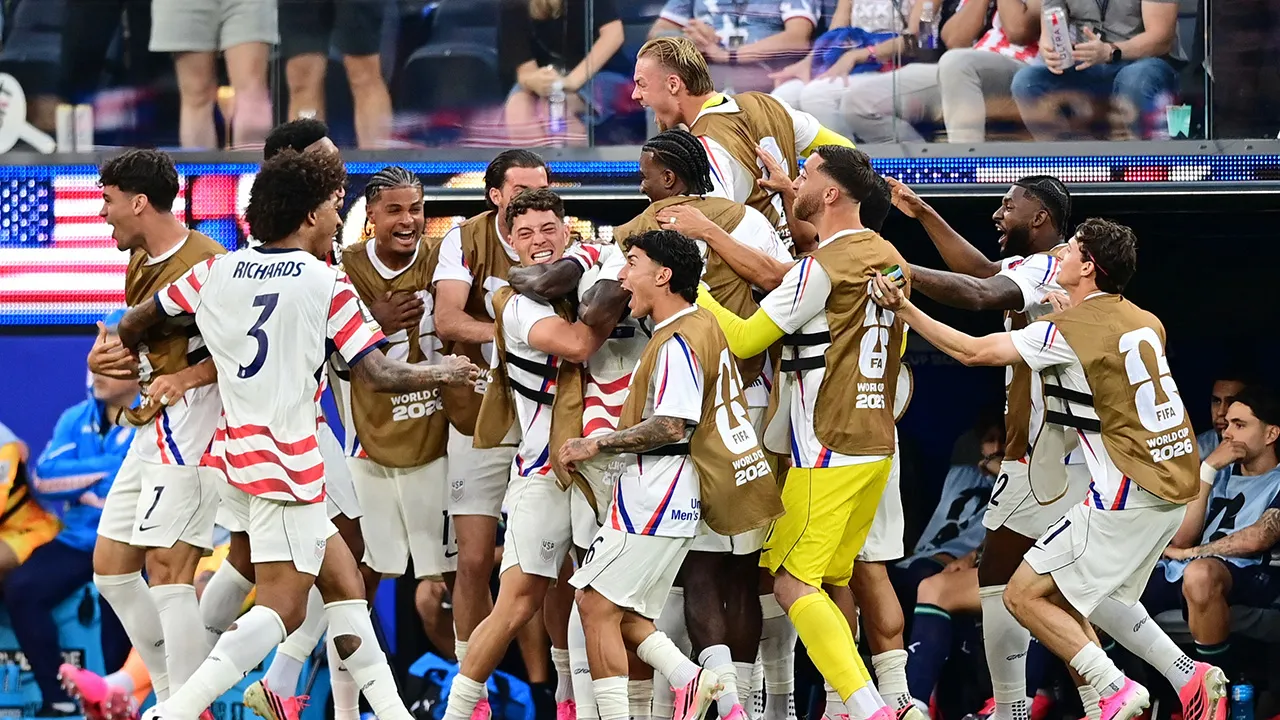
While an early stroke of fortune is always welcomed in the high-stakes, pressurized environment of a World Cup group stage, a truly dominant and elite team must eventually carve out its own destiny through moments of individual brilliance and collective chemistry. That defining moment of athletic excellence arrived in the thirtieth minute, courtesy of Folarin Balogun, the highly touted striker whose journey to the national team has been watched with bated breath by soccer enthusiasts and sports analysts across the globe. Born in Brooklyn, New York, but raised across the Atlantic, Balogun’s monumental decision to commit his international career to the land of his birth was celebrated as a massive, transformative coup for American soccer, and on this historic night, he showed precisely why he is considered the centerpiece of the nation’s attacking future. Seizing on a loose ball with the clinical instinct of a natural-born goalscorer, the young forward unleashed an incredibly precise and powerful strike that bypassed the Paraguayan goalkeeper, doubling the United States’ lead and sending the stadium into a deafening, historic frenzy. The sheer emotional weight of the moment was visible on Balogun’s face as he raced toward the corner flag to celebrate, eventually being engulfed by a mob of ecstatic teammates who understood the monumental significance of this milestone: his first-ever World Cup goal. For Balogun, who had dreamed of such a moment since his childhood kicking balls in the youth academies of Europe, this was not just another statistical mark on a scoresheet, but a profound validation of his choices, his raw talent, and his rightful place as the leading striker in Mauricio Pochettino’s offensive vanguard. The sheer joy radiating from the pitch infected every single corner of the Inglewood arena, solidifying a deep, emotional bond between the proud New York native and the passionate supporters who had traveled from all corners of the country to witness American soccer history in the making.
This rapid ascension to a commanding two-goal cushion within the first half-hour of play did far more than just put the United States in a comfortable tactical position on the pitch; it also etched this current squad’s name into the prestigious archives of American soccer history. Achieving a multi-goal lead so early in a World Cup matchup is an exceedingly rare feat, and sports historians quickly noted that Balogun’s thirtieth-minute strike marked the third-fastest time the United States Men’s National Team has ever reached a 2-0 lead in a World Cup fixture. To find instances of greater early dominance in the historical records, one has to travel back several decades, highlighting just how special and anomalous this modern performance truly was for the country. The only times the ambitious Americans managed to put the ball in the back of the opponents’ net twice in a swifter fashion were during the legendary 2002 World Cup campaign against Portugal, where they secured a shocking two-goal lead in the twenty-ninth minute on their way to a historic quarterfinal run, and all the way back during the inaugural 1930 tournament in a match against this very same Paraguayan delegation, where they achieved the feat in a blistering fifteen minutes. By drawing parallels to these iconic moments of the past, Pochettino’s contemporary squad proved that they are not merely playing to participate, but are actively walking in the footsteps of giants, bridging the gap between the pioneering generations of American soccer and the modern, highly sophisticated era of the sport. This historical context served to elevate the match from a simple group stage contest to a grand narrative of athletic evolution, showing a nationwide audience watching on Fox that this generation possesses the talent, the maturity, and the ruthless efficiency necessary to compete with the absolute best on the global stage.
As the first half drew toward its conclusion, the United States refused to simply sit on their comfortable two-goal advantage, choosing instead to deliver a spectacular masterclass in offensive football that would leave the crowd in Inglewood utterly breathless. Just before halftime, a brilliant display of vision and technical execution culminated in a third goal that felt like poetry in motion. The play began in the midfield, where Malik Tillman, a player renowned for his exceptional spatial awareness, creative distribution, and pinpoint passing accuracy, spotted a tiny gap in the tiring Paraguayan defensive line. With absolute precision and perfect pacing, Tillman threaded a phenomenal, defense-splitting pass into the path of an onrushing Folarin Balogun, who timed his run to perfection to beat the offside trap. Gathering the ball in stride and maintaining his balance against a recovering defender, the dynamic striker showed the composure of a seasoned veteran as he cut slightly inward, eyed the target, and unleashed a magnificent, curling effort that bypassed the outstretched arms of the goalkeeper and nestled perfectly into the top-left corner of the net. It was a breathtaking goal of the highest quality, a moment of pure sporting art that sent the packed stadium into an absolute frenzy of cheers, high-fives, and waving American flags. Coaching from the sidelines, Mauricio Pochettino could be seen applauding the tactical discipline and fluid movement of his players. Heading into the locker room with a commanding 3-0 lead, the USMNT had not only put on a show of total tactical dominance, but they had also sent a roaring statement of intent to the rest of the tournament field, showcasing the lethal, telepathic chemistry that their head coach had managed to instill in his players in such a remarkably short period since taking over the reins of the national program.
However, as any seasoned soccer fan or tactician knows, a football match is a tale of two distinct halves, and a true test of a team’s championship credentials often lies in how they handle the inevitable pushback from a proud and resilient opponent. Paraguay, refusing to go down quietly without a fight, emerged from the halftime break with a renewed sense of urgency, tactical discipline, and physical intensity that began to disrupt the fluent passing networks of the United States. The South Americans slowly began to claw their way back into the contest, utilizing a high press and aggressive, physical tackling to stifle the creative American midfield and create dangerous counter-attacking opportunities. The pressure eventually paid off in the seventy-third minute when the talented Paraguayan midfielder Mauricio seized on a momentary defensive lapse from the U.S. backline, driving a powerful and precise shot past the American goalkeeper to pull the scoreline back to 3-1 and bring a spark of hope to his squad. This goal acted as a stark reminder of the unforgiving, unpredictable nature of international competition, briefly silencing the celebratory atmosphere in the stands and injecting a tense, nervous energy into the final phase of the match. For Mauricio Pochettino, this period of intense adversity was highly educational, forcing his relatively young squad to transition from an exhibition of attacking flair to a gritty, disciplined, and cohesive defensive structure. The Americans showed admirable resilience during these pressure-filled final twenty minutes, throwing their bodies in front of shots, winning crucial aerial duels, and managing the clock with veteran-like maturity to secure the precious three points, demonstrating to the sporting world that they possess not only the artistic talent to blow teams away but also the raw mental toughness required to survive the harshest storms of tournament football.
With this vital and thrilling group-stage victory securely in hand, the United States Men’s National Team can celebrate a highly successful and deeply encouraging start to their World Cup journey, but their focus must quickly pivot to the unique challenges that lie immediately ahead. The tournament trail now leads the Americans away from the sunny, star-studded confines of Southern California to the dramatic, rain-kissed landscapes of the Pacific Northwest, where they are scheduled to return to action on June 19th against a formidable and physically demanding Australia squad in Seattle. This upcoming matchup in Seattle, which boasts one of the most passionate and loud soccer communities in North America, promises to be an entirely different tactical puzzle, requiring Pochettino to once again analyze his squad’s performance, correct the minor defensive lapses that allowed Paraguay to pull one back, and prepare his players for a grueling physical battle against the resilient Socceroos. Yet, the overwhelming feeling surrounding this rejuvenated team is one of profound optimism and national excitement, a sentiment deeply shared by soccer enthusiasts across the country who are following every step of this historic journey through Fox’s comprehensive media coverage, digital broadcasts, and newsletters. As the national team packs its bags for the Pacific Northwest, they carry with them the immense momentum of a spectacular three-goal performance, the emergence of Folarin Balogun as a bona fide elite striker on the world stage, and the collective belief of a sports-loving nation that is finally seeing its soccer potential realized. What began as a dream night under the bright lights of Los Angeles has set the stage for an epic summer of tournament soccer, leaving fans eagerly counting down the days until the whistle blows in Seattle, and the next thrilling chapter of this remarkable American sporting story is written.