





For over half a century, the city of New York carried a heavy, collective longing on its shoulders, a sports-induced melancholy that seemed to permanently hover over the iconic blue and orange seats of Madison Square Garden. Not since the golden, nostalgic era of 1973 had the New York Knicks hoisted the Larry O’Brien Championship Trophy, leaving generations of loyal fans to survive on grainy memories of legendary figures like Walt Frazier, Willis Reed, and Earl Monroe. But early on a historic Sunday morning, that agonizing fifty-one-year drought evaporated into the cool night air as the final buzzer sounded, cementing a thrilling 94-90 victory over the San Antonio Spurs in Game 5 of the NBA Finals. The emotional weight of this achievement cannot be understated; it was not just a victory on a hardwood court, but a profound cultural exorcism for a metropolitan area that eats, sleeps, and breathes basketball. As the clock ticked down to zero, the collective sigh of relief and explosion of pure, unadulterated joy reverberated from the rafters of the arena all the way to the outer boroughs, echoing through subway stations and neighborhood bars. Families who had spent decades waiting for this moment embraced in tears, while younger fans experienced an unfamiliar, deeply intoxicating sensation of ultimate sports triumph. The gritty, hard-fought nature of the 94-90 scoreline perfectly mirrored the blue-collar, resilient spirit of the city itself; this was not a glamorous, easy blowout, but a grueling, physical war of attrition that required every ounce of sweat, blood, and determination this roster could muster. By closing out the disciplined and formidable San Antonio Spurs in five games, the Knicks did more than just win a gold ball; they stitched themselves into the permanent ledger of legendary New York folklore, transforming decades of agonizing heartbreak into an unforgettable, legendary night of redemption.
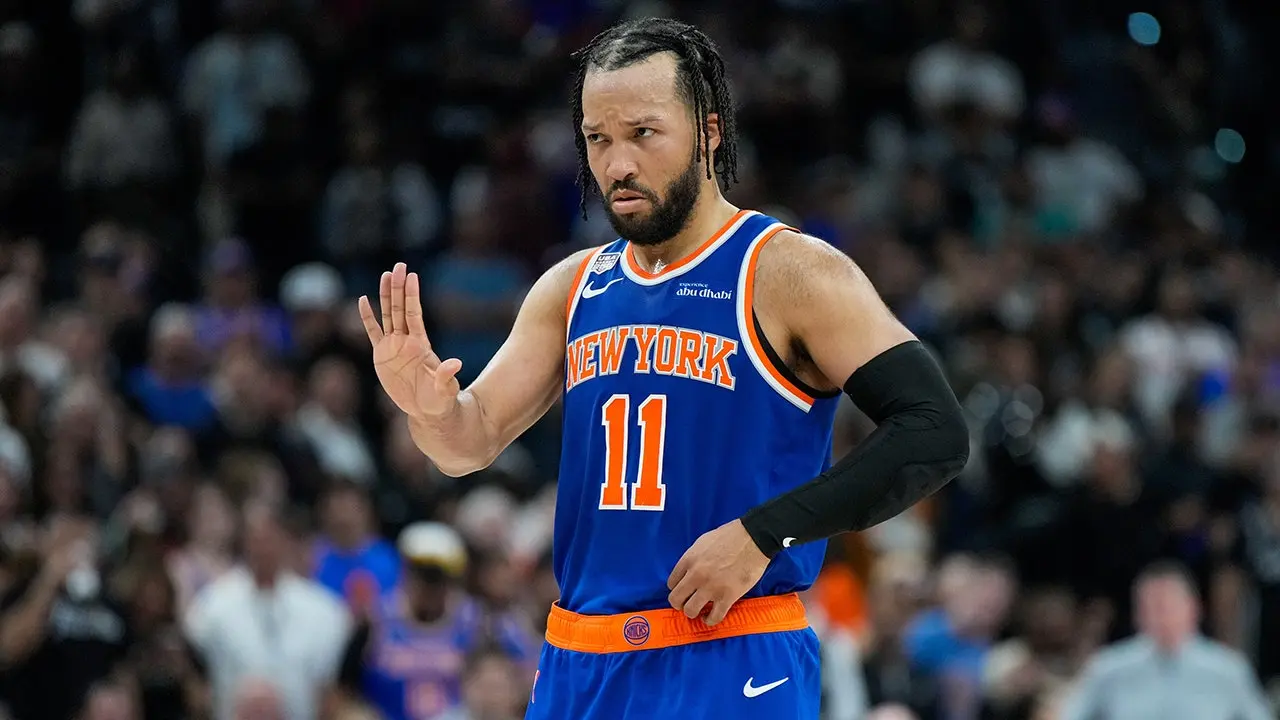
At the absolute center of this historic celestial alignment was Jalen Brunson, the giant-hearted guard who put together an individual performance for the ages. Scoring a jaw-dropping 45 points in Game 5, Brunson did not merely lead his team; he actively dragged them across the finish line through sheer force of will, earning the undisputed NBA Finals Most Valuable Player award in the process. His performance was a masterclass in mid-range precision, deceptive footwork, and cold-blooded decision-making under the most intense pressure imaginable. For a young athlete who has often faced skepticism regarding his size, athleticism, and status as a true franchise savior, this game was the ultimate vindication of his lifelong dedication to the craft of basketball. When the final buzzer sounded and the confetti began to rain down from the ceiling, Brunson stood on the court, visibly exhausted, his jersey drenched in sweat, overwhelmed by the magnitude of the moment. With tears in his eyes and a voice cracking with raw, unvarnished emotion, he encapsulated the feelings of millions of onlookers by simply stating, “I have no words. It’s everything I ever dreamed of.” This quiet, humble confession offered a beautiful window into the human soul behind the elite athlete, reminding everyone that beneath the multimillion-dollar contracts, corporate sponsorships, and national media spotlight lies a child who once shot hoops in a driveway, daring to hope for a moment exactly like this. Brunson’s journey to the pinnacle of basketball glory stands as a testament to the power of self-belief, proving that heart, passion, and basketball IQ can triumph over any physical limitations, inspiring an entire generation of young dreamers who have been told they are too small to achieve greatness.
The cultural gravity of the Knicks’ championship run was so immense that it transcended the boundaries of sports, captivating some of the nation’s most prominent and polarizing figures, including former President Donald Trump. Early Sunday morning, Trump took to his social media platform, Truth Social, to passionately congratulate the franchise and its leadership on their historic achievement. Trump, who has long maintained deep ties to the New York social, political, and real estate landscape, focused his praise on team owner Jim Dolan and the incredible journey the organization had undertaken. “Congratulations to Jim Dolan and the New York Knicks!!! What a year it has been but, even more so, what incredible playoff wins we have all witnessed, especially the last four – Maybe the greatest in the history of basketball,” Trump wrote. His public commendation did not stop with the front office; he also highlighted the breakout nature of the postseason, declaring that “tonight, a superstar was born,” in reference to Jalen Brunson’s rise to global fame. Trump’s message carefully acknowledged the collaborative effort of the roster, giving special nods to key players who anchored the team’s championship identity, including Karl-Anthony Towns, OG Anunoby, and the physically imposing center whom he affectionately labeled a “great Patriot,” Mitchell Robinson. This public acknowledgment highlighted how a local sports triumph can command national attention, bridging the worlds of high-level politics, celebrity culture, and professional athletics in a way that is uniquely characteristic of high-stakes American life, demonstrating the unifying power that a sports team can possess during historic moments.
To fully appreciate the magnitude of this championship, one must look at the dramatic, almost cinematic narrative arc of the actual games themselves, which kept fans on the absolute edge of their seats throughout the series. President Trump himself had been in attendance for Game 3 at Madison Square Garden, a contest which ironically resulted in the Knicks’ only loss of the series as the Spurs momentarily threatened to swing the momentum of the Finals. However, what followed that defeat was a showcase of pure psychological resilience and physical stamina. In Game 4, New York found themselves staring into an absolute abyss, falling behind by as many as 29 points in a game that looked like a guaranteed, spirit-crushing blowout. Yet, instead of packing it in and looking forward to the next match, the Knicks mounted an unfathomable comeback, storming all the way back to shock San Antonio and break their spirits. This pattern of dramatic, back-to-the-wall survival repeated itself in the decisive Game 5, where the Knicks again found themselves digging out of a deep 16-point deficit. The human element of these comebacks is extraordinary; it requires a group of athletes to collectively silence their doubt, push past extreme physical fatigue, and maintain absolute trust in one another when all statistical models point toward defeat. The Knicks’ ability to repeatedly claw their way back from the brink of blowout losses demonstrated a profound mental toughness, confirming that this championship was built on a foundation of grit, defiance, and a refusal to yield.
Behind every great championship team sits a mastermind holding the clipboard, and for the Knicks, head coach Mike Brown served as both the strategic architect and the emotional champion of his players. In the warm, chaotic aftermath of the championship celebration, amid the smell of cheap champagne and the brilliant flash of media cameras, Brown used his platform not to boast about his own tactical brilliance, but to fiercely advocate for his star player. Brown expressed absolute certainty that Brunson deserved the Finals MVP award, but he quickly turned his attention to a lingering injustice that had bothered him throughout the long regular season: the lack of serious MVP consideration for his point guard. “I hope you guys will listen to me: He’s a top-three MVP candidate,” Brown implored the gathered press corps, his voice ringing with passionate conviction. He criticized the national sports media for only mentioning Brunson’s name in passing rather than treating his candidacy with the gravity it rightfully earned. “He is a fricking 1-A. He is a MVP candidate and I hope tonight you guys recognize what this man is about,” Brown declared, ending his defense with the ultimate modern compliment of supreme athletic dominance: “He is him.” This passionate defense showcased the deep, paternal bond that often forms between a head coach and his primary leader on the floor, reminding the public that successful sports franchises are built on mutual respect, fierce loyalty, and a shared hunt for greatness that transcends the box score.
Ultimately, this championship will be remembered as a victory that belonged to the entire community of New York as much as it did to the athletic men who wore the jerseys on the court. As the sun began to rise over the Empire State Building on Sunday morning, the streets of Manhattan, Brooklyn, Queens, the Bronx, and Staten Island were filled with an infectious energy, an invisible but palpable bond connecting millions of strangers who shared the same triumphant grin. This victory humanized a notoriously tough city, opening up spaces for joy, connection, and shared celebration in a world that can often feel increasingly divided and isolating. The image of Jalen Brunson holding the Finals MVP trophy, the proud boasts of coach Mike Brown, the public congratulations from Donald Trump, and the wild, ecstatic reactions of fans in the streets all merged into a single, beautiful tapestry of human achievement. It proved once again that sports harbor a unique, almost magical power to freeze time, erase differences, and create long-lasting memories that families will pass down through the generations. For the New York Knicks, the decades of wandering in the basketball wilderness are finally over; they have returned to the mountaintop, not with a whisper, but with a roaring declaration of resilience, heart, and undeniable greatness.