






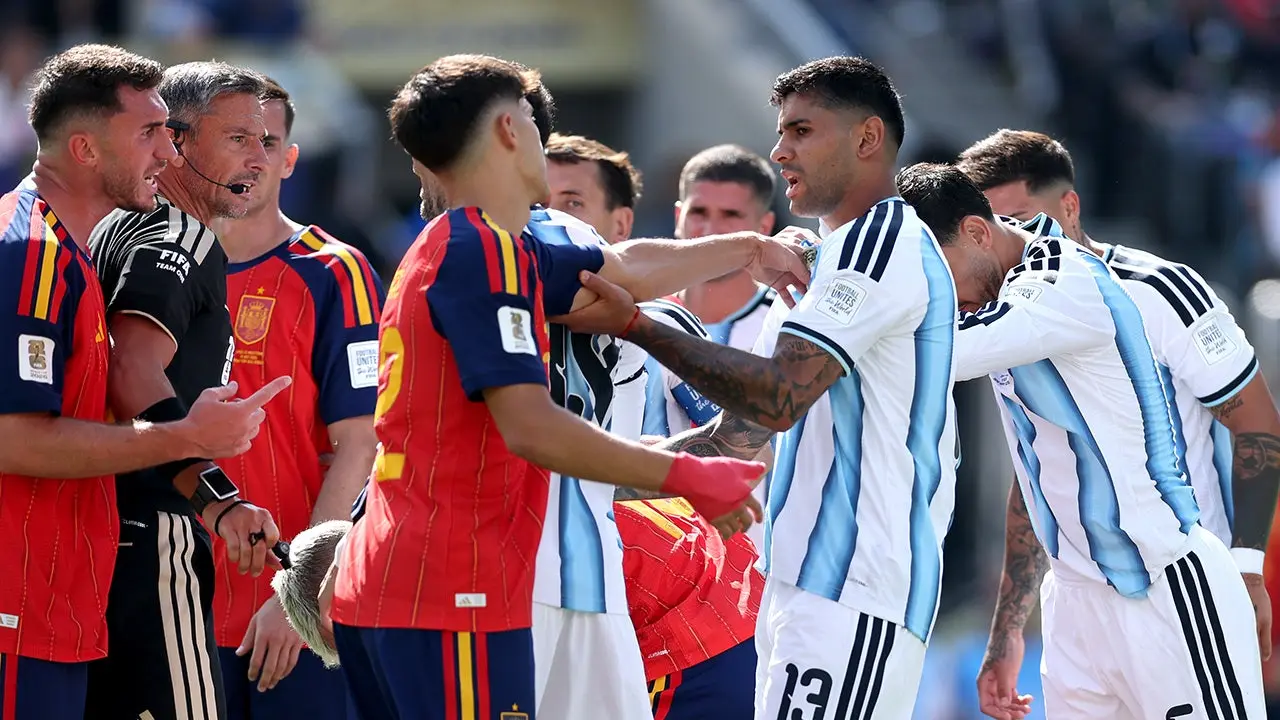
The grand stage of the New York/New Jersey Stadium was meant to host a celebration of athletic perfection, a majestic showcase where the pinnacle of global football would be crowned under the glittering lights of the 2026 FIFA World Cup Final. Instead, the final whistle of this historic confrontation between Spain and the reigning champions, Argentina, became the catalyst for a distressing descent into chaos, transforming a theater of dreams into an arena of raw, unbridled hostility. For one hundred and twenty exhausting minutes, the world watched a grueling chess match of unparalleled intensity, a physical and tactical war of attrition where every blade of grass was fiercely contested. The deadlock was finally shattered in the dying embers of extra time when Spain’s Ferran Torres exhibited a flash of clinical brilliance, steering the ball past the formidable, seemingly impenetrable reach of Argentine goalkeeper Emiliano Martínez. It was a singular, heart-stopping moment that instantly drew a line between ecstasy and agony—delivering Spain the ultimate glory while suddenly snatching the crown from an Argentine side that had defended it with their lives. Yet, as the referee blew the final whistle to solidify Spain’s 1-0 triumph, the collective fatigue of the players did not result in a peaceful collapse of exhaustion; rather, it ignited a volatile powder keg of pent-up pressure, disappointment, and raw human emotion that vaporized the traditional boundaries of sportsmanship.
What followed the historic whistle was not the immediate, joyous lap of honor typical of newly crowned world champions, but a sudden, violent splintering of composure as the pitch dissolved into a series of ugly, sporadic brawls across the turf. The transition from elite athletes to combatants happened in a heartbeat, laid bare before a global audience of millions who witnessed the fragile psychological state of players operating at the absolute limit of human endurance. The physical and emotional weight of losing a World Cup Final proved too devastating for the Argentinians to bear quietly, and spark after spark caught fire across the field. At the epicenter of the initial eruption was Argentina’s midfielder Leandro Paredes, whose frustration manifested in a highly aggressive confrontation with Spain’s Eric García. In a shocking display of hostility that transcended the normal boundaries of post-match tension, Paredes appeared to violently grab García by the throat, a provocative gesture that acted as a siren call for players from both benches to charge onto the field. Within seconds, a sea of red and blue jerseys collided in a chaotic web of shoving, tripping, and bitter verbal exchanges, with athletic figures tumbling onto the grass not in celebration of a game well played, but in a desperate, angry scramble to defend their teammates’ honor as basic human instincts of tribalism and protection overrode years of professional discipline.
The toxic spillover of emotion was not confined to those who had battled on the pitch; it quickly engulfed the technical areas, revealing how deeply the pressure of the tournament had penetrated the minds of the coaching staffs who are normally tasked with maintaining order. Argentina’s head coach, Lionel Scaloni, a man celebrated for his tactical composure and emotional intelligence throughout his tenure, was seen losing his trademark calm, shouting passionately toward the Spanish contingent while needing to be physically restrained by an opposing Spanish player. Nearby, veteran defender Nicolas Otamendi engaged in a furious war of words with Spain’s captain, Rodri, their faces inches apart as teammates struggled to separate the two giants of the game before their verbal spat turned physical. The most alarming breakdown of professional conduct on the sidelines, however, came from Argentine assistant coach Roberto Ayala, who bypassed verbal arguments entirely to approach Spain’s Dani Olmo, striking him square on the chin with a punch before onlookers intervened to pull the two apart. This shocking moment of physical violence from a senior member of the coaching staff underscored the utter collapse of structural authority under the crushing weight of defeat, proving that when the stakes are of such historic magnitude, the thin veneer of professional decorum can easily shatter, revealing the primitive, defensive impulses that lie just beneath the surface of elite competitive sport.
In the sobering aftermath of the physical hostilities, the footballing world was forced to grapple with a stark dichotomy of human behavior, contrasting the ugliness of the brawls with rare beacons of dignity and leadership. Amidst the swirling madness of his aggressive teammates, Argentina’s iconic captain, Lionel Messi, stood as a solitary monument of grace and sportsmanship, calmly walking through the eye of the storm to shake the hand of every single Spanish player. This display of quiet class did not go unnoticed by observers, including former England goalkeeper and BBC pundit Joe Hart, who publicly lauded Messi’s composure while reserving scathing criticism for the rest of the Argentine squad’s “disgusting behavior,” emphasizing that they had absolutely no justification for their post-match actions. Coach Scaloni, having regained his composure, echoed a sentiment of painful resilience in his post-match comments to ESPN, urging his team and country to find grace in defeat, to accept the loss after having given every ounce of their being, and to understand that the true measure of a person is how they pick themselves up after falling. His words represented the tragic human reality of elite sports: the agonizing necessity of accepting failure when you have sacrificed everything, a lesson that some of his players and staff, blinded by the immediacy of their heartbreak, were temporarily unable to grasp in the heat of the moment.
The fallout from this dark chapter in World Cup history has now formally moved from the impassioned arena of public opinion to the cold, analytical corridors of football’s governing body, as FIFA officially launched a comprehensive investigation into the post-match hostilities. Operating under the strict mandates of Article 36 of the FIFA Disciplinary Code (FDC), the FIFA Disciplinary Committee has appointed a specialized Disciplinary and Ethics Prosecutor to meticulously review match reports, broadcast footage, and eyewitness testimonies to identify potential breaches of conduct. Because the physical altercations occurred after the final whistle had blown, the disciplinary actions will stretch far beyond the standard match suspensions, with FIFA looking to make an example of those who tarnished the reputation of the beautiful game on its grandest stage. Leandro Paredes’ immediate red card for his chokehold on Eric García is merely the baseline of the impending punishments, as football analysts expect lengthy international bans to be handed down to several key figures. The investigation is also set to shine a harsh spotlight on defender Nahuel Molina and particularly assistant coach Roberto Ayala, whose physical assault on Dani Olmo could result in severe, long-term bans from sideline participation, highlighting how FIFA’s bureaucratic machinery must step in to restore the boundaries of civilized competition when personal restraint fails completely.
Ultimately, the 2026 World Cup Final will be remembered not only for Spain’s tactical triumph and Ferran Torres’ heroic extra-time goal, but for the profound human tragedy of how easily triumph and tragedy can corrupt the spirit of sport. The lasting legacy of this match is a sobering reminder that the line between passionate competitiveness and destructive behavior is incredibly thin, especially when individuals are subjected to extreme psychological pressure on a global stage. The physical battle on the turf of the New York/New Jersey Stadium exposed the raw vulnerability of human beings who, despite being global icons earning millions, are still susceptible to the basic, uncontrollable emotions of anger, pride, and devastation. As Spain begins its reign at the pinnacle of world football, and as Argentina faces a painful period of introspection and impending suspensions, the sporting world is left to contemplate the fragile nature of athletic glory. In the end, the beautiful game proved to be a mirror of the human condition itself—capable of producing moments of breathtaking, transcendent beauty, while simultaneously revealing the deeply flawed, volatile nature of our shared humanity when we are pushed to our absolute limits.