





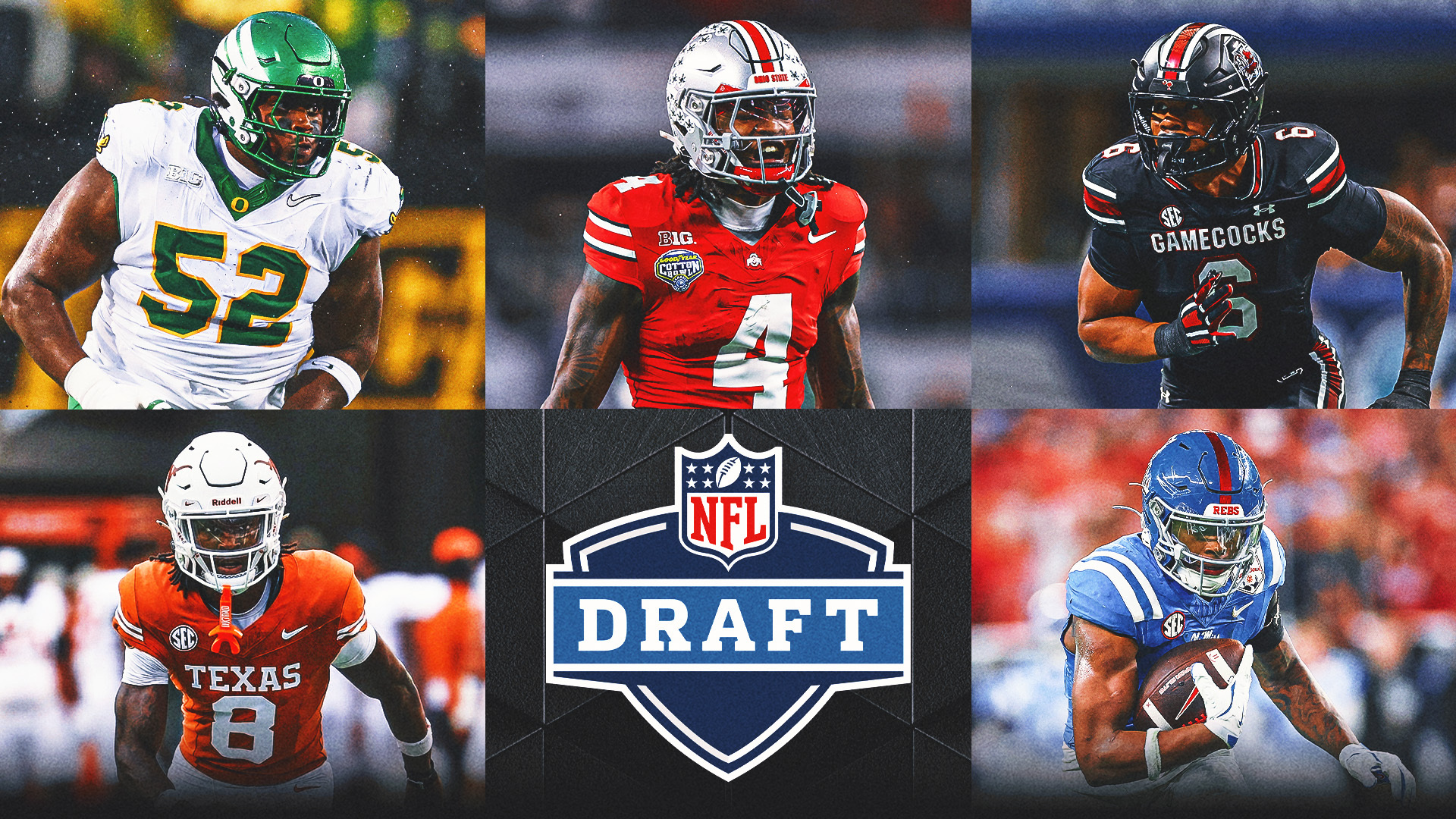
There’s something special brewing in college football, and it has nothing to do with the quarterbacks—well, not entirely. The 2027 NFL Draft is shaping up to be one of the strongest classes in years, and while the signal-callers like Texas’ Arch Manning, Oregon’s Dante Moore, and Ohio State’s Julian Sayin are grabbing the early headlines, the real gold is scattered across every other position. These are the prospects who don’t need a quarterback’s spotlight to change the trajectory of a franchise. In fact, if the top seven non-quarterbacks on this list had been eligible for the 2026 draft, they all would have heard their names called on Day 1. That’s how loaded this group is. It’s the kind of class that makes general managers lose sleep and fans start dreaming in February. What makes it even more exciting is that the hype isn’t just based on numbers or combine workouts—it’s based on the eye test, the feel, the moments when you watch a 330-pound defensive tackle move like a sprinter or a 6-foot-7 left tackle glide like a dancer. This is a draft class with size, speed, and swagger at every level of the field. So before we get lost in another quarterback debate, let’s take a step back and appreciate the full spectrum of talent. These are the ten best non-quarterbacks in college football heading into the season, and each one of them has a legitimate shot at becoming a first-round pick. Their stories, their strengths, and the pro comparisons that make you dream on their futures are all part of what makes this class so special.
Let’s start with the big men and the playmakers who don’t always get the love they deserve. At number ten, Missouri offensive tackle Cayden Green is the kind of lineman who makes analytics nerds and old-school scouts both nod in approval. He’s 6-foot-5, 324 pounds, a three-year starter who began his career at Oklahoma before transferring to Missouri. He spent his first two seasons at left guard, then slid outside to left tackle last year and didn’t miss a beat, allowing just two sacks on 751 pass drops. That’s a stat line that would make any offensive line coach smile. But Green isn’t just a pass-blocking robot. In the running game, he’s a people-mover, a guy who routinely pancakes defenders and plays with a mean streak that sets the tone for the entire offense. He has the lateral agility to handle counters and the core strength to anchor against bull rushers, and his experience at guard gives his future NFL team incredible flexibility. He could stick at tackle or kick inside, and either way, he’s going to be a valuable starter for a decade. His pro comp is Dion Dawkins, a steady, versatile, and nastier-than-he-looks force who has been a rock for the Buffalo Bills.
At number nine, Ole Miss running back Kewan Lacy is a human highlight reel. After transferring from Missouri, he led the entire country with 24 rushing touchdowns and touched the ball 335 times, a workload that shows just how much his coaching staff trusted him. He’s sudden and slippery, the kind of back who makes the first defender miss in a phone booth and then accelerates through the hole before anyone can recover. But Lacy isn’t just an elusive open-field runner. He’s also surprisingly effective in short-yardage situations, showing impressive leg drive, balance through contact, and a sheer determination to grind out tough yards. The big question is whether he can duplicate that production now that Lane Kiffin has left Oxford for Baton Rouge. There’s some skepticism about how much of Lacy’s success was system-driven, but the talent is undeniable. He’s got home-run speed, but he’s also a grinder, which is why his pro comp is TreVeyon Henderson, a back who can take it to the house from anywhere but is also tough enough to move the chains on third-and-short. Then there’s number eight, Georgia cornerback Ellis Robinson IV, who was the FWAA Freshman Defensive Player of the Year after hauling in four interceptions, tied for the most in the talent-rich SEC. Robinson is every bit the athletic phenom you’d expect from a former five-star recruit out of IMG Academy. He has a tight, low backpedal and easy hip turn, allowing him to track receivers downfield without losing speed. He’s also a surprisingly scrappy tackler, which isn’t always a given for young corners. What really sets him apart, though, are his hands. Robinson doesn’t just cover; he makes plays on the ball. He has impressive hand-eye coordination to either catch it himself or rake it out of the hands of the intended receiver at the last moment. He can get a bit grabby downfield, but officials often let him compete because he’s always in phase and always looking for the ball. His pro comp is Trent McDuffie, a smart, versatile, and competitive corner who makes quarterbacks pay for testing him.
Moving into the top five, Oregon’s A’Mauri Washington is a mountain of a man who moves like someone half his size. At 6-foot-4 and 330 pounds, he is the centerpiece of arguably the best defensive line in college football, and he would have been a first-round pick last year if he’d declared. Instead, he chose to return to Eugene for one more winter, and he’s the biggest reason the Ducks have a realistic shot at their first national championship. Washington is surprisingly quick and agile for his size, and he already possesses NFL-level power. He stacks and discards blockers like they’re paper plates at a summer barbecue, and his bull rush is the kind of thing that leaves opposing quarterbacks checking their ribs for days. He’s the kind of interior disruptor who makes everyone around him better, and his pro comp is Kenny Clark, a dominant defensive tackle who can stuff the run and collapse the pocket. At number six, Texas wide receiver Cam Coleman is about to see his star explode. He transferred from Auburn, where he caught 93 passes for 1,306 yards and 13 touchdowns over two seasons despite playing in a limited offense. Now he’s catching passes from Arch Manning in Steve Sarkisian’s system, which is a scary thought for the rest of the country. Coleman is 6-foot-3, 200 pounds, with the kind of effortless acceleration and fluid movement that makes him look like he’s gliding. He has exceptional body control and sticky hands, which means he can make acrobatic catches even with defenders draped all over him. He has the size and athleticism of a future No. 1 receiver, and his pro comp is George Pickens, a big, physical target who wins 50-50 balls and makes highlight-reel plays look routine. Then there’s number five, Notre Dame cornerback Leonard Moore, who might be the most underrated player on this entire list. He was a unanimous All-American as a true sophomore, recording five interceptions and being named a finalist for both the Jim Thorpe Award and the Bronko Nagurski Award. At 6-foot-2 and 197 pounds, Moore has intimidating size for a corner, but he moves with smooth, fluid grace. He transitions out of his backpedal into a full gallop seamlessly, and he reads underneath routes with impressive anticipation. The numbers are almost comical: he’s broken up or intercepted 25 passes while allowing just 23 first downs over his first two seasons. He also hits like a safety, forcing three fumbles, and Notre Dame often asked him to travel with the opponent’s top receiver, including playing out of the nickel. His pro comp is Christian Gonzalez, a long, athletic corner who can erase one side of the field.
At number four, Texas might have somehow upgraded at left tackle. Trevor Goosby is stepping in for Kelvin Banks Jr., who went ninth overall to the New Orleans Saints, and Goosby has the potential to be even better. He’s 6-foot-7, 325 pounds, still growing into his frame, but he already moves with an exciting combination of grace and force. In pass protection, he eases off the snap, slides laterally, and keeps himself square to the rusher, making it nearly impossible to get around him. In the running game, he surges low and hard, showing impressive bend, balance, and power to move defenders off the ball. Some analytics sites credited him with three sacks allowed last year, but anyone who actually watched the tape knows those weren’t really on him. His tape is as clean as any blocker in the country, and he projects as a future Pro Bowler, maybe even an All-Pro. His pro comp is Laremy Tunsil, a left tackle with rare athleticism and dominance. At number three, South Carolina’s Dylan Stewart is the kind of edge rusher who keeps offensive coordinators up at night. He’s 6-foot-5, 250 pounds, with long arms that he uses to lock out and shed blockers, and he’s sudden off the snap, with excellent core flexibility to dip under the reach of offensive tackles. He’s recorded 11.5 sacks over his first two seasons of SEC football, but the pressure numbers suggest his production could easily be twice that. Stewart is still growing into his frame and his game, which is a scary thought for everyone who has to block him. He’s already technically sound with refined pass-rush moves, and he has the physical tools to be a future All-Pro. His pro comp is Robert Quinn, a relentless and explosive edge rusher who could take over games in bursts. Then there’s number two, Collin Simmons, another Texas edge rusher and arguably the most versatile defender in the class. Simmons is a malleable monster, capable of starring off the edge or as an off-ball linebacker. He’s 6-foot-3, 240 pounds, and he’s as swift on the perimeter as any rusher in this class, accelerating off the ball like a receiver getting into his route. He’s flexible and slippery, slithering through waves of blockers, and he’s shockingly strong for his size, often bulldozing through offensive linemen nearly 100 pounds larger. He has 21 sacks in just two seasons despite starting only 13 games. His physical gifts are undeniable, and he’s almost certainly a top-five pick whenever he decides to enter the draft. The flaws are minor but real—he’s been penalized a dozen times in two seasons, mostly for mental errors like lining up in the neutral zone or late hits on the quarterback. But with his rare combination of speed, power, and football IQ, his pro comp is Von Miller, a game-changing defender who can wreck a game plan from multiple alignments.
And then there’s the best of the bunch: Ohio State’s Jeremiah Smith. It’s almost impossible to talk about him without slipping into hyperbole. Ohio State has produced more superstar NFL wide receivers than just about any school, but Smith’s production over his first two years in Columbus is unprecedented even among them. His 2,558 receiving yards and 27 touchdowns aren’t just records for the Buckeyes; they top every pass-catcher in Big Ten history. He’s one of a handful of players—along with Calvin Johnson, Julio Jones, Derrick Henry, Myles Garrett, and Penei Sewell—who I believe could have played in the NFL as true freshmen. Smith is a rocked-up 6-foot-3, 223 pounds, and he uses that size to bully defensive backs at the college level. He’s an ideal red-zone weapon, with good timing and hand-eye coordination to play above the rim. He’s also a legitimate vertical threat who accelerates smoothly and tracks the ball well over his shoulder. On slants and crossing routes, he uses his frame to keep defenders on his hip, and then he shows excellent vision and power to rack up yards after the catch. It’s remarkable how many times he outruns pursuit angles or slips between defenders who seemed to have him stopped. We often hear the phrase “runaway freight train” used for running backs, but it applies perfectly to Smith as a receiver. Comparisons to Johnson, Jones, and DK Metcalf will be everywhere during the draft process, but the scary part is that Smith is already a more polished route-runner than any of those guys were coming out of college. His pro comp is Julio Jones, and honestly, that might be underselling him. He’s the kind of prospect who can transform an entire offense from day one, and he’s the clear No. 1 non-quarterback in this class.
This draft class is a reminder that football is ultimately about more than just the quarterback position. It’s about the massive human beings in the trenches who set the tone for everything else. It’s about the cornerbacks who can erase half the field and the pass rushers who make offensive coordinators change their entire game plan. It’s about the running backs who make defenders miss in open space and the receivers who make the impossible look routine. For fans, this is a season of hope, a chance to watch future stars before they become household names. For scouts, it’s a treasure hunt, a chance to find the hidden gems and project how college production will translate to the pros. For the players themselves, it’s the culmination of years of sacrifice, a chance to hear their names called and realize a lifelong dream. Some of these guys will become superstars. Some will become busts. Most will land somewhere in between, carving out solid careers and becoming beloved figures in their communities. But that’s the beauty of the draft—it’s not a science, it’s a story. And the 2027 class is writing a compelling one. So as the college football season kicks off, keep an eye on these names. Watch how Cayden Green anchors the offensive line at Missouri, how Kewan Lacy handles the workload without Lane Kiffin, how Ellis Robinson keeps making plays at Georgia, how A’Mauri Washington wrecks game plans at Oregon, how Cam Coleman blossoms in Austin, how Leonard Moore locks down receivers in South Bend, how Trevor Goosby fills Kelvin Banks’ shoes in Texas, how Dylan Stewart turns pressures into sacks at South Carolina, how Collin Simmons harnesses his raw talent in Austin, and how Jeremiah Smith continues to do things we’ve never seen before. The quarterback debate will be loud, but the real story of the 2027 draft might be found everywhere else. This is a class that could reshape the NFL, and we’re lucky enough to watch it unfold in real time.