




The pursuit of a dream deferred is a heavy, collective burden that the city of New York carries with a unique mixture of pride, anxiety, and relentless passion. Since the golden era of Walt Frazier and Willis Reed in 1973, the New York Knicks have marched through five decades of agonizing heartbreak, massive rebuilding phases, and tragic near-misses, with each passing season carrying the heavy expectation of a fanbase that refuses to settle for mediocrity. This year, however, the stakes feel entirely different, charged with an electric energy that seems to hum through the concrete of Seventh Avenue and directly into the hearts of the faithful. When the Knicks stepped onto the court to open their latest championship quest, the atmosphere inside the arena was thick with a palpable anticipation that bordered on spiritual. Facing them were the San Antonio Spurs, a historic franchise now spearheaded by Victor Wembanyama, a towering, generational prodigy whose very presence on a basketball court feels like an impossible glimpse into the future of the sport. The matchup was far more than just another game on the calendar; it was a dramatic collision of two distinct basketball worlds—the bruising grit and deep-seated historical hunger of a storied Eastern Conference franchise against the raw, astronomical potential of the league’s most watched young star. From the very opening tip-off, it was clear that this would not be an easy night of basketball for the hosts. The young Spurs, playing with a disciplined fearlessness, seized control of the game early on, leaning on their length and spatial dominance to keep the Knicks scrambling defensively. By halftime, the Spurs held a slim but stubborn seven-point lead, exposing the vulnerabilities of a New York team still trying to find its rhythm under the blinding lights of postseason pressure and setting up an incredibly tense battle.
Nowhere was this immense physical and emotional toll more evident than in the heroic, agonizing performance of Jalen Brunson. As the undisputed engine and emotional heartbeat of this modern Knicks squad, Brunson carries the hopes of millions on his relatively small shoulders, playing with a cerebral, footwork-heavy style that beautifully defies the hyper-athleticism of his modern peers. But that brilliance was nearly snuffed out in a terrifying moment during the first half of the game. In the chaotic scramble of a half-court defensive set, Spurs forward Harrison Barnes was shoved backward by a teammate, tumbling directly and violently into Brunson’s right knee. The entire arena held its breath in a collective, horrified gasp as Brunson collapsed to the hardwood, clutching his leg in obvious agony before slowly, painfully limping back to the safety of the locker room. It was the exact kind of devastating moment that can derail an entire season, an agonizing reminder of just how fragile a championship run truly is. Yet, embodying the blue-collar, never-say-die attitude that New York fans demand of their modern heroes, Brunson emerged from the locker room tunnel in the second quarter, his compromised knee bound heavily in thick, white compression wrap. The crowd erupted into a deafening roar, a collective sigh of relief turning into an emotional standing ovation. Even when adversity struck a second time later in the game—with Brunson painfully tweaking his left ankle after landing awkwardly on a defender’s foot while contesting a shot—he resolutely refused to yield. Remaining on the floor and grimacing through the pain, he put on an absolute masterclass in resilience, ultimately racking up 30 crucial points to lead his team through the fire, cementing his status as a legendary figure of toughness.
On the other side of the hardwood stood Victor Wembanyama, a true physical marvel who has absolutely captivated the global basketball universe like no young player before him. Standing well over seven feet tall with the wingspan of a mythical creature and the uncanny coordination of a seasoned point guard, Wembanyama is not merely an opponent; he is a walking, breathing spectacle, drawing the eyes of everyone in the building whenever he takes a single step. To watch him play is to witness a profound rewriting of the traditional laws of physics, as he effortlessly alters shots at the rim while simultaneously splashing smooth three-pointers from deep on the perimeter. It is this surreal, almost cinematic quality that has turned his early career into a major cultural event, attracting not just hardcore sports fans but casual observers who simply want to say they were physically present when the future of basketball arrived. For the Spurs, he represents the spectacular dawn of a brand-new dynasty, a brilliant beacon of hope for a proud franchise accustomed to winning championships but currently charting a patient path back to the NBA mountaintop. Throughout the game, Wembanyama’s terrifying defensive presence heavily dictated how the Knicks operated their offense, forcing them to completely adjust their shooting trajectories and challenge him with complex double-teams. The sheer gravitational pull he exerts on the court is immense, causing experienced defenders to hesitate and fans to gasp at his incredibly fluid athletic movements. He is a modern-day basketball titan, carrying the immense pressure of global expectations with an air of cool, collected nonchalance that highlights a level of maturity far beyond his young age. His performance proved that he is not just a player of the future, but a dominant force in the present, capable of altering the outcome of a game simply by stepping onto the floor and raising his arms.
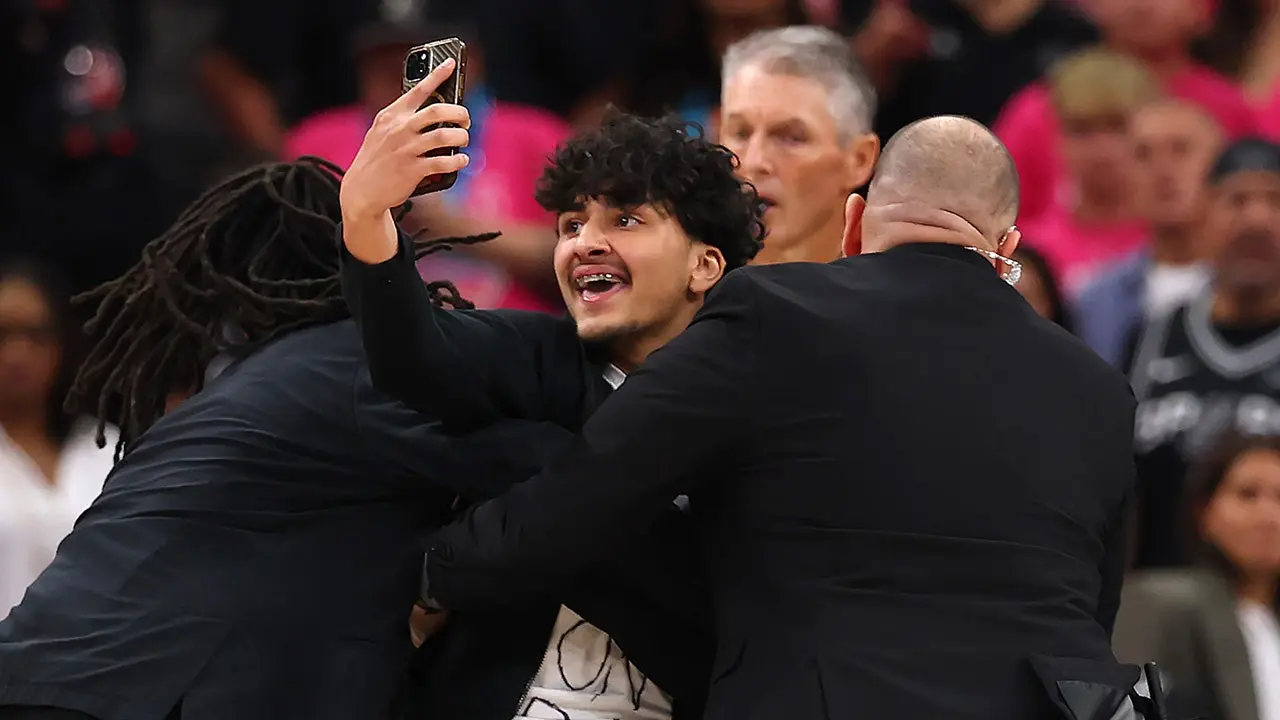
This intense pull of celebrity and the desperate, modern desire to touch greatness culminated in a bizarre, fourth-quarter security breach that briefly shattered the tension of an incredibly tight, neck-and-neck game. Amidst the high-wire drama of the closing minutes, with both teams trading crucial baskets and the crowd screaming at every possession, a lone fan decided to gamble his freedom for a fleeting moment of digital immortality. Darting from the sideline opposite the team benches, the unidentified young man sprinted onto the active court, weaving through the play as the San Antonio Spurs pushed the ball into their offensive end. His objective was immediately clear: he was clutching a smartphone, desperate to snap a quick selfie with the colossal, towering figure of Wembanyama. It was a stark, somewhat unsettling reminder of the bizarre lengths to which individuals will go in the social media era to capture a “once-in-a-lifetime” piece of content, prioritizing viral internet fame over basic safety, legal boundaries, and common sports etiquette. Fortunately, before the fan could bridge the gap to the French phenom or cause any dangerous contact with the players, two exceptionally alert security guards intervened with practiced, military precision. They immediately intercepted the runner, tackling and hauling him off the hardwood before whisking him away through a baseline tunnel to face the heavy legal consequences of his impulsiveness. Though the frustrating interruption lasted only about a minute, wrapping up with a somewhat awkward jump ball to resume play, it left a lingering sense of astonishment and frustration throughout the arena. It highlighted the strange, modern intersection of extreme sports fandom and social media obsession, where the boundary between spectator and participant has become dangerously blurred in the relentless pursuit of online clout and digital validation.
While this particular fan’s highly reckless method of getting close to the action was widely condemned, it speaks to a much broader, deeper desperation felt by the everyday, working-class fans of New York. The financial reality of being a modern sports fan has become increasingly exclusionary, particularly in a massive market as lucrative and crowded as Manhattan. To sit inside the hallowed, circular bowl of Madison Square Garden for a high-stakes playoff game has slowly become a luxury reserved almost exclusively for the ultra-wealthy, corporate sponsors, and A-list celebrities. A stunning, recent economic analysis revealed a heartwarming yet heartbreaking truth: it is actually far more cost-effective for a passionate, die-hard Knicks fan to purchase a round-trip airline ticket from New York to San Antonio, book a comfortable hotel room deep in the heart of Texas, and purchase a ticket at the Spurs’ arena than it is to buy a single, mid-tier seat at MSG. This striking economic disparity deeply humanizes the struggle of the loyal fan, the person who has stayed up late watching losing seasons for decades, only to find themselves completely priced out of the arena when the team finally achieves greatness. It paints a vivid picture of a passionate fanbase that is geographically displaced by economics but remains fiercely loyal, willing to travel thousands of miles across the country just to be in the room where history is being made. This organic migration of New York faithful to opposing arenas creates a unique, loud culture of traveling fans who carry their chants of “Go Knicks Go” across the nation, transforming hostile away games into neutral-site battlegrounds and proving that the true spirit of New York basketball cannot be contained by the expensive ticket gates of Midtown Manhattan.
In the end, despite the sudden distractions of court-storming selfie-seekers and the physical tolls of a grueling, baseline-to-baseline battle, the Knicks ultimately proved why they are currently considered one of the most formidable forces in the league. Dragging themselves across the finish line with a brilliant combination of defensive grit and clutch offensive execution, New York secured a hard-fought 105-95 victory in Game 1. This crucial win not only set a dominant tone for the series but also extended the team’s incredible postseason winning streak to an astonishing twelve games—a remarkable feat of consistency that has sent shockwaves of genuine hope through the five boroughs. As the final buzzer sounded, a battered Jalen Brunson, his knees and ankles screaming in pain, shared a weary but triumphant embrace with his teammates, knowing that the journey toward a championship is far from over. This high-stakes game was a perfect microcosm of what makes NBA playoff basketball so deeply human: the raw physical sacrifice of its star athletes, the unpredictable and sometimes invasive chaos of the crowd, the dramatic clashing of eras between rising young rookies like Wembanyama and battle-tested veterans, and the sheer financial and emotional devotion of the fans who live and die by every single possession on the hardwood. Their resilience in the face of both physical injuries and unexpected court interruptions showed that this team possesses the mental strength crucial for a deep run. As the Knicks prepare for the next grueling chapter of this historic campaign, they do so with the knowledge that their dream of raising a championship banner for the first time since 1973 is no longer a distant, impossible fantasy, but a real, tangible destination that they must continue to fight for, one bruising, unforgettable, and highly cinematic night at a time.