


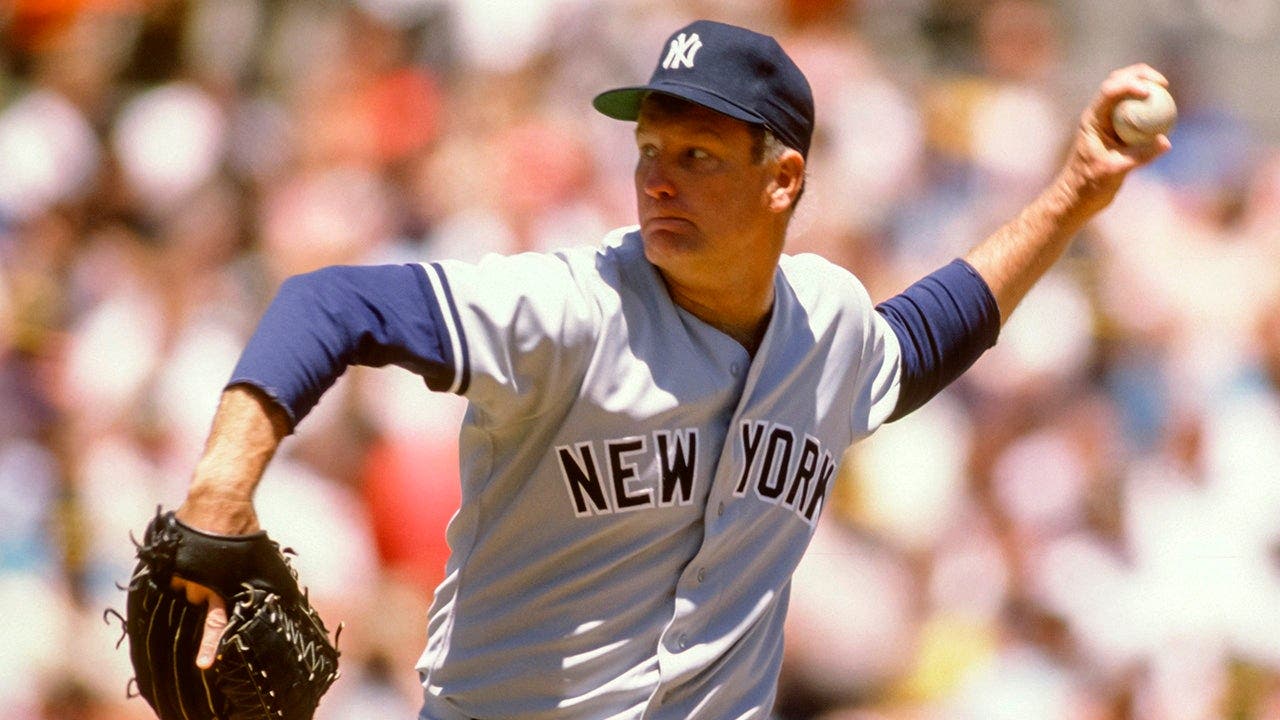
Every year, New York Yankees fans gather at the iconic Yankee Stadium for Old-Timers’ Day, a nostalgic celebration of franchise history where legendary pinstriped heroes step back onto the field to hear the roar of the crowd one more time. However, this past Saturday’s ceremony carried a particularly poignant and emotional weight that transcended the usual lighthearted celebrations. Among the roll call of legends, a heartfelt, bittersweet message was delivered on behalf of Tommy John, the 83-year-old former Yankees pitcher who is currently facing severe, undisclosed health struggles at his home in Florida. Realizing that his physical limitations would prevent him from ever attending another reunion in person, the beloved pitcher chose this sacred baseball stage to deliver his final, formal farewell to the sport, the Yankees organization, and the generations of fans who have cheered him on. The announcement cast a reflective hush over the stadium, turning a celebration of the past into a deeply moving tribute to a man whose impact on the game of baseball is both uniquely personal and universally profound.
To understand the depth of Tommy John’s legacy is to understand a pivotal moment in sports history that altered the trajectory of modern medicine. In 1974, while pitching for the Los Angeles Dodgers, John suffered what was then considered a career-ending injury: a ruptured ulnar collateral ligament (UCL) in his left elbow. Before that fateful year, a torn UCL meant a player’s career was instantly over, leaving them to look for work outside the game. Enter Dr. Frank Jobe, an innovative orthopedic surgeon who proposed a radical, highly experimental procedure to reconstruct the damaged ligament using a tendon harvested from John’s right wrist. With nothing to lose and a career to save, John placed his trust in Dr. Jobe’s hands. The surgery was a roaring success, and in the decades that followed, this once-unthinkable operation became known simply as “Tommy John surgery.” In his farewell message, John made sure to shine a bright light on the doctor who made his extended career possible, expressing his eternal gratitude to Dr. Jobe for saving his arm and paving the way for countless modern pitchers—from Cy Young winners to teenage prospects—to keep their athletic dreams alive.
What makes Tommy John’s story truly remarkable is not just that he survived the groundbreaking surgery, but that he thrived in its aftermath, proving that the human body could rebuild itself to achieve greatness. After sitting out the entire 1975 season to endure a grueling and unprecedented rehabilitation process, John returned to the mound in 1976 with a bionic arm and a renewed sense of purpose. He went on to play for another 14 seasons, defying every medical expectation of the era by winning more than 160 of his 288 career victories after the operation. He became a three-time All-Star post-surgery, cementing his status as one of the most durable and reliable left-handed pitchers in baseball history. Over a monumental 26-year career that spanned nearly three decades, John showcased his masterful control and sinkerball across several storied franchises, including the Chicago White Sox, Los Angeles Dodgers, California Angels, Cleveland Indians, Oakland Athletics, and, of course, the New York Yankees, where he spent eight memorable seasons. Finishing his career with a stellar 3.34 ERA and 2,245 strikeouts, his numbers on the field were magnificent, but his contribution to the longevity of the sport was database-altering and revolutionary.
Yet, despite having his name immortalized as a household medical term known to virtually every sports fan on earth, Tommy John never let the fame, the history, or the accolades change his core identity. In his emotional farewell letter, he shared a deeply personal memory that served as his life’s anchor, recalling the day he first set out to pursue his dreams as a young professional ballplayer. He recounted how his father looked him in the eye and gave him a piece of advice that would define his character for the next six decades: “Good luck, Tommy. Just remember one thing: whether you make it big in the big leagues or you don’t, you’ll always just be Tommy John from Terre Haute, Indiana.” These simple, grounded words from a loving father kept the major league superstar humble throughout his quarter-century in the spotlight. Whether he was pitching in the World Series under the bright lights of Los Angeles and New York or recovering from a revolutionary surgery that made him a medical pioneer, he remained, at heart, that modest boy from Indiana who simply loved the game of baseball and respected the people who played and watched it.
His final letter was a masterclass in grace, dignity, and overwhelming appreciation for the life he was privileged to live. Rather than dwelling on his current health battles in Florida or expressing bitterness about his physical decline, John utilized his platform to thank the Steinbrenner family and the entire Yankees organization for allowing him the opportunity to say a proper goodbye. He poured his heart out to his former teammates, his lifelong friends, and the legions of fans who stood by him through the triumphs of his comeback and the struggles of his recovery. By choosing to frame his farewell around gratitude, John reminded the sports world of the gentle humanity that often gets lost in the statistics, the contracts, and the business of modern athletics. His words resonated as a beautiful reminder of the connection between a player and those who cheer for him, illustrating that the bond formed between an athlete and the public can endure long after the cleats have been hung up and the stadium lights have faded.
As Tommy John wages his private battle with illness in Florida, his legacy remains permanently etched into the very fabric of baseball. Every time a young pitcher undergoes UCL reconstruction and successfully returns to the mound to fire a fastball, they are walking along a path that Tommy John and Dr. Frank Jobe bravely blazed fifty years ago. He is a rare figure in sports history whose name will be spoken daily for generations to come, serving as a beacon of hope, resilience, and medical triumph. Though he may be saying a physical goodbye to the stadiums and the public eye, his spirit, his contributions to sports medicine, and his incredible 26-year career will never be forgotten. Tommy John leaves the public stage not just as a legendary pitcher who came agonizingly close to the Hall of Fame, but as a beloved husband, father, teammate, and friend who, true to his father’s wishes, will always be remembered simply and affectionately as Tommy John from Terre Haute.