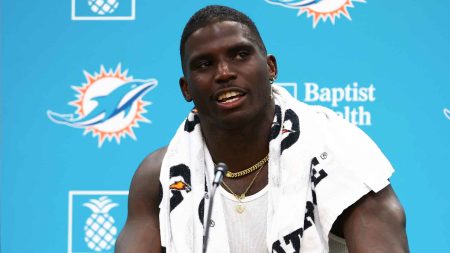




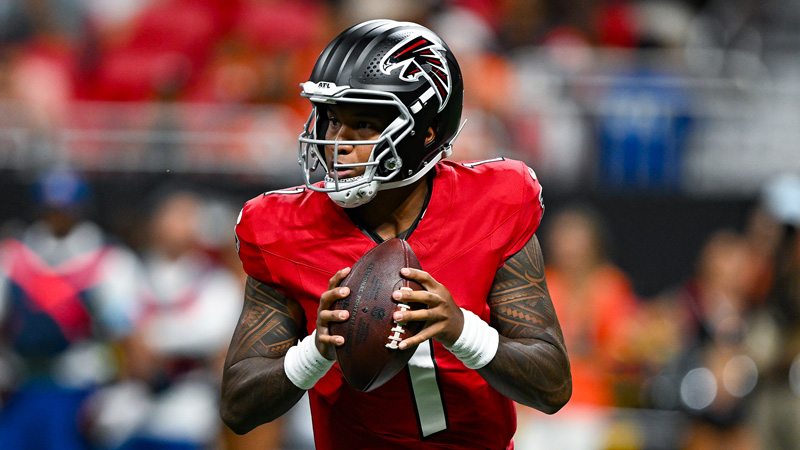
Football has a way of humbling even the most confident offseason plans. The Atlanta Falcons walked into training camp with a quarterback room that looked interesting on paper: a young, rehabbing Michael Penix Jr., a veteran journeyman in Cooper Rush, and a newly signed former Pro Bowler in Tua Tagovailoa. But Week 1 has a way of stripping away depth charts and wishful thinking. We already knew Penix Jr. wouldn’t be under center for Atlanta’s opener. Then, on Friday afternoon, head coach Kevin Stefanski delivered another dose of harsh reality: Tagovailoa is dealing with an oblique injury and will not be available either. Cooper Rush will get the start on the road against the Pittsburgh Steelers, with Jack Strand backing him up. It is a lot to process in a few days. Tagovailoa, whom many fans had hoped would give Atlanta a steady, veteran presence under center after his release from the Miami Dolphins, is considered “week-to-week” per ESPN. The injury apparently happened during Thursday’s practice, and a video clip appears to show the exact moment the discomfort first grabbed him. For a team that spent months imagining how the offense might look with a healthy, confident Tagovailoa at the controls, the news felt like a punch to the gut. Instead of drama and optimism, Atlanta now enters Sunday with a quarterback who has spent most of his career as a backup. In the NFL, that is not a crime. It is just not the headline anyone hoped to write.
The oblique injury itself is one of those quiet, frustrating things that football fans sometimes underestimate. When people think of quarterback injuries, they picture shattered knees, torn shoulders, or concussions—the big, obvious, scary moments. But an oblique muscle injury is the kind of nagging, painful problem that can affect every throw, every turn, and every step back in the pocket. The oblique isn’t just a muscle; it’s part of the core engine that connects a quarterback’s legs to his upper body. When it is compromised, even a simple pass can become a fight against your own body. Tua Tagovailoa, who has been through more than his share of physical battles throughout his career, apparently felt that sharp tug during Thursday’s practice. The video that emerged seems to show the moment he knew something was wrong, the kind of moment every athlete dreads. You can see it in the subtle pause, the way the body stiffens, the sudden realization that the pain isn’t just going to shake itself out. Now the team is left with a “week-to-week” label, which could mean anything from a short, manageable recovery to a longer absence no one wants to think about. For a player who signed a one-year deal in March to prove he could still be a productive starter, this is as much an emotional setback as a physical one. He has spent months learning a new system, building chemistry with new teammates, and adjusting to a new city. And now, with the season about to begin, he has to sit and watch.
The most recent numbers from Tua’s time on the field say a lot about who he is as a quarterback. In 2025, he started 14 games and threw for 2,660 passing yards with 20 passing touchdowns and 15 interceptions, posting an 88.5 passer rating while completing 67.7 percent of his passes. Those stats are neither spectacular nor disappointing; they paint a picture of a talented, aggressive, sometimes reckless passer who can move the ball when he’s healthy and who is prone to costly mistakes when he tries to force things. But numbers don’t tell the full story. There were moments in those 14 starts when Tua looked like the 2023 Pro Bowler, throwing into tight windows, extending plays with his feet, and carving up defenses that had no answer for his quick release. There were also moments when those 15 interceptions came back to haunt him, turning promising drives into empty possessions. For the Atlanta Falcons, the hope was that Tua could bring the good version of himself consistently—the version that made him one of the most intriguing quarterbacks in the league before everything got complicated. But football has taught us that hope is fragile, especially when a quarterback’s body is involved. Watching Tua get hurt again, unable to start the season, is a reminder that even the most talented players cannot control the timing of pain. It’s not a question of will, or toughness, or even heart. Sometimes the body simply says no, and no amount of preparation or desire can change that.
So now the spotlight shifts to Cooper Rush, a 32-year-old quarterback who has been around long enough to know that opportunity often comes at the worst possible time of someone else’s misfortune. Rush has 16 NFL starts under his belt, most recently making two starts for the Baltimore Ravens last season. Before that, he spent time with the Dallas Cowboys, where he earned 14 starts across three different seasons: one in 2021, five in 2022, and eight in 2024. That’s the résumé of a classic NFL backup: dependable enough to keep around, smart enough to learn multiple systems, and patient enough to wait for a chance that might never come. When the Falcons signed Rush, it felt like a depth move, a veteran insurance policy behind a recovering Michael Penix Jr. and a newly signed Tua Tagovailoa. Nobody expected him to be the Week 1 starter. But here he is, suddenly the most important player on Atlanta’s offense, asked to walk into Pittsburgh’s notoriously loud stadium and lead a team that has been through an emotional roller coaster for weeks. Rush has never been a superstar, but he has always been steady. He doesn’t panic. He doesn’t try to be something he isn’t. He just takes the snap, reads the defense, and makes the throw, trusting that preparation will carry him through moments like this. Behind him, Jack Strand will serve as the backup, another reminder that in the NFL you are always one play away from being the guy. It’s not glamorous, but it’s the reality of the sport, and Rush seems to understand it better than most.
Meanwhile, Michael Penix Jr. remains the long-term hope for the franchise, but he is also a cautionary tale about how quickly a promising season can turn. Penix suffered a season-ending knee injury in Week 11 of last year, a moment that changed the trajectory of Atlanta’s entire season and forced the organization to rethink its quarterback plan. He won’t be on the active roster to open the new season, which means he’ll be watching Sunday’s game from the sideline, or from a training room, or maybe from the couch with a tablet in hand, studying every move Cooper Rush makes. That’s the strange, humbling part of being a young quarterback: even when you’re injured, you’re still learning. Penix has been through a long rehabilitation process, missing out on the repetitions, the preseason games, and the natural growth that comes from playing against live defenses. His absence from the active roster isn’t a judgment of his talent; it’s a practical acknowledgment that a knee injury needs time, and time is the one thing the NFL never gives anyone. The Falcons now enter the season with a quarterback room that is thinner than anyone would have liked. Instead of a battle between Tagovailoa and Penix, or a smooth transition from one starter to the next, they are relying on a journeyman backup and a rookie relief pitcher. It’s not how the coaches drew it up in March. But football is not a sport that respects the offseason imagination. It is a sport that tests depth, resilience, and the ability to adapt under pressure, and the Falcons are being tested before the season even begins.
When Sunday arrives and the Falcons line up against the Pittsburgh Steelers at 1 p.m. ET on FOX, there will be a lot of reasons to watch. Cooper Rush will have a chance to prove that he is more than just a practice-field hero. The offensive line will have to protect him against a Steelers defense that loves to bring pressure. The receivers will have to win their matchups and make contested catches. And somewhere on the sideline, Tua Tagovailoa will be trying to balance frustration with hope, knowing that “week-to-week” is not the same as “season-ending.” There may be fans who feel disappointed, and that disappointment is fair. It’s hard to watch a team you love stumble before it ever gets off the ground. But there is also something quietly human about this moment. Football, at its core, is a game of ordinary people doing extraordinary things, and right now the Atlanta Falcons are being forced to lean on the extraordinary ordinariness of a backup quarterback named Cooper Rush. It’s easy to romanticize the idea of the superstar swooping in to save the day, but the truth is that football is often won by players who were never supposed to start. Michael Penix Jr. is recovering. Tua Tagovailoa is hurting. And yet the games will still be played, the hits will still be delivered, and somebody will still raise a fist in triumph when the final whistle blows. That is the beauty of the sport, and its cruelty, all wrapped into one Sunday afternoon. So tune in, root for the backups, respect the injured, and remember that in football, as in life, the next opportunity is always one unexpected moment away.