





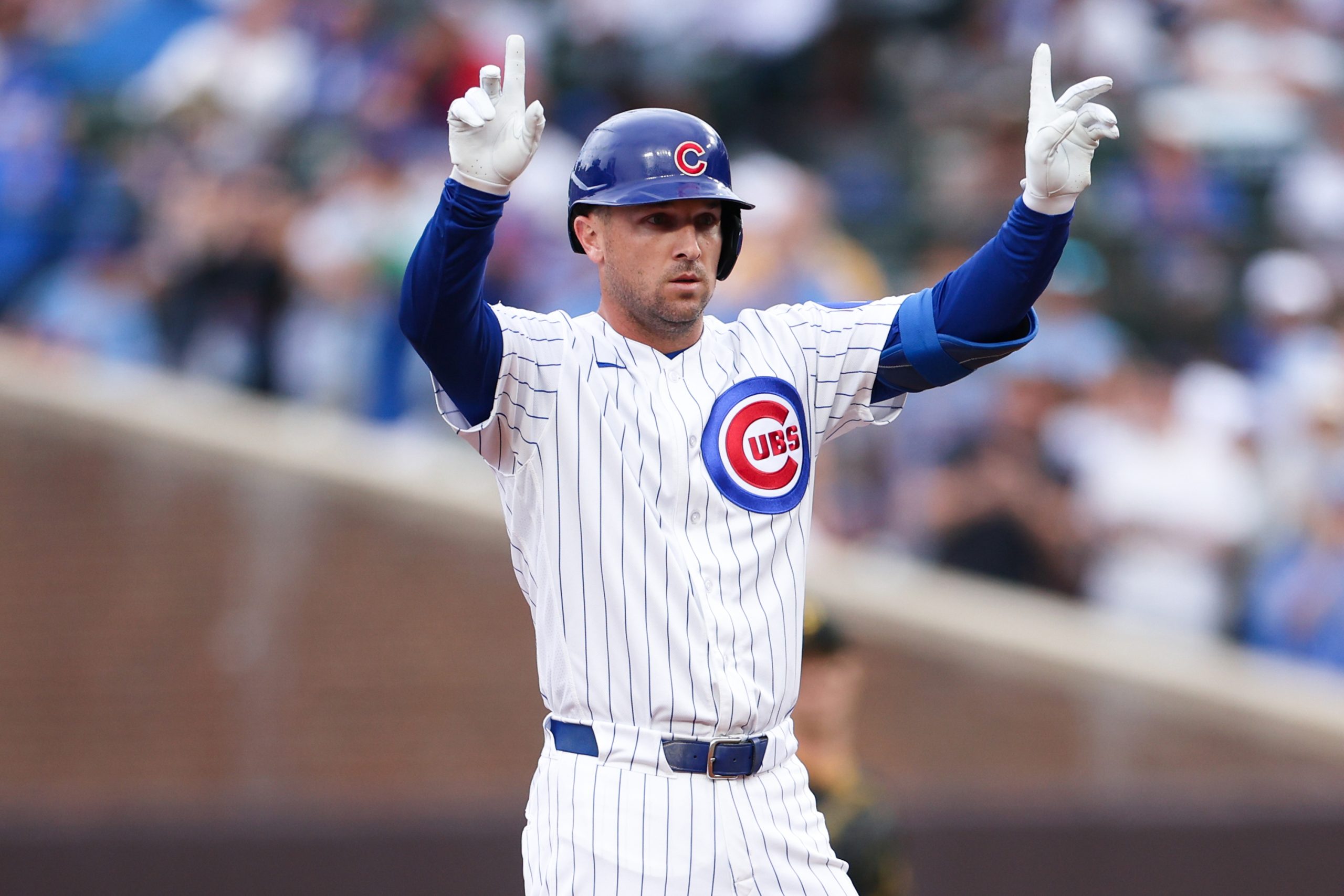
I. The scene at Wrigley Field on Sunday afternoon was supposed to be another tense, mid-summer battle between the Chicago Cubs and the Cincinnati Reds, a game with playoff implications and the familiar rhythm of baseball in the air. But in the fourth inning, that rhythm was shattered by a single, sickening moment. Alex Bregman, the Cubs’ veteran third baseman, was standing on the grass several feet in front of the on-deck circle, loosely following the at-bat, when Michael Busch, his own teammate at the plate, checked his swing on a pitch from Reds right-hander Luis Mey. The ball came off the bat not with a clean line-drive crack, but with the wicked, unpredictable spin of a foul tip, slicing directly into the dugout side. It struck Bregman square in the face before he could even flinch. For a split second, the stadium seemed to hold its breath. Then Bregman, blood already visible on his face, turned and jogged quickly toward the Cubs’ dugout, his hand pressed against the left side of his face. A trainer met him at the top step and escorted him down into the clubhouse. The game continued, but for everyone watching, something important had changed: the score no longer mattered as much as the sight of a man walking off with his head bowed and his future unknown.
II. The initial fears were confirmed on Monday night, when ESPN reported that Bregman had suffered multiple facial fractures. The injury was centered around his left cheekbone, essentially beneath his eye, according to Cubs manager Craig Counsell. The manager described the scene with the kind of restrained worry that comes from someone who has seen too many baseball accidents not to take them seriously. “He got hit in the left cheekbone essentially, under the eye,” Counsell said. “I don’t know anything more than that right now. He was bleeding from his nose a little. There’s some swelling. It’s a terrible, terrible accident. We hope he’s OK.” The most hopeful news, buried beneath the frightening diagnosis, was that Bregman would not need surgery. The Cubs, who have spent the season fighting for a place in the postseason, remain optimistic that their star third baseman could return before the playoffs, though no timeline has been given. For a team that has leaned on Bregman’s leadership and steady bat since he signed a massive five-year deal in January, the prospect of losing him for even a few weeks is daunting. But for the people who know him, the only concern that mattered in those first hours was whether he was going to be all right—not whether he could be ready for a wild-card series.
III. The aftermath of the accident brought a flood of raw emotion from Bregman’s teammates, each one struggling to put into words the strange, helpless feeling of watching a friend get hurt by an object moving faster than the eye can track. Michael Busch, the hitter whose foul ball caused the injury, spoke with a voice full of concern. “It just happens so fast,” Busch said. “[Mey]’s throwing the ball hard and it comes off hard. Any time it enters the head area, it’s always a scary thing. We try to focus on the game, but it’s tough. Hopefully he’s OK, first and foremost.” There is a particular kind of guilt that comes with being the one who hit the ball, even when it was a complete accident, and Busch’s words carried that weight. Outfielder Pete Crow-Armstrong, one of the youngest and most energetic players on the roster, echoed the same sentiment with a simpler, more personal worry. “I mean, at the end of the day, you just hope your friend is OK,” Crow-Armstrong said. “That’s the news that I’m hoping for. But scary stuff. Such a rarity.” On the field, the Cubs had to keep playing, of course. Matt Shaw replaced Bregman at third base and drew a walk in his first plate appearance, later shifting to second base as Pedro Ramírez moved to third. But no one was fooled by the normalcy of the game. The dugout felt different, quieter, and the players who stood on the top step kept glancing toward the tunnel where Bregman had disappeared, waiting for any word that he was conscious and comfortable.
IV. Losing Bregman for any extended period would be a serious blow to a Cubs team that has relied on him as one of its most consistent offensive forces. Before the injury, he had gone 1-for-1 with a walk, an RBI, and a run scored, continuing a season that had already seen him post a .262 batting average with 26 home runs and 89 RBIs. Those numbers are even more impressive when you remember the pressure that came with his arrival in Chicago. Bregman signed a $175 million, five-year free agent contract in January, a deal that made him one of the cornerstones of the franchise and brought with it the weight of enormous expectations. He has handled that pressure with the same analytical, gritty approach he showed in his years with the Houston Astros: working counts, driving in runs, and playing third base with a sharp, competitive edge. But no contract or statistic mattered on Sunday afternoon. When Counsell was asked after the game how a potential long-term absence might affect his postseason roster plans, he refused to go there. “You know, we’ve got to get good results from the hospital,” Counsell said. “He got hit in the face, [so] you’re worried just about his general well-being first. I want to get a good report first.” That is the mindset of a manager who understands that baseball, for all its joy and strategy, is ultimately just a game played by human beings, and that a man’s health will always take precedence over a lineup card.
V. The incident is a stark reminder of a truth that baseball fans often forget: even with all its protective gear and safety measures, the game still has a wild, uncontrollable element. Foul balls travel at tremendous speed, sometimes exceeding 100 miles per hour, and they can go anywhere. Players in the dugout, in the on-deck circle, and even in the stands have been struck by batted balls for as long as the sport has existed. There are nets behind home plate, extended dugout screens, and rules about where players should stand, but no rule can account for a checked swing and a ball spinning off the bat at a bizarre angle. Bregman was doing exactly what he was supposed to do—staying out of the way, standing on the grass in a relatively safe area—and still found himself in the wrong place at the wrong time. His injury is a reminder that every player on the field accepts a certain level of risk every time they step between the lines. The human body is not built to absorb a baseball traveling at major league speed, and when it happens, even the toughest athletes are reduced to the same vulnerability as anyone else. It is a rare and frightening event, but it is also a part of the game that can never be completely eliminated, no matter how many safety protocols are put in place.
VI. As the Cubs left the ballpark on Sunday night, the mood was heavy, but not without hope. Bregman’s injury, while serious, could have been far worse. Multiple facial fractures sound terrifying, and they are, but the fact that no surgery is needed suggests that the bones will heal on their own over time, and that the swelling will eventually go down. The Cubs are hopeful that Bregman will be back, perhaps even in time for the playoffs, and the team has been in touch with him and his family to offer support. In the coming days, there will be more tests, more scans, and more updates. But for now, the baseball world is simply waiting, hoping for the best, and remembering that behind every player is a person with a family, friends, and a life far bigger than the game. Pete Crow-Armstrong said it best: “I mean, at the end of the day, you just hope your friend is OK.” That is the message that will echo through the Cubs’ clubhouse until Bregman returns, whether that is next week or next month. He will come back wearing the same jersey, standing a little closer to the railing perhaps, but the team that greets him will be reminded of how fragile a baseball season can be, and how much they value the man behind the stats. For now, the only score that matters is the one that says Alex Bregman is going to be all right.