

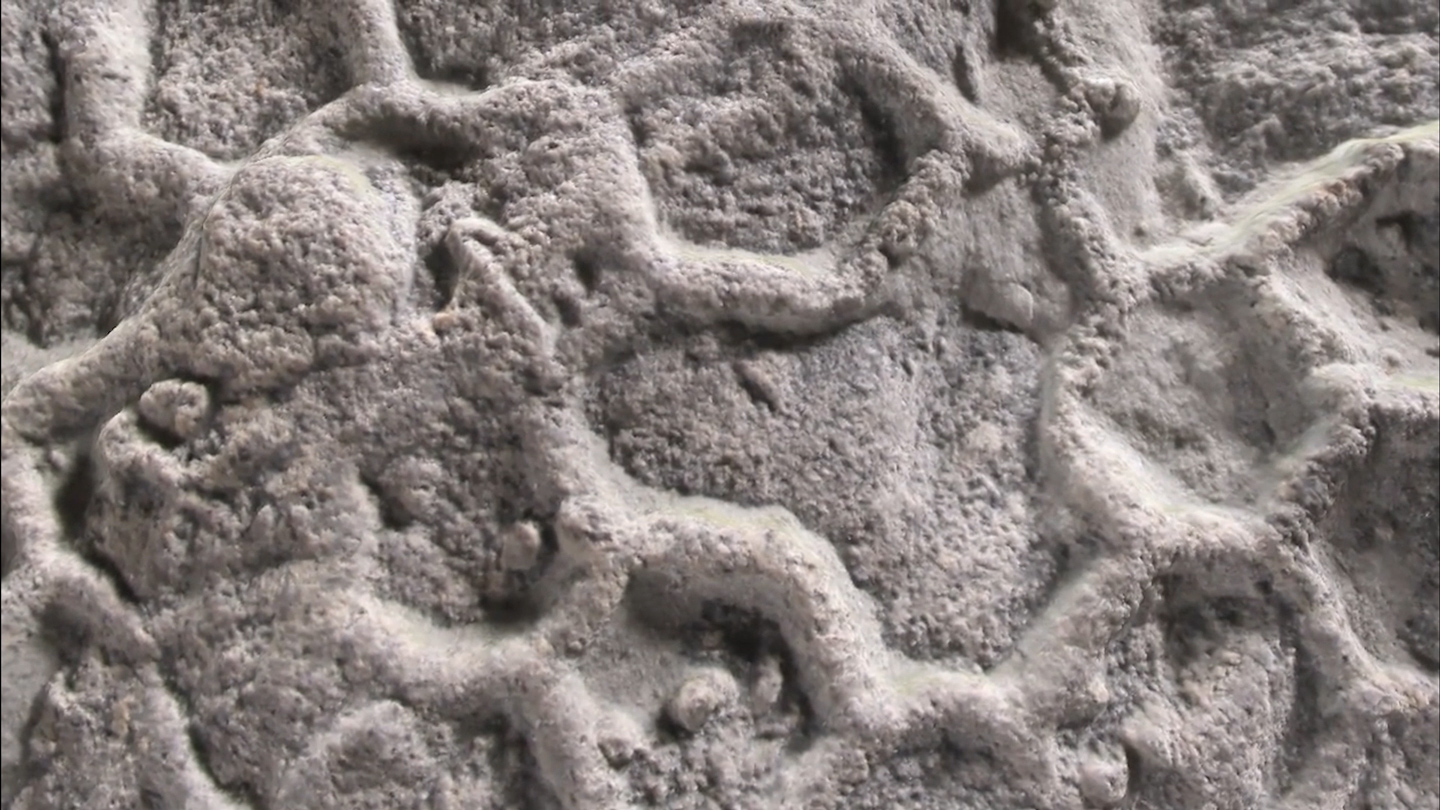
For more than 150 years, a ghostly geometric pattern etched into ancient seafloor rocks has left scientists guessing. The design looks like a perfectly regular honeycomb, a repeating grid of hexagonal cells carved into marine sediment, and it has been given the name Paleodictyon. It appears in fossil beds around the world, yet no one has ever been able to say with confidence what living thing made these mysterious traces. Were they burrows? Tracks? The work of some ancient creature’s feeding frenzy? Or perhaps something entirely nonbiological, like a chemical reaction or the imprint of fossilized algae? Over the decades, the leading suspicion fell on wormlike animals, soft-bodied creatures that might have tunneled through mud in search of food. But a new study offers a strikingly different answer. Researchers now propose that Paleodictyon was most likely created by arthropods—the enormous animal group that includes insects, spiders, and crustaceans—and possibly by a subgroup of crustaceans related to the humble roly-poly, also known as the pill bug or woodlouse. “Our study addresses one of paleontology’s most enduring enigmas,” says Andrea Baucon, a paleontologist at the University of Cagliari in Sardinia, Italy, and the lead author of the paper published in Earth-Science Reviews. It is a bold claim, but one that could finally crack a cold case that has puzzled geologists and paleontologists since the mid-1800s.
The mystery of Paleodictyon runs deep into the history of science itself. It is widely believed that Leonardo da Vinci, the Renaissance artist and inventor, sketched these distinctive geometric forms after spotting them in ancient marine deposits that had been uplifted to become dry land. Even today, similar honeycomb patterns are still found on the modern seafloor, which suggests that whatever makes them has been at work for hundreds of millions of years. During the 19th and 20th centuries, scientists floated a range of explanations. Some thought the patterns were created by worms; others imagined chemical processes could have produced such symmetry by accident; still others argued they were remnants of algae. None of these ideas fully satisfied, because the patterns are too structured to be random and too geometrically precise to be dismissed as a simple fossilized plant. To test a different possibility, Baucon and his colleagues took a comprehensive approach. They combed through previous research, re-examined fossil collections, and studied newly discovered specimens. Among their finds was a particularly striking example: a Paleodictyon fossil dated to roughly 530 million years old, making it one of the oldest ever discovered. It was found in a quarry near Torre de Moncorvo, Portugal, a place where the deep past is literally written in stone. For Baucon, this ancient specimen was not just another fossil—it was a crucial clue that connected Paleodictyon to a critical moment in the history of life, when complex animal bodies were first beginning to appear in abundance.
So why do Baucon and his team believe arthropods were the makers? The answer lies in the shape and structure of the burrows themselves. Paleodictyon’s honeycomb has sharp, angular corners and well-defined walls, and according to the researchers, such precise digging would be nearly impossible for a soft-bodied, wormlike organism. Worms are essentially tubes of muscle; they can push through weak sediment, but they cannot carve rigid, angular structures that require a steady, tool-like force. Arthropods, on the other hand, come equipped with rigid exoskeletons and jointed appendages. These body parts function like miniature digging tools, allowing an animal to cut through sediment, shape tunnels, and reinforce walls. The complexity of Paleodictyon also suggests more than just physical strength. Creating a regular hexagonal network would require a high degree of mobility, efficient burrowing behavior, and spatial awareness—an ability to navigate and organize one’s movements in a coordinated way. Those cognitive and behavioral abilities, the researchers argue, are consistent with what is known about arthropods, both living and extinct. Furthermore, there is a striking coincidence in timing. Paleodictyon appears in the fossil record around the same time as the earliest known fossils of arthropods, during the early Cambrian Period, about 530 million years ago. That timing alone is not proof, Baucon acknowledges, but it adds another thread to the emerging picture, linking the first appearance of these complex burrows to the rise of animals that had the right bodies and brains to build them.
Still, not everyone is ready to close the case. Stephen Hasiotis, a geologist at the University of Kansas in Lawrence who was not involved in the study, remains cautious. He agrees that the new hypothesis is thought-provoking, but he is not entirely convinced that arthropods are the sole creators of Paleodictyon. In his view, the fossil record is full of surprises, and without “smoking gun evidence”—clear, direct proof that a particular animal was caught in the act of building these structures across geological time and in the many different marine environments where Paleodictyon has been found—there is still a real possibility that other animals, including segmented worms, were responsible for at least some of these formations, both ancient and modern. Hasiotis’s hesitation reflects the broader challenge of studying trace fossils, which are records of behavior rather than body parts. You rarely get a perfect fingerprint of the animal itself, only the marks it left behind. Nevertheless, he says, the team’s hypothesis will doubtlessly push Paleodictyon aficionados “back onto the trail of whodunit and why.” In science, even a plausible suspect can breathe new life into an old investigation, and this study has done exactly that by giving researchers a fresh framework to test, question, and refine.
If Paleodictyon really was made by arthropods, the implications extend far beyond solving a fossil whodunit. These honeycomb patterns could represent some of the earliest evidence of complex animal behavior, suggesting that creatures living more than half a billion years ago were capable of sophisticated construction projects and structured movement through their environment. That would make Paleodictyon not just a curiosity, but a meaningful window into the evolution of behavior itself. Understanding who made these traces could also help scientists reconstruct ancient ecosystems, revealing relationships between early animals and the seafloor habitats they inhabited. Baucon and his colleagues are already thinking about how to push the investigation forward. They suggest that researchers could establish “Paleodictyon observatories” on modern ocean floors, carefully monitoring sites where the patterns appear in real time in the hope of catching the builders in the act. It is an ambitious idea, but modern technology makes it increasingly feasible. “Technologies such as artificial intelligence could help us automate the search for the creator of this mysterious structure,” Baucon says. With underwater cameras, remote sensing, and machine learning systems that can scan huge stretches of seafloor, scientists might finally be able to observe the elusive animal as it works, turning speculation into firsthand knowledge.
In the end, Paleodictyon remains a reminder that our planet’s history is not a closed book. Every fossil, no matter how puzzling, is a kind of message from a vanished world, and sometimes it takes centuries of questions before someone finds a new way to read it. The image of a tiny arthropod—perhaps an ancient relative of the harmless roly-poly—patiently carving a perfect honeycomb into the ocean floor is as strange as it is delightful. It challenges us to imagine what we still don’t know about the creatures that came before us and the behaviors they developed long before humans existed. The new study does not claim to have solved every aspect of the Paleodictyon mystery, and healthy scientific skepticism remains part of the process. But it shifts the conversation, reopening a case that had grown cold and inviting a new generation of researchers to look with fresh eyes at old stones. For those who love puzzles, there is comfort in knowing that some mysteries are not yet solved. The honeycomb is still there, hidden in layers of rock, waiting to tell its secret. And thanks to this new research, the next time someone asks who built it, the answer might just be closer than ever before.