

The Ocean’s Hidden Wonders
Imagine the vast, mysterious depths of the ocean, where sunlight dims and creatures live lives we can only glimpse through fleeting encounters. In this undersea world, the sperm whale reigns as both a giant and a gentle mystery—from its massive head to its deep-diving hunts for squid. But among the most intimate and rarely witnessed moments is birth, a process shrouded in the abyss. Recently, scientists captured a sperm whale birth like never before, offering a window into the emotional and communal sides of these marine mammals. Traditional views paint them as solitary hunters, but this footage reveals a touching sociality, where the ocean itself becomes a nurturing cradle. It’s a reminder that beneath the waves, life unfolds with a tenderness echoing human family bonds. When a mother whale gives birth, it’s not just survival; it’s a symphony of support from her pod, lifting a vulnerable new life toward air and hope. This event humanizes these colossal beings, showing their capacity for care amidst the pressures of the deep—a profound contrast to the loneliness we sometimes feel on land.
Setting the Scene of a Whale Pod
To fully appreciate the drama, let’s delve into the location and circumstances of this remarkable birth. It occurred in the warm, secluded waters near the Azores, a volcanic archipelago in the Atlantic Ocean, where sperm whales converge seasonally. These waters are a haven, far from the noisy shipping lanes of busy coasts, allowing pods to rest and rear young without constant disturbance. Sperm whales, especially mothers with calves, prefer these serene spots, where the sea floor drops into trenches perfect for their echolocation hunts. The footage came from a team of marine biologists using underwater drones equipped with high-definition cameras, venturing deeper than ever without intruding on the pod’s space. Picture the scene: a pod of perhaps a dozen whales, including the expectant mother, gliding through the blue like living shadows. The air above shimmers with sunlight, but down here, bioluminescent creatures and nutrient-rich currents set the backdrop. As the birth approached, the group’s energy shifted—subtle nudges, synchronized swims suggesting an unspoken understanding. Unlike humans who prepare nurseries, the whales rely on their collective instinct, turning the fluid ocean into a shared womb. This communal vigilance highlights their intelligence, a stark juxtaposition to how we isolate ourselves during life-changing moments.
The Intimacy of the Birth Process
The sperm whale birth itself is a feat of endurance, hidden from human eyes until now. Female sperm whales carry their calves for about 14 to 16 months, a gestation period mirroring the anticipation of a human pregnancy. When labor begins, the calf descends through the mother’s massive body—a challenging emergence in the weightless yet watery environment. Unlike terrestrial births, where gravity aids, whales must rely on buoyancy and the mother’s contractions to expel the offspring. In this intimate recording, we see the mother arching slightly, her powerful fluke strokes providing rhythm, while the calf, newborn and blind in the dark waters, emerges headfirst, pinkish and wrinkless, measuring around 12 feet—if this were a human equivalent, think of delivering a full-grown adult from your abdomen. The calf doesn’t cry like a baby; instead, tubes along its pectoral fins release sounds as it takes its first breaths near the surface. This moment pulses with vulnerability: the mother needs immediate help, and her pod senses it. Emotionally, it’s heart-wrenching— her eyes, though small, seem to convey strain, a parallel to the exhaustion of new parenthood. The footage humanizes the ordeal, making us empathize with her strength and the calf’s disorientation in a world of currents and predators.
The Pod’s Compassionate Assistance
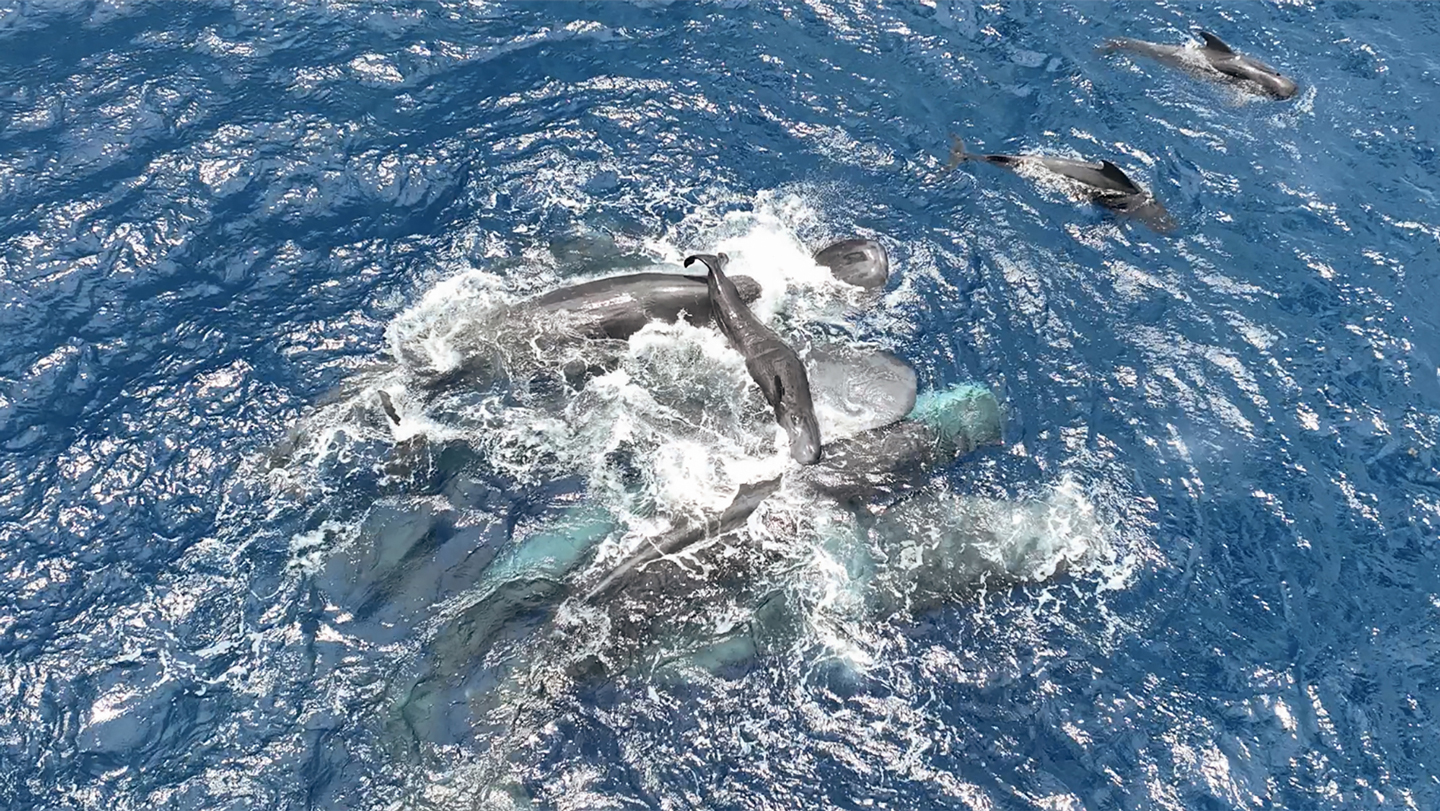
What makes this birth truly extraordinary is the involvement of the pod, transforming a solitary struggle into a group effort. As the exhausted mother navigates upward, other whales—likely relatives, sisters, or aunts—in this tightly knit family gather. They huddle around her like a protective shield, their bodies forming a supportive cluster that defies expectations of whale independence. This “huddling” isn’t chaotic; it’s coordinated, with adult males and females using their heads to gently push the newborn toward the surface for its first lungful of air. One whale might position itself under the calf, lifting it with buoyant force, while others flank the mother, possibly nudging her onward or fending off any curious sharks drawn by the commotion. It’s a ballet of empathy, where each member contributes instinctively, much like extended family rallying during a human birth crisis. The footage shows tails gently fanning to stabilize, flippers guiding delicately—actions that speak of deep social bonds. Sperm whales, once thought to be loners, reveal here a profound altruism, challenging our anthropocentric views. For observers, it’s awe-inspiring, evoking scenes of human villages coming together in times of need, reminding us of our own communal nature interwoven with oceanic grace.
Deeper Insights and Biological Significance
Beyond the spectacle, this event offers crucial scientific insights, deepening our understanding of cetacean biology and behavior. Sperm whales, the largest toothed mammals, live in matriarchal societies where females and young form strong bonds, while males roam solitarily. The observed assistance during birth likely enhances survival rates in harsh ocean environments, where threats like orcas or human pollution lurk. Calves, needing to surface every few minutes initially, rely on the pod’s lifting to avoid drowning—literally “breathing lessons” from their kin. This footage, captured at unprecedented intimacy, shows behaviors previously inferred from necropsies or guesses: for instance, the whales’ synchronized movements suggest acoustic communication, clicks and whistles coordinating the rescue. It’s humanizing because it parallels our parenting guides—think of seasoned grandparents teaching lullabies or safety holds. Furthermore, it underscores conservation needs; these gentle giants face threats from climate change and deep-sea mining, yet their perseverance shines. By witnessing such care, we feel indebted, urging us to protect these sentient beings. Scientifically, it refines models of whale pod dynamics, potentially inspiring AI swarm algorithms or studies on animal empathy, bridging marine biology with human psychology.
Reflections on Humanity and the Sea
In reflecting on this sperm whale birth, I can’t help but draw parallels to our own world, where community lifts us through life’s thresholds. Just as the pod’s huddle ensures a calf’s first gasp, human families assemble in hospitals or homes, sharing the joy and fear of new beginnings. The mother whale’s journey humanizes her—she’s not just an animal but a protagonist in an epic of endurance, embodying the universal struggle of creation. For divers or researchers involved, watching this must evoke humility, a recognition that we’re guests in their realm. It teaches us empathy: in an era of division, perhaps we can learn from whales to support each other across generations. Globally, stories like this inspire environmental action, reminding artists, writers, and policymakers of our interconnectedness with the sea. As the calf surfaces, lifted by love, it symbolizes hope—a new story starting in the depths, one that encourages us to nurture our planet with similar care. Ultimately, this intimate glimpse transforms science into poetry, urging us to see whales not as resources but as neighbors in the tapestry of life. If we listen, the ocean’s whispers might guide us toward a more compassionate existence.