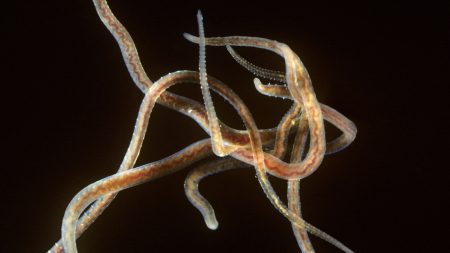






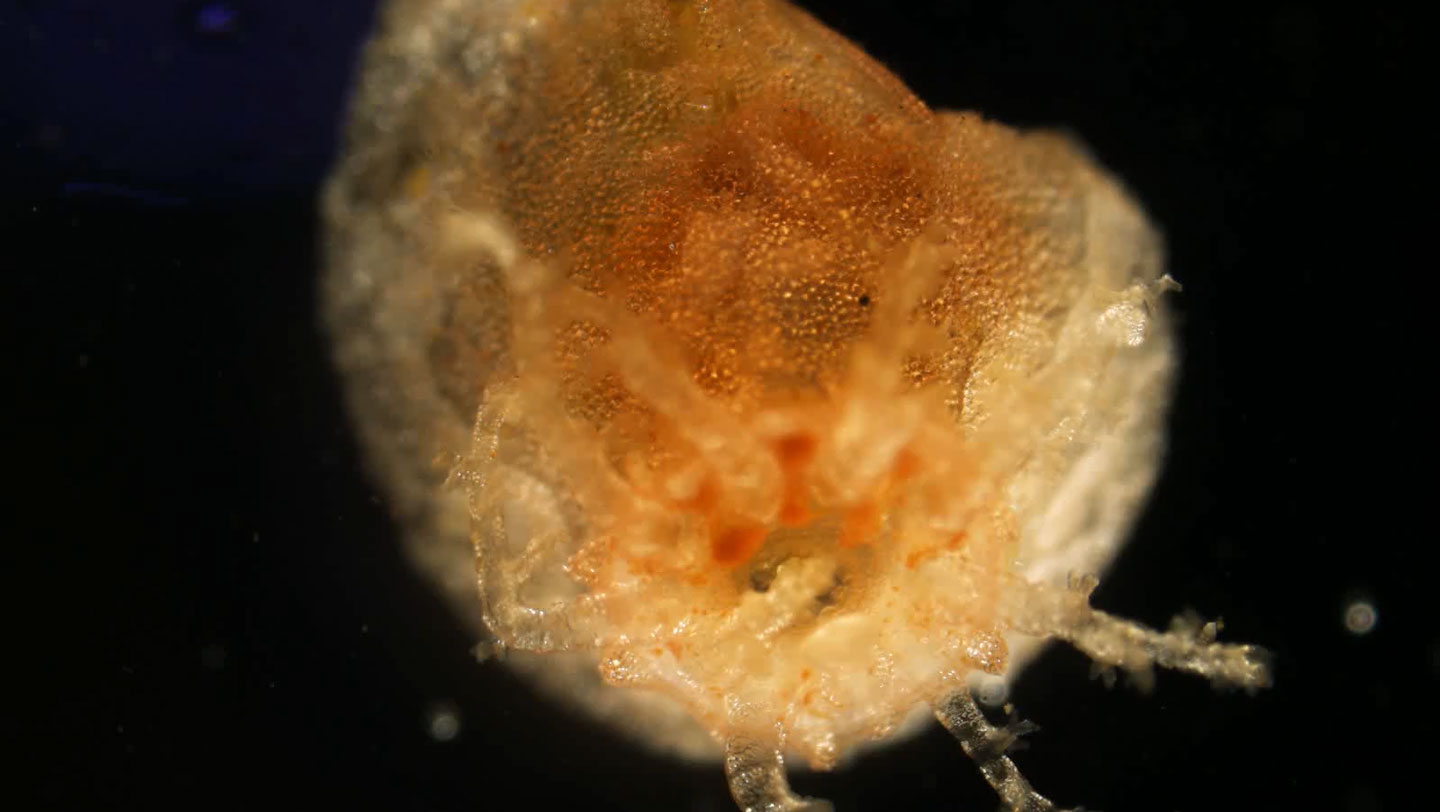
For generations, fans of the macabre have been entertained by “Thing,” the lively, disembodied hand that scuttles around the gothic mansion of the fictional Addams Family, helping out with chores and communicating through expressive gestures. While this loyal companion has long been understood as a product of pure cinematic fantasy, nature has recently revealed a bizarre real-world parallel lurking in the freezing depths of our oceans. Biologists studying the scarlet sea cucumber (Psolus fabricii), a vibrant, sausage-shaped marine invertebrate that populates the seafloors of the North Atlantic, have discovered that certain detached tissues from these creatures can survive, adapt, and behave almost like independent, living units long after being severed from their host bodies. According to a groundbreaking study published on May 29 in the journal Science Advances, scientists observed detached tissues from the sea cucumber’s small, tube-like appendages persisting in flowing seawater for upwards of three years. Remarkably, these orphaned pieces of flesh did not require any special nutrient infusions, sterile laboratory environments, or protective antibiotic cocktails to stave off the decay that normally claims dead organic matter, forcing the scientific community to fundamentally reevaluate the biological boundary separating mere tissue from an autonomous living organism. This startling discovery blurs the traditional definitions of life and death, suggesting that the drive to survive is deeply embedded within individual cells, capable of operating independently of a centralized brain, stomach, or heart. By demonstrating that biological tissues can endure, thrive, and reorganize themselves in the open wild after being amputated, these simple marine organisms are challenging the core tenets of evolutionary biology and regenerative medicine alike. Under normal circumstances, when an animal loses a limb, that severed piece of flesh is doomed to a rapid, bacterial decomposition, yet these marine wonders seem to possess an intrinsic blueprint for survival that defies standard decay. Researchers are now looking at these immortal-like fragments with a mixture of awe and professional curiosity, eager to trace the ancient genetic pathways that allow a simple structure to withstand the passage of years while completely detached from its parent system.
The journey toward this monumental discovery began not with a high-tech experiment, but with a moment of simple, serendipitous observation in a coastal laboratory in Canada. Marine ecologist Annie Mercier and her research team at the Memorial University of Newfoundland in St. John’s are intimately familiar with the quirks of sea cucumbers, regularly keeping these bottom-dwelling creatures in specialized tanks filled with fresh, continuously flowing seawater for observation. During a routine transfer of several scarlet sea cucumbers from one holding environment to another, one of Mercier’s colleagues noticed something unusual sticking to the empty tank’s floor: the animal had left behind several “podia,” which are tiny, tube-like structures that the creature utilizes like suction cups to crawl across rocks and navigate the ocean floor. In the harsh reality of the wild ocean, sea cucumbers frequently shed these tube feet due to predation, rough currents, or physical stress, and researchers had always assumed that these detached bits of flesh decomposed rapidly once separated from the main body. However, when Mercier and her colleagues returned to the tank several days after the transfer, they were stunned to find the abandoned tube feet looking fresh, vibrant, and completely free of decay. Intrigued by this unexplained durability, the research team decided to design a more structured investigation, using surgical scalpels to carefully amputate different types of tissues—including the animal’s feeding tentacles, its muscular body wall, and its suctioning tube feet—to observe how each piece would fare in simulated natural conditions over time. While the muscular body wall segments deteriorated and succumbed to bacterial decay within a matter of weeks, the tube feet and feeding tentacles defied all expectations, remaining healthy and structurally sound for over thirty-six months.
To understand how these disembodied structures managed to stave off death, Mercier’s team placed the surviving tissues under compound microscopes, uncovering a beautifully orchestrated sequence of cellular self-preservation and biological ingenuity. Immediately following their detachment, the tube feet and tentacles did not simply lie dormant; instead, they actively initiated a wound-healing process, neatly sealing the raw edges where they had been cut to prevent pathogens from infiltrating their interiors. The cells within these fragments then undertook a meticulous cleaning process, identifying and digesting older, damaged cells, while simultaneously signaling healthy cells to divide and multiply to stabilize the structure. Even more astonishing was the discovery of how these disembodied parts sustained their energetic needs without a digestive system, mouth, or stomach to process food. By adding trackable, isotopically tagged amino acids to the circulating seawater, the researchers watched in real-time as the detached tissues absorbed these microscopic nutrients directly through their outer skin, bypassing traditional metabolic pathways to fuel their cellular machinery. The sheer resilience of these fragments was put to the ultimate test when the scientists buried them beneath several centimeters of heavy, bacteria-laden marine mud, a hostile environment that would quickly suffocate and rot almost any other animal tissue. Instead of decomposing, the sea cucumber tissues persisted, remaining clean, organized, and structurally intact, demonstrating a level of biological defense that of itself constitutes a marvel of evolutionary engineering.
Confronted with the uncanny persistence of these self-sustaining tissues, the research laboratory affectionately began referring to their ongoing study as the “zombie project.” The term, while playful, captures the profound philosophical and biological paradox that these specimens represent to modern science: they exist in a twilight state, performing all the essential functions of life without being a unified, distinct organism. Traditionally, scientists have viewed tissues as subservient assemblies of cells that depend entirely on the homeostasis maintained by the larger animal’s organs, and once severed, they are expected to fail as the machinery of life grinds to a halt. In this case, however, the detached tentacles and tube feet proved capable of independent metabolic regulation, cellular growth, structural reshaping, and ongoing survival in a dynamic, non-sterile aquatic environment. This challenges the conventional hierarchy of anatomical construction, showing that complex tissues can transition into a quasi-autonomous phase of life that lacks a centralized nervous system but possesses a highly coordinated collective behavior. Rather than being a passive collection of dying cells, these fragments actively interact with their surroundings, seeking out nutrition, repairing internal damage, and maintaining cellular order over years. The “zombie project” thus forces us to rethink what it truly means for tissue to be alive, proving that life does not necessarily require a complete bodily framework to assert its presence, adapt to adversity, and resist the natural forces of decay. This conceptual leap opens up a mesmerizing debate on the nature of individuality, prompting scientists to wonder if these pieces might challenge our very understanding of what constitutes a single animal versus a community of cooperative cellular networks.
The implications of this discovery have sent shockwaves through the global scientific community, capturing the imagination of experts who specialize in extreme biology and animal regeneration. José García Arrarás, a renowned regenerative biologist at the University of Puerto Rico in San Juan who was not involved in the Newfoundland study, described the findings as both amazing and deeply exciting, though he noted that they align with the sea cucumber’s already legendary reputation for biological resilience. In the wild, certain species of sea cucumbers possess the mind-boggling capability to undergo fission—literally dividing their bodies completely in half—after which each individual section regenerates its missing organs to become two fully functioning, independent animals. Yet, as García Arrarás points out, the survival of these tiny, isolated tissues for years raises an entirely new suite of fascinating and unanswered questions that could revolutionize our understanding of longevity. Scientists must now work to identify the precise types of cells that populate these long-lived fragments, determine how they manage to continuously generate energy, and answer the tantalizing question of whether these detached tissues can actually outlive the very animal they originally belonged to. If these disembodied parts possess a longer potential lifespan than the host organism itself, it would turn many long-held beliefs about mortality on their head, suggesting that somatic cells are not necessarily bound by the aging clock of the individual creature. The pursuit of these cellular secrets promises to shine a bright light on the dark corners of evolutionary survival mechanisms, potentially revealing how simple creatures managed to thrive in Earth’s oceans for hundreds of millions of years.
Looking ahead, this extraordinary research offers scientists a revolutionary new model for exploring the biological mysteries of aging, cellular degeneration, and tissue preservation. Because these sea cucumber fragments can survive indefinitely in a natural state of suspension, they provide a clean, living canvas where researchers can observe how cells age, communicate, and repair themselves without the complicating variable of a host organism’s internal hormone shifts or systemic diseases. As García Arrarás highlights, the potential to study tissues of vastly different ages—having samples that are only a week old side-by-side with samples that have survived independently in a tank for three years, all originating from the exact same genetic donor—is an invaluable tool for isolating the exact molecular triggers of senescence and decay. Before these applications can be fully realized, however, researchers must embark on the painstaking work of mapping out the genetic expression and cellular profiles within these long-lived tissues to understand how they maintain their structural integrity so effortlessly. Ultimately, deciphering the secret of the sea cucumber’s self-sustaining “zombie” limbs could yield transformative breakthroughs in human medicine, perhaps inspiring new methods for preserving transplant organs, extending the shelf-life of human tissues, or unlocking regenerative therapies that allow our own bodies to heal with unprecedented efficiency. By listening closely to the quiet survival story of these humble, bottom-dwelling marine organisms, humanity may find itself on the cusp of rewriting the rules of life, aging, and what is possible when we strive to persist against all odds.