





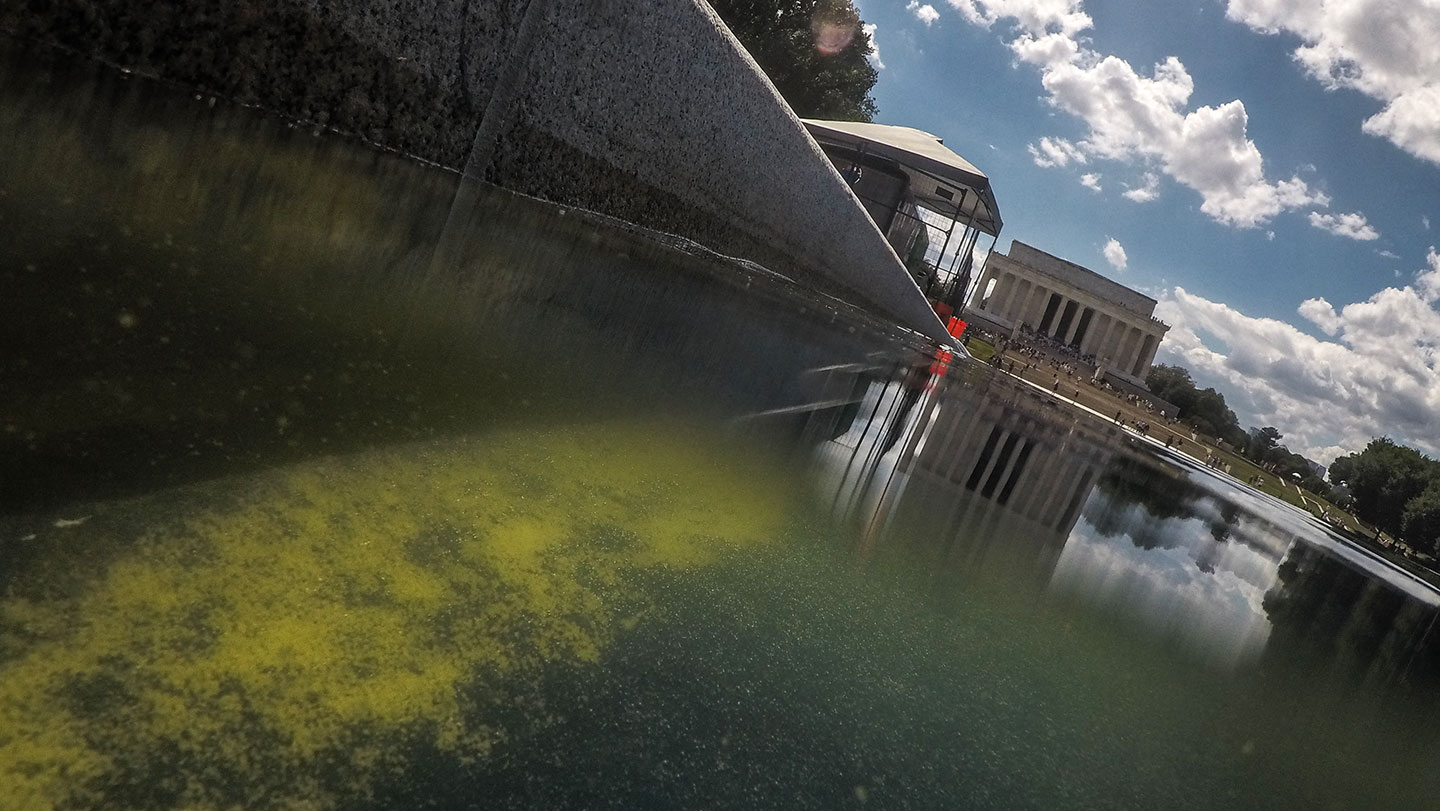
Nestled between the towering stone obelisk of the Washington Monument and the solemn temple of the Lincoln Memorial lies the Reflecting Pool, one of the most culturally significant and frequently photographed vistas in the United States. Historically, this expansive stretch of water has served as a silent witness to pivotal moments of civil rights history and a peaceful mirror to the shifting skies of the American capital. Recently, park authorities treated the pool to a fresh coat of specialized paint, designed specifically to capture a deep, patriotic hue affectionately described by its creators as “American Flag blue.” The visual objective of this restoration was simple: to offer the millions of annual tourists, wide-eyed school groups, and daily commuters a pristine, sapphire-tinted canvas that would beautifully double the image of Abraham Lincoln’s marble statue in the bright summer daylight. However, on June 16, nature staged an unprompted and highly ironic intervention, transforming this civic masterpiece into a stagnant, pea-soup green marshland practically overnight. An aggressive, sudden algal bloom had exploded across the expansive waters, completely devouring the intended blue paint and replacing it with a sickly, primeval green that instantly dimmed the majesty of the National Mall. While sanitation crews and National Park Service officials frantically mobilized to scrub the hard concrete surfaces and chemically treat the water, a team of international researchers published a groundbreaking study in the journal Science that revealed how these massive, unsightly blooms might actually destroy themselves from within through a natural, microscopic chain reaction. Yet, as fascinating as this newly discovered cellular self-destruct sequence is to environmental biologists, it carries a bittersweet reality for the citizens and stewards of the nation’s capital; the ecological drama currently unfolding in the Reflecting Pool has already mutated past the point of this specific scientific cure, leaving our iconic national mirror stubbornly clouded.
To understand both the tragedy of this ruined vista and the hope offered by the new research, one must look at the minuscule, ancient organisms responsible for these dramatic aquatic takeovers. The scientific study focuses primarily on cyanobacteria, an incredibly old phylum of photosynthetic bacteria that are frequently, though scientifically incorrectly, referred to as “blue-green algae.” These microscopic pioneers are remarkably adaptive; when warm weather, stagnant water, and human-caused nutrient runoff align perfectly, billions of these single-celled organisms multiply exponentially, forming thick, unsightly blankets across lakes, reservoirs, and slow-moving rivers. Yet, as frustrating as these blooms are when they ruin a family beach day or spoil a national monument, the true danger of cyanobacteria actually begins at the end of their life cycle. When these massive populations inevitably run out of resources and die off en masse, their decaying corpses sink to the bottom of the water column, triggering a secondary biological catastrophe. Other species of bacteria rush to consume the decomposing organic matter, reproducing so incredibly fast that they deplete the dissolved oxygen in the water, creating suffocating “dead zones” where fish, turtles, and aquatic invertebrates cannot survive. Compounding this ecological devastation, dying cyanobacteria often rupture and release potent hepatotoxins and neurotoxins into the water supply, threatening public health, poisoning local wildlife, and costing the United States economy more than $50 million annually in lost tourism, water treatment costs, and agricultural damage—a massive sum that does not even account for the ongoing maintenance headaches at the Lincoln Memorial. Consequently, scientists have spent decades trying to understand what triggers the sudden, synchronized collapse of these harmful blooms, searching for a natural pressure point that could be exploited to clear polluted waters without introducing harsh synthetic chemicals.
For generations, the sudden and seemingly coordinated death of an entire algal bloom has remained a profound biological mystery, but the research team’s new findings point to a microscopic form of cellular suicide known as ferroptosis. This process is a destructive chain reaction that relies on a delicate balance of iron and hydrogen peroxide, occurring deep within the cellular boundaries of the cyanobacteria. To survive and perform photosynthesis, these bacteria require a surprisingly large amount of iron to facilitate their energy-producing reactions, and they store any excess iron inside themselves as a highly reactive chemical form known as ferrous iron. However, this internal stockpile is effectively a biological landmine waiting for a fuse, and that fuse is provided by hydrogen peroxide, a compound that occurs naturally in sunlit waters when solar radiation interacts with water and decomposing organic matter. When the surrounding concentration of hydrogen peroxide rises, it penetrates the bacterial cells, initiating the Fenton reaction—a famous chemical process where ferrous iron converts the peroxide into highly destructive free radicals, also known as reactive oxygen species. These volatile molecules behave like microscopic buzzsaws inside the cell, quickly attacking and breaking down the complex fatty acid chains, or lipids, that constitute the defensive cell membrane. Robbed of their structural integrity and riddled with tiny, chemically burned holes, the cell membranes fail entirely, causing the cyanobacteria to literally burst open and perish. If the chemical and environmental conditions of the surrounding water are just right, this localized destruction does not remain isolated; instead, it can rapidly cascade outward, converting a thriving microbial colony into a vast, silent graveyard of ruptured cells.
This natural self-destruct mechanism was documented in real-time by phycologist Yi Tao and his research team at Tsinghua University in Shenzhen, China, who closely monitored a naturally occurring algal bloom in Dianchi Lake. Located in the picturesque Yunnan province, Dianchi Lake experienced a severe bloom of Microcystis cyanobacteria in 2024, providing the scientists with an ideal natural laboratory to study the final days of a microbial empire. Just before the lake’s massive bloom underwent its sudden, dramatic collapse, Tao’s team gathered water samples and discovered that the cyanobacteria exhibited extreme levels of internal oxidation, coupled with a shocking threefold increase in their normal levels of stored ferrous iron. To verify if this chemical imbalance was indeed the trigger for the mass die-off, the researchers returned to their laboratory and introduced hydrogen peroxide directly to cultures of Microcystis aeruginosa, a particularly troublesome species of cyanobacteria. The results were instantaneous and dramatic: the introduction of the chemical caused iron levels and free radicals within the cells to skyrocket, shredding the membrane lipids exactly as hypothesized. Even more remarkably, the team discovered that these dying cells did not perish in silence; as their membranes ruptured, they released unstable, broken lipids called truncated phospholipids into the surrounding water. These damaged molecules instinctively clumped together to form tiny, highly mobile bubbles called vesicles, which drifted through the water and interacted with healthy neighboring cells, transferring the unstable chemical reaction and systematically tearing their membranes apart as well, proving that a single spark of ferroptosis can trigger a devastating domino effect across an entire lake.
The scientific community has greeted these findings with a mixture of excitement and cautious pragmatism, recognizing both the brilliance of the biochemical discovery and the immense difficulty of applying it to real-world environments. Biogeochemist and science communicator Markus Dengg, who works with the Otago Regional Council in New Zealand, described the study as offering a “nice window” into the elaborate mechanics of how harmful algal blooms naturally collapse. However, like many field-based scientists, Dengg emphasizes that there is a vast, complicated gulf between observing a controlled chemical reaction in a laboratory petri dish and successfully manipulating an entire wild ecosystem. In a natural lake, reservoir, or river system, there are countless overlapping biological, geological, and meteorological processes occurring simultaneously—such as wind patterns, water currents, competing microbial species, and varying mineral concentrations—all of which could potentially disrupt or neutralize the fragile chain reaction of ferroptosis before it can spread. To truly weaponize this biochemical process as an environmental management tool, researchers will need to conduct extensive, large-scale lake trials to determine if hydrogen peroxide can consistently spark this destructive domino effect in wild, open waters without causing collateral damage to other aquatic plants and animals. Nevertheless, the study represents a monumental step forward in our understanding of microbial ecology, giving conservationists a potential blueprint for dealing with one of the most persistent and costly environmental crises of the modern era.
Unfortunately, this elegant scientific breakthrough offers absolutely no comfort or solution for the tragic, green state of the Lincoln Memorial Reflecting Pool, as explained by aquatic scientist Lewis Molot of York University in Toronto. While the devastating bloom in Washington, D.C. may have originally started with a population of cyanobacteria similar to the Microcystis studied by Tao and his colleagues, the ecosystem within the concrete pool has already undergone a dramatic evolutionary shift. Today, the pool is heavily dominated by a genus of green algae called Scenedesmus, which is a eukaryotic organism featuring a highly complex cellular structure, unlike the simpler, prokaryotic cyanobacteria. Molot notes that the specific concentrations of hydrogen peroxide used to successfully trigger ferroptosis and control cyanobacteria in scientific trials have historically had a completely negligible effect on tougher, eukaryotic algae like Scenedesmus, rendering this newly discovered chemical weapon entirely useless against the pool’s current invaders. Furthermore, the very design of the updated Reflecting Pool may have unintentionally created a flawless, highly resilient breeding ground for this aggressive species. As Markus Dengg points out, the dark blue paint applied to the pool’s bottom absorbs solar radiation, significantly warming the water, while the regular feeding of fresh water from the Potomac River constantly replenishes the pool with a rich supply of nutrients, organic debris, and diverse microorganisms. In a cruel twist of environmental engineering, the capital’s attempt to paint a perfect blue patriotic mirror has instead produced a highly competitive, warm, nutrient-rich laboratory where only the hardiest, most chemical-resistant green organisms survive, leaving Washington’s most iconic view stubbornly green for the foreseeable future.