



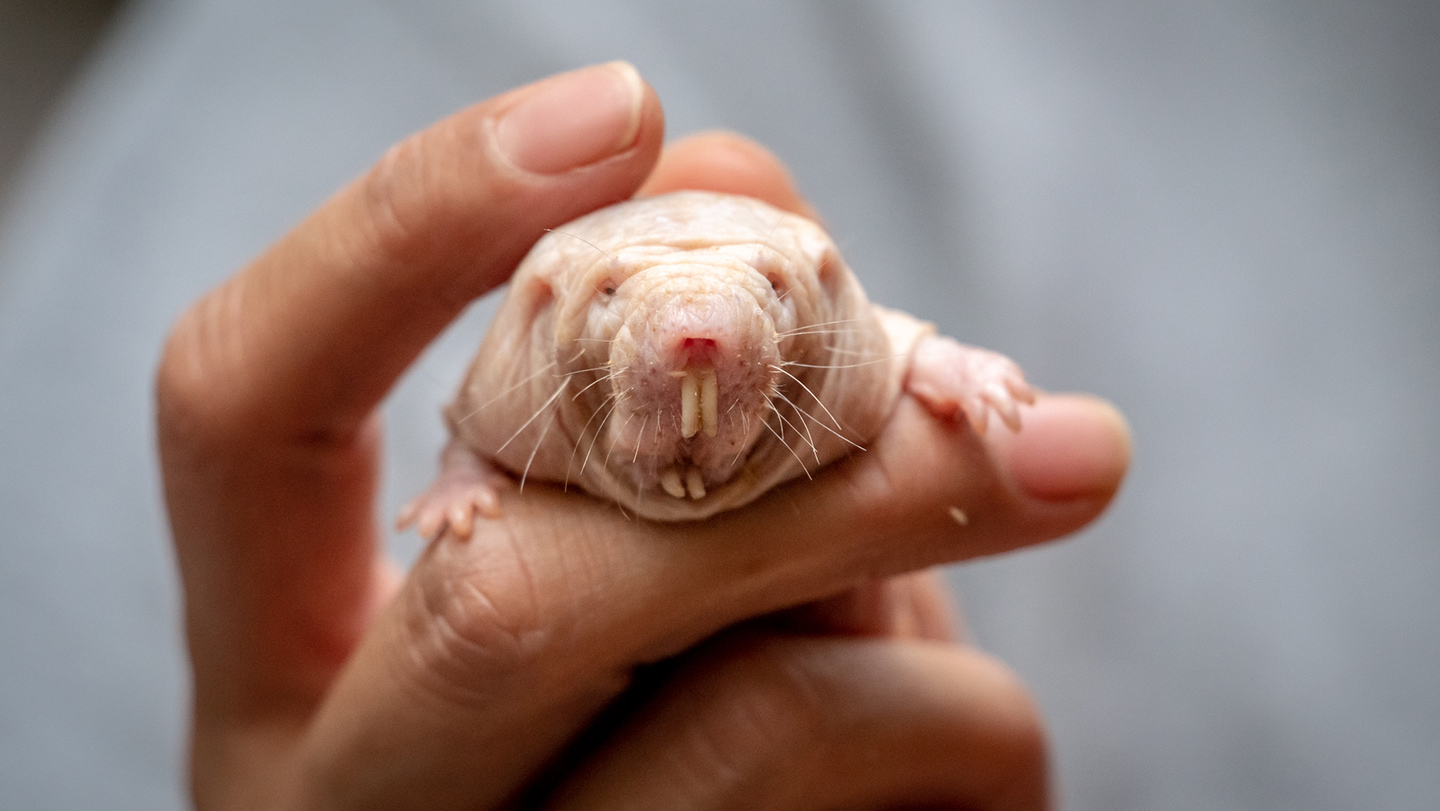
Deep beneath the arid soils of East Africa, far removed from the warmth of the sun, lies one of the most bizarre and highly organized societies on Earth. Naked mole-rats, with their wrinkled, hairless skin and prominent, protruding teeth, live in vast, subterranean labyrinthine fortresses that function less like standard mammalian packs and more like highly efficient, insect-like superorganisms. In these cooperative, eusocial empires, hundreds of individuals live in complete harmony under the absolute rule of a single sovereign: the queen. She is the mother of the entire colony, the sole reproductive female, while the rest of the citizens are relegated to lifelong roles as sterile workers, tirelessly foraging for tubers, cleaning tunnels, and defending the borders from predators. To maintain this hyper-structured caste system, the queen must exercise absolute control over her subjects, ensuring that no other female attempts to mate and no ambitious male tries to challenge the status quo. For decades, biologists marveled at this undisputed dominance, wondering how a single, seemingly defenseless rodent could pacify hundreds of her peers and keep them in a state of arrested sexual development. Because these creatures spend their entire lives in pitch-black, oxygen-depleted tunnels, visual cues are useless, and auditory signals are limited. Instead, they navigate, communicate, and enforce order through a complex, invisible web of chemical signals. Groundbreaking research has finally pulled back the veil on this chemical monarchy, revealing that the queen’s crown is not forged from physical violence or intimidation, but from a potent, invisible chemical weapon. It is a biological superpower that allows her to rule her subterranean kingdom through scent alone, effectively keeping her subjects in a state of peaceful, obedient trance, proving that in the dark, odor is the ultimate arbiter of power and peace.
The quest to uncover the secret of the queen’s power led Gary Lewin, a renowned neuroscientist at the Max Delbrück Center in Berlin, and his team of international collaborators into a fascinating investigation of olfactory biology. Having previously discovered that naked mole-rats use distinct colony-specific odors to recognize friends and identify hostile intruders from rival clans, Lewin wondered if a similar chemical language was used to govern internal colony dynamics. To isolate the elusive compounds that might be responsible for the queen’s absolute authority, the researchers had to get creative, adapting a specialized technique originally engineered by environmental scientists for collecting volatile odor samples from outdoor pit latrines. Using this highly sensitive chemical trapping method, they analyzed the air surrounding the queen and successfully isolated a specific organic compound unique to her called isopropyl myristate. While this chemical is entirely odorless to the human nose, the researchers discovered that it acts as a powerful neuro-chemical trigger in naked mole-rats, directly lighting up their olfactory cortex—the specialized region of the brain dedicated to processing smell. By mapping the neural pathways of the mole-rats, Lewin’s team showed that the mere presence of isopropyl myristate alters brain chemistry, suggesting that the rodents are biologically hardwired to respond to this royal signature. It is a brilliant evolutionary adaptation: a physical crown can be stolen or broken, but a chemical signal that directly rewires the sensory perception of everyone in the room is practically impossible to ignore. This discovery marked a massive leap forward in our understanding of mammalian social structures, shifting the paradigm from behavioral dominance to chemical orchestration and showing that the queen’s presence is chemically woven into the very fabric of her subjects’ minds.
To test the true limits of this royal perfume’s power, Lewin and his team designed an elegant yet daring experiment to see if they could rule a colony by proxy using only the isolated chemical. They temporarily removed the living queen from her colony, a disruption that would normally trigger immediate social collapse, and instead treated the habitat daily with synthetic isopropyl myristate. The results were nothing short of miraculous: for three consecutive months, the colony remained perfectly peaceful, cooperative, and entirely celibate, even though their physical ruler was nowhere to be found. The workers continued their chores, foraging for food and maintaining the tunnels without a single dispute, fooled into obedience by the lingering, phantom scent of their monarch. However, the true dramatic potential of this chemical became clear the moment the researchers ceased the daily treatments. Within a single week of stopping the scent, the delicate social contract shattered, and the colony plunged into a brutal, bloody civil war. High-ranking individuals, suddenly liberated from the chemical suppression, became intensely aggressive, fighting viciously for dominance. Tragically, this power vacuum led to the first death within days, as the animals fought tooth and nail to establish a new hierarchy. Within a few weeks, the chaos settled, mating events occurred, and a new queen emerged from the carnage, demonstrating that the queen’s scent is the only barrier protecting the colony from self-destruction. This experiment illuminated the double-edged sword of the mole-rat’s social system: the peace of the colony is entirely artificial, maintained by a constant chemical sedative. Without it, the evolutionary drive to reproduce, normally locked away by the queen’s pheromones, is unleashed with savage intensity. It shows that the workers are not truly content with their sterile roles; rather, they are chemical hostages to the queen’s perfume. The moment the chemical handcuffs are removed, the dormant instincts of self-interest, ambition, and biological survival reawaken, proving that under the peaceful surface of the colony lies a powder keg of competitive tension ready to explode at the slightest hint of the queen’s absence.
The biological mechanism behind this chemical control is even more sinister and fascinating than simple behavioral modification. To understand how the queen prevents her subjects from breeding, Lewin’s team conducted a series of controlled experiments isolating pairs of non-breeding male and female mole-rats. When left to their own devices in a clean environment, five out of six of these pairs became pregnant within just four weeks, showing how quickly their reproductive systems activate when free from the colony. However, when identical pairs were exposed to daily doses of isopropyl myristate, their reproductive organs remained completely dormant, and not a single pregnancy occurred. Comprehensive blood work revealed that the compound acts as a powerful endocrine disruptor, directly manipulating the animals’ hormone levels. The chemical lowers progesterone, the hormone essential for establishing and maintaining pregnancy, while simultaneously elevating prolactin, a hormone that, in high levels, suppresses ovulation and fertility. In essence, the queen’s perfume acts as an involuntary, airborne contraceptive, keeping all other females in a state of chemical castration. By physically hijacking the endocrine systems of her subordinates, the queen ensures that no rival can divert precious colony resources to their own offspring, consolidating all reproductive power to herself while forcing the rest of the colony to dedicate their lives to raising her genetic legacy. This hormonal puppetry is a masterclass in evolutionary efficiency. Instead of wasting energy chasing down and physically fighting every female in the colony to prevent them from breeding, the queen simply breathes out a cloud of chemical compliance that biologically disables their ability to conceive. The subordinates’ bodies respond to the scent by shutting down their own reproductive machinery, effectively prioritizing the queen’s survival over their own reproductive potential. This level of physiological manipulation blurs the line between individual organisms and a single, giant, distributed body, where the queen acts as the reproductive organ and the workers act as the somatic cells that feed and protect it. It is a chilling reminder of how deeply chemistry can govern biology, dictating the most fundamental drives of life—mating and motherhood—without the subject ever realizing they are being controlled.
However, this absolute chemical sovereignty is not a permanent privilege; it is a grueling, continuous biological tightrope that the queen must walk every single day. By monitoring queens through their reproductive cycles, the researchers made another startling discovery: the queen does not produce isopropyl myristate constantly throughout her life. Instead, she synthesizes this crucial compound almost exclusively when she is actively pregnant or preparing her body for another pregnancy. This linking of chemical production to fertility creates a high-stakes biological contract between the queen and her colony. The workers are not blindly loyal to a title; they are loyal to the chemical signal of a highly productive, fertile mother. If the queen’s health declines, or if she becomes barren and ceases to produce the compound, the protective chemical veil instantly vanishes. The colony immediately senses this drop in chemical output as a sign that their ruler is no longer capable of fulfilling her primary duty. With cold, utilitarian efficiency, the workers will turn on their former sovereign, brutally attacking and killing her to clear the way for a younger, more fertile successor. The queen’s life is therefore a perpetual race against time, where her very survival depends on her ability to remain constantly pregnant, making her both the absolute master and the ultimate prisoner of her own chemical empire. This brutal reality strips away any romanticized notion of royalty; the queen is just as much a slave to the system as her workers. Her crown is only as secure as her last litter of pups. The moment her body tires, the chemical signal fades, and she transitions from a protected deity to a useless mouth to feed. This ruthless survival strategy ensures the long-term viability of the colony, replacing an aging, inefficient ruler with a vibrant successor before the colony’s population can decline. It is an evolutionary mechanism where empathy has no place, and the survival of the collective group is valued far above the life of any single individual, even the queen herself.
This remarkable level of highly synchronized hormonal and behavioral coordination is incredibly rare among mammals, representing a social complexity that we often arrogantly assume is unique to humanity. While we pride ourselves on our sophisticated laws, treaties, and social contracts designed to maintain peace and enforce cooperation across vast societies, naked mole-rats have been achieving a similar level of harmonious coordination for millions of years using nothing but a single, potent molecule. This research not only reshapes our understanding of mammalian biology but also forces us to reflect on the invisible forces that shape our own social structures and behaviors. While humans may not use airborne contraceptives to govern our societies, we are still deeply biological creatures, influenced by subtle chemical signals, hormones, and evolutionary drives that we are only beginning to comprehend. The story of the naked mole-rat is a powerful testament to the sheer ingenuity of nature, showing how evolutionary pressures can carve out complex, self-regulating societies from the dark, quiet earth, reminding us that sometimes, the most profound mysteries of life are carried on the wind, waiting to be discovered by those willing to look—and smell—a little closer. By bridging the gap between neuroscience, chemistry, and sociology, Lewin’s work invites us to appreciate the delicate balance of life in the animal kingdom, where peace and violence are balanced on the head of a single chemical pin. It challenges us to look beyond our human-centric view of society and recognize that cooperative harmony can take many forms, some of which are far more ancient and chemically sophisticated than our own. In the end, the naked mole-rat queen’s invisible crown is a brilliant reminder that in the grand tapestry of evolution, survival often belongs not to the strongest or the loudest, but to those who can master the quiet, invisible languages of the natural world.