

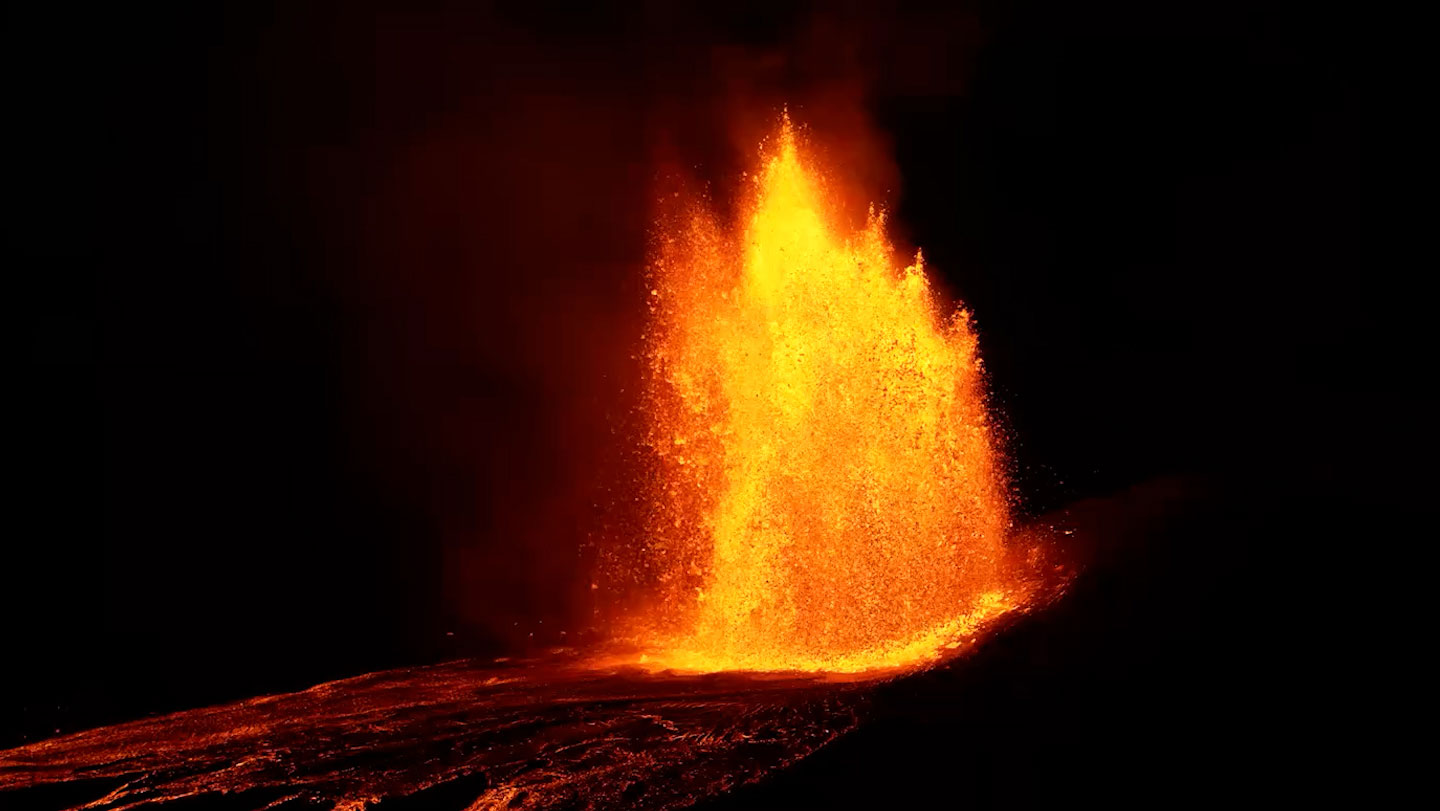
For nearly two centuries, Kilauea has been a constant, restless presence on the Big Island of Hawaii, erupting so often that scientists have come to expect almost anything from it. Yet even by the standards of this famously active volcano, the past couple of years have been extraordinary. Kilauea has always been a showman, but in late 2024 it began doing something no one had ever documented with such intensity: it started producing lava fountains again and again, like a geological fireworks display that refused to end. The spectacle began at dawn on December 23, 2024, inside the summit crater of Halemaʻumaʻu, and it has continued in bursts ever since. By September 2026, researchers had counted 54 distinct lava fountains, some of them blasting molten rock as high as 457 meters into the air. That is taller than many skyscrapers, and it is enough to make even seasoned volcanologists pause. For a volcano that has been erupting almost continuously for roughly 200 years, this new “fountain era” is a striking reminder that even the most familiar forces of nature can still find ways to surprise us.
The reason this behavior is so remarkable is not that lava fountains themselves are rare. During an eruption that lasts for hours, days, months, or even years, occasional fountains are actually fairly common. What is unusual is the pattern Kilauea has shown: a series of repeated, distinct fountains, separated by pauses of minutes to weeks, all within a single ongoing eruption. These clustered spurts are not something scientists see very often. In fact, researchers have noted that Kilauea has produced this kind of episodic fountain activity only three times since 1823, and never with the frequency seen in the recent sequence. Imagine a volcano that usually erupts in long, sustained flows suddenly switching to a rhythm of pulsing bursts, like a heartbeat made of fire. That is essentially what has been happening. The fountains are not just random explosions; they are a repeating pattern, a kind of volcanic punctuation mark that has left geophysicists both thrilled and puzzled. Because these events are so rare, scientists have had relatively little opportunity to study exactly what triggers them, what keeps them going, and what finally brings them to a halt. Kilauea, with its dense network of instruments and decades of careful observation, has now given them a front-row seat to one of nature’s most dramatic mysteries.
For years, researchers have debated what might cause such episodic fountains. Two main ideas have dominated the discussion. The first suggests that water dissolved in magma, the underground mixture of molten rock and gas, suddenly escapes as the magma rises and pressure drops. This rapid release of water vapor could create a powerful burst, much like shaking a bottle of carbonated water and then cracking it open. The second idea involves carbon dioxide. In this scenario, a foam rich in carbon dioxide builds up at the top of the trapped magma, like the frothy head on a freshly poured soda. When that foam becomes unstable, it can violently expand, sending lava shooting skyward. Both explanations are plausible, but they are very different in their mechanics, and telling them apart requires precise observation. That is where Kilauea’s unique status as a natural laboratory comes in. The volcano has been intensely monitored for decades, with instruments tracking seismic activity, ground temperature, low-frequency acoustics, the swelling and deflating of the ground, and the gases escaping from vents. All of this data has allowed researchers to watch the volcano’s behavior in remarkable detail, and to test these competing hypotheses against what they actually see happening before, during, and after each fountain.
What they found is a pattern that seems to point toward one explanation over the other. Before each fountain, the floor of Kilauea’s bowl-shaped caldera would swell and tilt, a clear sign that magma was gathering beneath the surface. This was not entirely surprising, but the consistency of the signal was striking. As the eruption matured and the fountains continued, a more detailed pattern emerged. It first appeared before the fourteenth fountain, and once the researchers recognized it, they could see it repeating again and again. Just before each eruption, they detected a sequence of minutes-long bursts of seismic energy and low-frequency acoustic signals. These signals, they believe, are linked to the buildup and release of trapped gases within the magma. The gases cause the magma to rise and fall through the narrow volcanic vents in the rock, moving like a piston inside an engine. Each cycle of gas accumulation and release pushes the magma upward, and when the pressure finally becomes too great, the result is a fountain of lava. This rhythmic, mechanical behavior fits the data beautifully, and it offers a compelling explanation for why the fountains occur in such regular, repeated bursts. It is as if the volcano has developed its own internal rhythm, a slow, powerful breathing that occasionally erupts into visible flame.
The gas chemistry also provided an important clue. Throughout the fountain episodes, the volcano emitted noticeable amounts of sulfur dioxide, but relatively little carbon dioxide. That is significant because it weakens the carbon dioxide foam hypothesis. If the fountains were being driven by a CO₂-rich foam, scientists would expect to see much higher levels of carbon dioxide in the emissions. Instead, the relatively low CO₂ levels, combined with the seismic and acoustic patterns, point toward water as the main driver. As water dissolved in the magma escapes under changing pressure, it creates the explosive force behind the fountains. This does not mean the mystery is fully solved, of course. The researchers, led by geophysicist Ashton Flinders of the U.S. Geological Survey’s Hawaiian Volcano Observatory, are careful to describe their findings as a preliminary glimpse into a complex phenomenon. Many questions remain. Why did this behavior start when it did? Why has it persisted for so long? Will it continue, or will Kilauea eventually settle back into its more familiar patterns? The volcano is still active, and the data are still flowing. Each new fountain offers another chance to refine their understanding, and each new measurement adds a piece to the puzzle.
For those who live in Kilauea’s shadow, and for the scientists who watch it every day, this new chapter is both awe-inspiring and humbling. The fountains are a vivid reminder that the Earth beneath our feet is alive, constantly moving, constantly changing. They are also a reminder of how much we still have to learn about the planet we call home. Kilauea has been erupting for generations, and in all that time, it has never stopped finding ways to teach us something new. The recent fountain activity is not just a spectacle; it is a natural experiment unfolding in real time, offering insights that could help scientists better understand volcanic behavior not only in Hawaii but around the world. With every burst of molten rock, the volcano is telling a story about the forces that shape our planet, and for the first time, researchers are beginning to understand the language it speaks. There is still much to discover, but one thing is certain: Kilauea is far from finished, and it will keep surprising us for as long as it continues to rumble, swell, and blaze against the Hawaiian sky.