

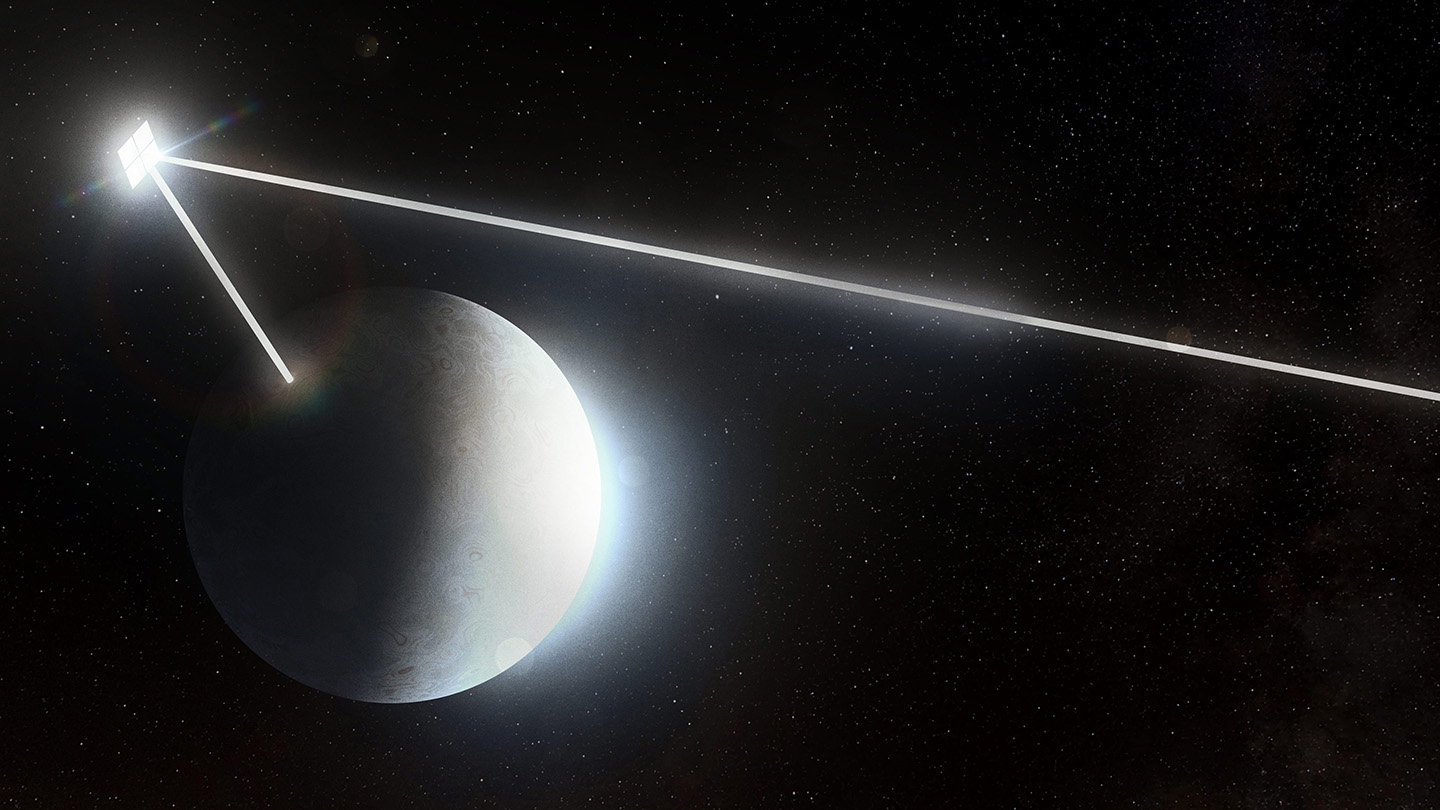
Since 1989, astrophysicist Jonathan McDowell has kept a running account of every human-made object in orbit around Earth. His catalog, updated every few weeks, is more comprehensive and detailed than most government records, and from that front-row seat he has watched the sky transform. In 2018, there were roughly 2,000 active satellites; today there are more than 16,000. Private companies have launched dozens, then hundreds, then thousands of spacecraft in little more than a decade. So when McDowell learned that a California company called Reflect Orbital planned to launch a satellite to reflect sunlight onto the night side of Earth, he sighed. “It’s an insane project,” said McDowell, who retired from Harvard and is now an honorary professor at Durham University. “There’s a failure to understand that darkness is a good thing.” Reflect Orbital, based near Los Angeles, sees the plan differently. Its first demonstration satellite, Eärendil-1, is an 18-meter sheet of reflective material that will unfold in orbit 600 to 650 kilometers above the ground. Motors will aim it to bounce a circle of sunlight about five kilometers wide across the planet. The spot will be about as bright as a full moon, but because the mirror moves at 7.5 kilometers per second, it will stay over one place for only about four minutes. The company calls this “sunlight on demand” and hopes it can eventually aid disaster response, illuminate festivals, and let solar farms generate electricity through the night. “We believe that exploring how new technologies can help the world forgo fossil fuels is a responsible application of the scientific process,” spokesperson Christopher Buscombe wrote to Science News. Many astronomers and dark-sky advocates disagree. In March, the American Astronomical Society petitioned the FCC to deny the company permission to operate; when the FCC approved the test in July, DarkSky International asked the agency to reverse its decision. The project, says astronomer Stephen Hummel of McDonald Observatory in West Texas, “amplifies the issue to the point where it’s impossible to ignore.”
At the center of the alarm is what satellites already do to astronomy. Meredith Rawls, a researcher at the University of Washington in Seattle, compares satellites to “bugs on the windshield.” The new Vera C. Rubin Observatory in Chile—built to sweep the sky in unprecedented detail—has spent years preparing for the light streaks that will slash through its images. Those streaks can ruin searches for transiting exoplanets, gravitational wave sources, objects in the distant Kuiper Belt, and asteroids that might someday cross Earth’s path. Low-Earth orbit satellites are especially visible just before sunrise and just after sunset, which is prime time for many observations. “One of the most frustrating parts about it is you won’t know what you didn’t discover,” Rawls says. “We can’t know what we didn’t see.” Reflect Orbital’s mirror could make even that problem look small. Astrophysicist Gaspar Bakos of Princeton and colleagues ran computer simulations of the beam. As light travels through the atmosphere it scatters off molecules—the same reason the sky is blue and clouds are visible. They found that a beam from Eärendil-1 could appear as a hazy chimney on the horizon from as far as 14 kilometers away, even outside the intended spot. Future mirrors would be much larger: Reflect Orbital says the full system would use 54-meter reflectors, each capable of shining with the light of four full moons. Olivier Hainaut of the European Southern Observatory calculates that a fleet of 50,000 such mirrors would add hundreds of objects as bright as Venus to the sky by 2035, and that atmospheric scattering would make the night sky three or four times brighter over many hundreds of kilometers. Even the darkest, most remote observing sites would look suburban. John Barentine, who cofounded the Center for Space Environmentalism and is based in Tucson, has seen the simulations. “The only word I can think of to describe what they look like is horrifying,” he says. “If you are within a few kilometers of a beam, it looks like the mother ship is landing.” McDonald Observatory is already developing tools to track Eärendil-1 and plans to pause observing when it passes. Astronomers warn that a bright beam viewed through a moderate-sized telescope could damage eyes or instruments. Reflect Orbital says the risk is extremely low and that tracking the satellite for 100 seconds through a 12-inch telescope would stay within international eye-safety limits. The company disputes both Bakos’s and Hainaut’s simulations.
The regulatory system has not kept up with this new reality. Space law’s roots are in the Cold War; some of the earliest treaties grew from agreements to stop nuclear tests high in the atmosphere. “People [were] saying, ‘Let’s not nuke the sky, please,’” says Cristian van Eijk, an expert in international space law at Newcastle University. More than 100 nations have signed the 1967 Outer Space Treaty, which declares space “the province of all mankind” and says no country can claim sovereignty over any part of it. But such treaties are voluntary and almost impossible to enforce. “Nobody can make a state do any of these things,” says Dana Zartner, an international environmental lawyer at the University of San Francisco. “You cannot throw a state in jail.” In the United States, the FAA oversees rocket launches and reentries, but the FCC has become the de facto gatekeeper for commercial satellites because it licenses the radio communications that satellites use to talk with Earth. The FCC is supposed to consider whether applications serve the public interest, but it has not traditionally weighed light pollution. Since 1986, it has mostly excluded itself from the National Environmental Policy Act on the grounds that space is outside Earth’s environment. That position appears unlikely to change. The Trump administration has directed agencies to “prioritize efficiency and certainty” in environmental reviews, and FCC Chairman Brendan Carr has promised a “licensing assembly line” to speed satellite approvals and clarify that space-related activities require no environmental review. As Barentine puts it, the FAA finds nothing wrong with a launch, the FCC finds nothing wrong with radio communications, and no one checks the environmental consequences. “It becomes this buck passing thing,” he says. The FCC did not respond on the record to requests for comment. Past efforts to force environmental review have failed: DarkSky International challenged the FCC’s 2023 license for SpaceX’s second-generation Starlink satellites, arguing that the agency should have required an environmental review, and lost. Samantha Lawler of the University of Regina calls the current approval system a set of “serious loopholes,” because regulators look at launches one by one without considering what thousands of satellites mean in aggregate. The law, Zartner says, “has not caught up to the reality of what is happening.”
Outside the observatories, the risks are biological and human. Artificial light at night disrupts circadian rhythms, changes the behavior of nocturnal animals, and confuses the migration patterns of birds and insects. Glints from rotating mirrors could distract pilots and drivers. Biologist Brett Seymoure of the University of Texas at El Paso says a short-lived beam might not matter much if it appears only a few nights a year. “But we don’t know,” he adds. The more disturbing possibility is permanently illuminating the night sky, which could alter ecosystems in ways no one fully understands. “It’s an existential crisis for me,” he says. Reflect Orbital insists its beam is fully controllable. It can be shut off instantly by tilting the mirror away from Earth; outside the beam, the satellite is supposed to look like just another star. The company says it has built safeguards around precisely how, where and when the service is delivered, and that it is developing strict exclusion zones for astronomy and sensitive environments with the National Science Foundation. It plans to adjust those zones after launch based on the satellite’s actual brightness. Still, space scientists worry about more than the mirror. The number of active satellites has exploded, as has the amount of space junk from dead satellites and discarded rocket stages. A collision could destroy GPS navigation and other essential tools. Most commercial satellites have thrusters to avoid such accidents, but as the sky fills, those thrusters fire more often—sometimes weekly. Scientists wonder what happens when they fail. When satellites de-orbit, they also leave potentially hazardous residue in the atmosphere. “We are now using space as a species at an unprecedented level,” McDowell says. “A lot of effects that were previously trivial are now no longer trivial.” And what is being lost is not just scientific data. In 2023, astronomers Aparna Venkatesan and John Barentine proposed a name for the grief that many people feel as the night sky changes: noctalgia, or sky grief. They wrote that the world is witnessing “loss of heritage, place-based language, identity, storytelling, millennia-old sky traditions and our ability to conduct traditional practices grounded in the ecological integrity of what we call home.”
Reflect Orbital’s first test satellite may be small, but the project’s ambitions are enormous. If the test succeeds, the company says it wants to launch 5,000 mirrors by 2030 and 50,000 by 2035, with each future mirror about three times the size of Eärendil-1. Arranged in a chain, they could keep a spot illuminated continuously, because a new mirror would appear over the horizon just as the old one sets. Hainaut’s models show that the full fleet could make the night sky three or four times brighter within a few hundred kilometers of any beam, and Bortle scale simulations suggest 50,000 mirrors would make an excellent dark-sky site look like a suburb. Reflect Orbital disputes these figures. What is not in dispute is the larger trend: SpaceX alone plans to launch as many as a million satellites for orbiting data centers beginning in late 2027, and China’s space agency and other countries and companies have proposed hundreds of thousands more. Even if only some reach orbit, McDowell estimates that artificial lights in the night sky could rival the number of visible real stars by 2030. The idea of space mirrors is not new. In the 1960s, Project Able—a study by NASA and the U.S. Department of Defense—looked at placing a 600-meter mirror in geosynchronous orbit 36,000 kilometers above Earth, partly to light the sky over Vietnam for combat operations. The mirror was never built. In 1993, Russia deployed a 20-meter mirror that swept a spot of light across Europe; the demonstration aimed to show that Siberia could be lit during its long winter nights, though clouds blocked most of the beam. Astronauts aboard the Mir space station filmed the event. “They say history doesn’t repeat itself, but it does rhyme,” says space historian Lisa Ruth Rand. What is different now is scale and commercial momentum. Only one satellite has been cleared to operate, Reflect Orbital and the FCC note, but critics worry there is nothing in the licensing logic that would stand in the way of more. If anything, the licensing assembly line is meant to make it easier.
At its core, this is not a dispute about one satellite or even about one company. It is about what the night sky is for. For nearly all of human history, darkness was the backdrop for stories, wayfinding, calendars and wonder. The night is not a blank canvas for industry; it is habitat and heritage. Zartner observes that satellites are intangible for most people, and the law needs something tangible to respond to. Reflect Orbital’s beams are tangible; they are visible, measurable, and capable of crossing borders. If scattered light spills into another country, the company—or even the United States—could be liable for harm done there. If someone is injured by looking through a telescope, a lawsuit becomes possible. That may be a blunt way to make policy, Barentine acknowledges, because “we might actually have to wait for something to happen, for somebody to be injured.” Still, he, Zartner and Venkatesan have outlined legal strategies drawing on individual rights, community rights and the rights of nature. None has succeeded yet, but Venkatesan says, “I don’t believe that will be the case forever. We have to keep trying.” What follows now depends on public and political response. Could people be moved to act by artificial sunbeams in the night sky? Or are we already too accustomed to starless, satellite-filled skies? Spotting human-made objects in space has become a pastime in its own right, which may be a sign of how quickly we adapt—and what we are willing to accept. What comes of this moment could determine what future generations experience when they look up. In one future, there is awe for ancient celestial phenomena, light that has traveled hundreds or thousands of years to reach our eyes. In another, we look up and applaud only the things we made and sent into space ourselves. Noctalgia is already real; the question is whether it becomes a movement or merely a eulogy. Darkness, McDowell reminds us, is a good thing. Keeping it may require declaring that some places—and some skies—are not for sale.