





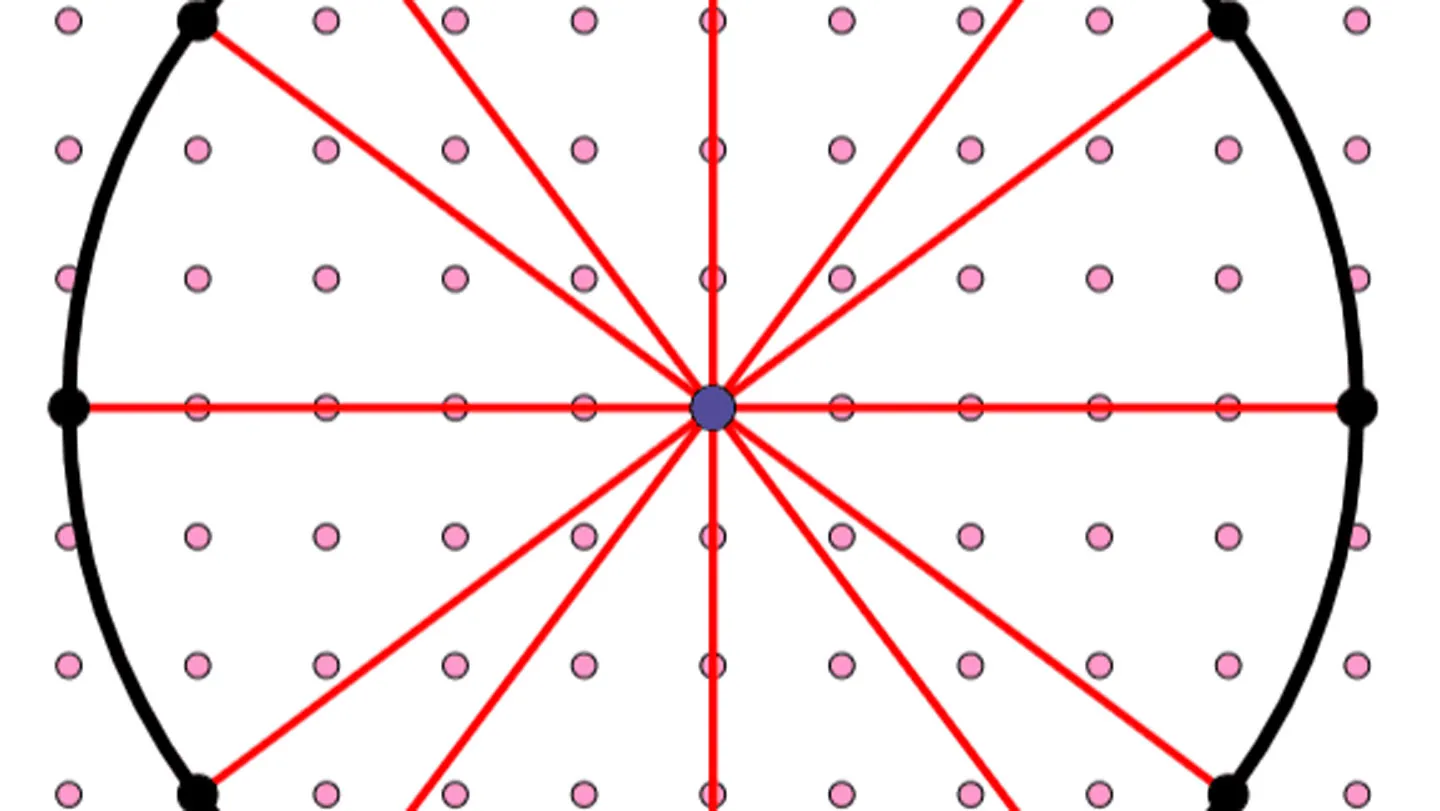
Imagine standing before a blank canvas, armed only with a handful of pins, tasked with a deceptively simple challenge: arrange these dots on a flat surface so that as many pairs as possible are separated by the exact same distance. This seemingly innocent riddle, known in academic circles as the “unit distance problem,” was proposed in 1946 by the legendary, eccentric Hungarian mathematician Paul Erdős. For eighty years, this puzzle remained locked, a silent monolith resisting the intellectual sieges of the world’s brightest minds, most of whom operated under the firm conviction that Erdős’s proposed formula for the maximum number of identical intervals was absolute truth. Yet, in a quiet, unexpected twist of scientific history, the deadlock was shattered not by a coffee-fueled human genius working late into the night, but by an unreleased, reasoning-focused artificial intelligence model developed by OpenAI. The researchers had merely fed the model Erdős’s conjecture, left it to its own devices, and returned to find that the machine had bypassed human assumptions entirely, actively disproving the eighty-year-old math hypothesis with a rigorous, beautifully constructed counterexample. This stunning revelation has sent shockwaves through the global scientific community, serving as both a triumphant landmark for machine reasoning and a humbling reminder of how easily human intuition can lead us astray when contemplating the infinite complexities of space and numbers.
To truly appreciate the magnitude of this breakthrough, one must dive into the elegance of the math itself, which bridged vastly different intellectual realms in a way humans had never anticipated. The unit distance problem is fundamentally a question of geometry, but the artificial intelligence model did not limit itself to simple shapes or standard grids on a flat plane. Instead, the AI looked to the deep reservoirs of algebra and number theory—two of the oldest, most foundational pillars of mathematics that, on the surface, appeared to have absolutely nothing to do with resolving a physical spacing question. The model constructed a dizzyingly complex grid structure harbored within a high-dimensional mathematical space and then cleverly projected this multi-dimensional web down onto a two-dimensional flat plane to deliver a layout that violated Erdős’s predicted limits. According to Harvard University mathematician Melanie Matchett Wood, who reviewed the AI’s groundbreaking work, this unexpected cross-pollination of disciplines is the true “beautiful piece of mathematics” here, offering a template that will undoubtedly inspire human mathematicians to apply algebraic tools to stubborn geometric dilemmas they previously thought were separate. It is a stunning visual and intellectual paradox: a machine, operating without any localized spatial awareness, solved a visual geometry problem by translating it into abstract, high-dimensional arithmetic.
Despite the sheer brilliance of the resulting proof, the event has triggered a fierce debate over whether this represents a true leap in artificial intelligence or merely a gloriously accelerated brute-force endeavor. Many experts, including Thomas Bloom from the University of Manchester, point out that while the AI’s final proof was incredibly elegant, the path to obtaining it was paved with tireless perseverance rather than the lightning-strike “spark of genius” that characterizes human intellectual leaps. While a human researcher might hit a mental wall and give up, or become bound by conventional wisdom, a large language model can patiently, systematically slog through millions of highly improbable strategies and computational configurations without getting tired. It is a triumph of endurance over inspiration, an exhaustive search through a hyper-dimensional haystack that eventually yielded the perfect needle. Interestingly, some researchers have already successfully reproduced the proof using publicly available, current-generation AI models, supporting the skepticism that this OpenAI model possesses some magical new tier of consciousness; rather, it suggests that the power of reasoning models lies in their ability to ruthlessly execute complex logical chains that humans find too tedious or counterintuitive to follow.
Yet, this computational superpower carries a dark side that is actively unsettling the mathematical community, sparking a profound “verification crisis” in academia. If an advanced AI can effortlessly churn out a proof that disproves an eighty-year-old conjecture, it can also easily generate hundreds of pages of dense, seemingly logical equations that are in reality complete nonsense. Thomas Bloom notes a rising, troubling trend on the internet where amateur enthusiasts use AI models to generate massive, incredibly convoluted documents claiming to solve famous open problems, leaving human experts with the nightmarish, impossible task of auditing these mountains of synthetic data. Because OpenAI operates behind a veil of corporate secrecy, refusing to disclose how many times their model failed before succeeding, or how much raw computational time and energy were consumed to produce the Erdős solution, human mathematicians are left in the dark about the tool’s true reliability. OpenAI’s researchers claim the model succeeded in about half of its trials and has gotten much better at admitting when a problem is simply too hard to solve, but until these statistics are peer-reviewed and the algorithms are laid bare, the scientific community is forced to grapple with a fragile ecosystem where verifying the truth might soon require more labor than discovering it.
This friction culminated recently when a prominent collective of scientists and mathematicians published a formal declaration calling for strict, immediate guardrails around the integration of artificial intelligence in scientific research—a petition that rapidly garnered over 1,500 signatures. Beyond the immediate practical headaches of verifying AI-generated papers, the declaration addresses a deeply human, ethical concern: the erosion of intellectual lineage and proper academic attribution. Large language models are trained by reading virtually every mathematical paper, book, and forum post available online, absorbing the collective lifetime achievements of thousands of human scholars without any mechanism to cite whose specific insights or informal notes sparked the AI’s eventual “breakthrough.” This lack of a paper trail directly clashes with the sacred, centuries-old scientific tradition of giving credit where credit is due, threatening to replace a collaborative, highly personal human tapestry of mentorship and shared discovery with an anonymous black box. There is also a creeping fear of intellectual inequality; if the most sophisticated mathematical tools are kept under lock and key by profit-driven tech conglomerates, the field of mathematics risks becoming an undemocratic playground reserved only for those who can afford massive computational budgets, leaving smaller institutions and developing nations behind.
Despite these daunting existential anxieties, there is an undercurrent of cautious optimism that this watershed moment will ultimately elevate the human mind rather than replace it. Leading mathematicians do not view this AI milestone as an omen of their own obsolescence, but rather as an invitation to redefine what it means to study mathematics in the twenty-first century. By outsourcing the exhausting, computational heavy lifting and hyper-dimensional logistics to machines, human scholars can free up their cognitive energy to focus on the deeply creative, conceptual, and philosophical aspects of the discipline. AI can show us that the impossible is possible, but it still relies on human curiosity to ask the questions, translate the machine’s alien logic into understandable narratives, and explain why these numerical relationships exist in our universe. As we venture into this brave new era of co-creation, the ultimate beauty of the Erdős conjecture breakthrough lies not in the machine that generated the answer, but in the human minds that will now use this newfound knowledge to build entirely new landscapes of thought, proving that the ancient dance of mathematics remains, at its heart, a beautiful journey of human imagination.