





Paragraph 1: The Illusion of the Simple Proton
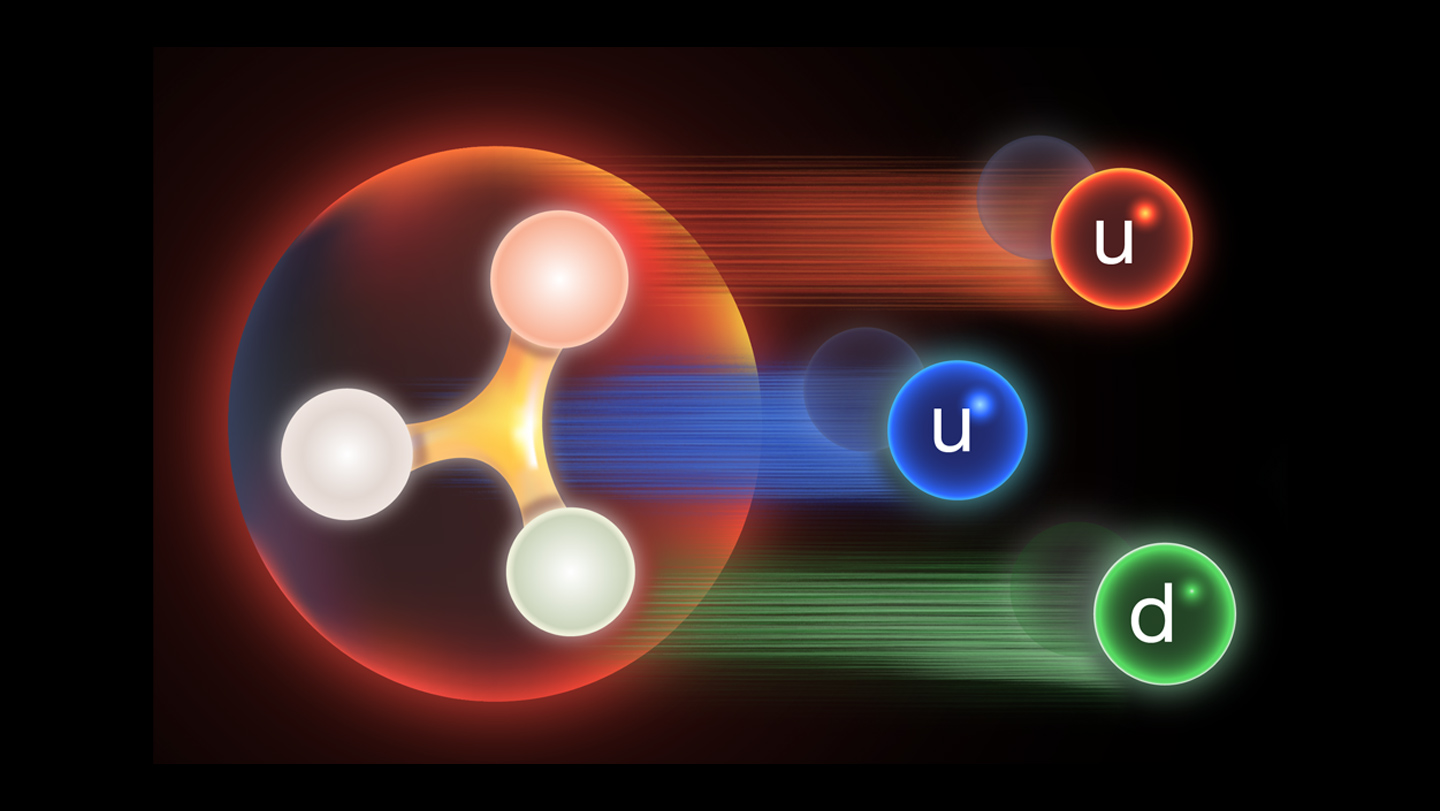
For over a century, we have built our understanding of the universe on a foundational, almost childlike image: the atom, with its central nucleus and orbiting electrons. And if we zoom deeper into that nucleus, we find the proton—a particle so stable it forms the bedrock of all visible matter in the cosmos. In school, we are taught a neat, tidy picture: the proton is a tiny, hard sphere composed of exactly three quarks—two “up” quarks and one “down” quark—bound together by the strong nuclear force. This force is carried by particles called gluons, which act like cosmic superglue, sticking the quarks together. For decades, this simplistic model has been the lens through which physicists have viewed the world. The quarks are the actors, and the gluons are the stagehands, merely facilitating the interactions that keep the proton whole. But this familiar narrative is a comfortable illusion. The proton is not a simple box of three quarks; it is a seething, chaotic, relativistic storm of energy, and the gluons are not passive bystanders. Recent developments in theoretical physics are challenging the very core of our understanding, suggesting that gluons do far more than just glue things together. They may, in fact, be integral to the proton’s most fundamental identity card—a quantum property known as baryon number. This revelation means that the particles we thought of as mere force carriers are actually co-authors of matter’s very existence, reshaping our philosophical and scientific understanding of what it means to “be” a proton.
Paragraph 2: The Cosmic ID Card—Defining Baryon Number
To grasp the profound implications of this discovery, we must first understand the concept of baryon number. In the standard model of particle physics, every particle is defined by a set of quantum numbers—intrinsic properties that dictate how it interacts and behaves. Baryon number is one such property, and it serves as a kind of cosmic ID card that distinguishes matter from antimatter. Baryons are composite particles made of three quarks, such as protons and neutrons. By convention, each quark has a baryon number of +1/3, and each antiquark has a baryon number of -1/3. Therefore, a proton, composed of three quarks, possesses a total baryon number of +1. Correspondingly, an antiproton, made of three antiquarks, has a baryon number of -1. This number is not just an arbitrary label; it is a deeply conserved quantity in all known physics interactions. This conservation law—the absolute rule that the net baryon number in a closed system remains constant—is the primary reason why protons are so extraordinarily stable. They cannot simply decay into lighter particles like electrons or photons because such a decay would violate the conservation of baryon number. The cosmic ledger must always balance. If we look at the observable universe, we see that it is overwhelmingly filled with matter (positive baryon number) and almost devoid of antimatter (negative baryon number). This asymmetry is a massive unsolved mystery, and the stability of baryon number is the sentinel that protects the universe from spontaneously reverting to a soup of energy. In the simplest textbook model, the baryon number is a simple count of the quarks. But as we delve deeper into the quantum realm, we discover that this arithmetic is far more subtle than it appears. The proton is not a static sculpture of quarks, and its identity might not be merely the sum of its parts.
Paragraph 3: Diving into the Quantum Sea of QCD
The simplistic image of a proton with three static quarks collapses under the scrutiny of Quantum Chromodynamics (QCD), the quantum field theory describing the strong force. QCD is a notoriously difficult and wild theory, primarily because of its property of “asymptotic freedom”—the strange phenomenon where quarks interact weakly at extremely short distances but interact increasingly strongly as they are pulled apart. Because of this, the quarks inside a proton are never inert. The vacuum of space itself isn’t truly empty; it is a roiling sea of virtual particles constantly popping in and out of existence. Inside the proton, this boils down to an environment of frantic activity. The three “valence” quarks are constantly emitting and absorbing gluons. These gluons can momentarily split into quark-antiquark pairs, creating what is known as a “sea” of temporary quarks. This isn’t a rare occurrence; it happens incredibly frequently. As a result, the proton is an emergent phenomenon—a dynamic, fluctuating cloud of quarks, antiquarks, and gluons. In this chaotic environment, the concept of a discrete, countable set of quarks becomes blurred. The gluons themselves, which outnumber the valence quarks by a massive margin, are not just passive messengers; they carry color charge and interact with each other. They form a dense, self-interacting lattice of energy. When physicists attempt to calculate the total properties of the proton—such as its mass, spin, and momentum—they find that the contributions of the valence quarks are only a small fraction of the total. Over 90% of the proton’s mass is generated by the kinetic energy of the gluons and the sea quarks. This tells us that the proton is not defined by its constituent particles in the classical sense, but rather by the intensely complex dance of the fields themselves. This leads to a profound question: if the sea quarks and gluons dominate the physical properties, do they also dictate the fundamental quantum numbers?
Paragraph 4: The Topological Twist—Glue that Counts
For years, physicists mathematically avoided a messy contradiction. While the baryon number of the valence quarks was clear, the sea of quark-antiquark pairs created and destroyed by gluons introduced a complex problem: how do we accurately count the net quarks when there is a constant churning of the vacuum? The answer lies in the mathematical structure of the gluon field itself. In QCD, the gluon field is not just a smooth, simple force field; it can twist, knot, and turn in complex ways. These configurations are known as “topological” structures. In the 1970s, physicists like Gerard ‘t Hooft discovered “instantons”—localized, sudden fluctuations of the gluon field that cause a profound effect. These gluon fluctuations interact with the quark fields via a phenomenon known as the chiral anomaly. Through this anomaly, a specific configuration of the gluon field (the instanton) can effectively change the quantum state of the vacuum, causing a transition that involves the creation or annihilation of a quark. But here’s the catch: the baryon number is supposed to be strictly conserved. To reconcile this, physicists realized that the mathematical definition of the baryon number operator cannot just look at the quarks; it must also include a term that explicitly depends on the gluon field itself. This means that the gluons, through their topological twists, carry a “portion” of the baryon number. They are not merely enforcing the rules of the cosmos; they are actively participating in the accounting. When an instanton causes a gluon field to twist, it momentarily “steals” a quark’s baryon number, or “lends” it to the vacuum. The crucial takeaway is that the gluons are not just holding the quarks together—they are part of the very algebraic equation that defines whether the proton is a proton (matter) or an antiproton (antimatter). The identity of the proton is not exclusively dictated by the three valence quarks any longer; it is a composite property woven from both the quarks and the topological structure of the gluon field.
Paragraph 5: A Human Analogy—Defining the Storm
To humanize this mind-bending physics, imagine a hurricane. If we ask, “What is the identity of the hurricane?” a naive observer might point to the collection of air molecules (the quarks). They might say, “A hurricane is just billions of oxygen and nitrogen molecules moving quickly.” But that is incomplete. The actual identity of the hurricane—its spinning structure, its eye, its category, its very existence as a “hurricane”—is defined by the wind patterns, the pressure gradients, and the rotational dynamics (the gluons). Without the specific topological twist of the air currents, the molecules would just be a puff of breeze. The identity isn’t in the molecules; it is in the field dynamics. Now, apply this to the baryon number. The classic view says the “number of air molecules” is the identity. But the new physics says the specific curling and spiraling of the wind—the gluon knots—also contributes to the count of molecules. In a more personal sense, consider a family or a community. The residents are the quarks—finite and countable. But the identity of the community isn’t just the census data. It’s the shared culture, the interactions, the bonds of trust, and the invisible rules that govern the group. The gluons are those social bonds. And now, physics is telling us that these bonds—these social interactions—aren’t just tying the residents together; they are actually altering the legal definition of who counts as a resident and what their social security number (baryon number) is. The proton is thus not a tiny box of three balls; it is a self-energizing ecosystem, a veritable vortex of quantum reality where the glue defines the actor. The baryon number is not a static label on the quarks; it is a dynamic property of the whole swirling system, heavily influenced by the invisible structure of the glue.
Paragraph 6: Rethinking the Universe and Our Place in It
This revelation fundamentally shifts our perspective on the universe. It tells us that matter is not simply made of discrete, independent lumps. Instead, matter is an emergent property of interacting fields, where the force carriers are just as essential to identity as the matter particles they bind. This has profound implications for cosmology. The great mystery of baryogenesis—why the universe has more matter than antimatter—might find its resolution in the behavior of these gluonic fields. In the chaotic, high-energy conditions of the infant universe, the topological twists of the gluon field (instantons and other sphaleron events) could have provided the mechanism to violate baryon number conservation, tipping the scales in favor of matter. The gluons, acting as the “genetic material” of the vacuum, may have actively created the matter asymmetry we see today. On a philosophical level, this dissolves the classic reductionist approach. We can no longer look at a proton and simply sum its constituent parts. The identity is fluid, distributed across the field. As we continue to probe the depths of QCD, we learn that the universe is far more interconnected and holistic than we ever imagined. The insight that gluons contribute to the baryon number is a humbling reminder that the distinction between “matter” and “force” is artificial. The proton’s existence—its very charge of matter-hood—is a testament to the complex, interwoven dance of quarks and gluons. We are not just made of tiny blocks; we are made of immense, dynamic equations of energy and topology. The glue that holds us together does not just bind us; it defines us.