


Paragraph 1: The Unruly River of Mathematics
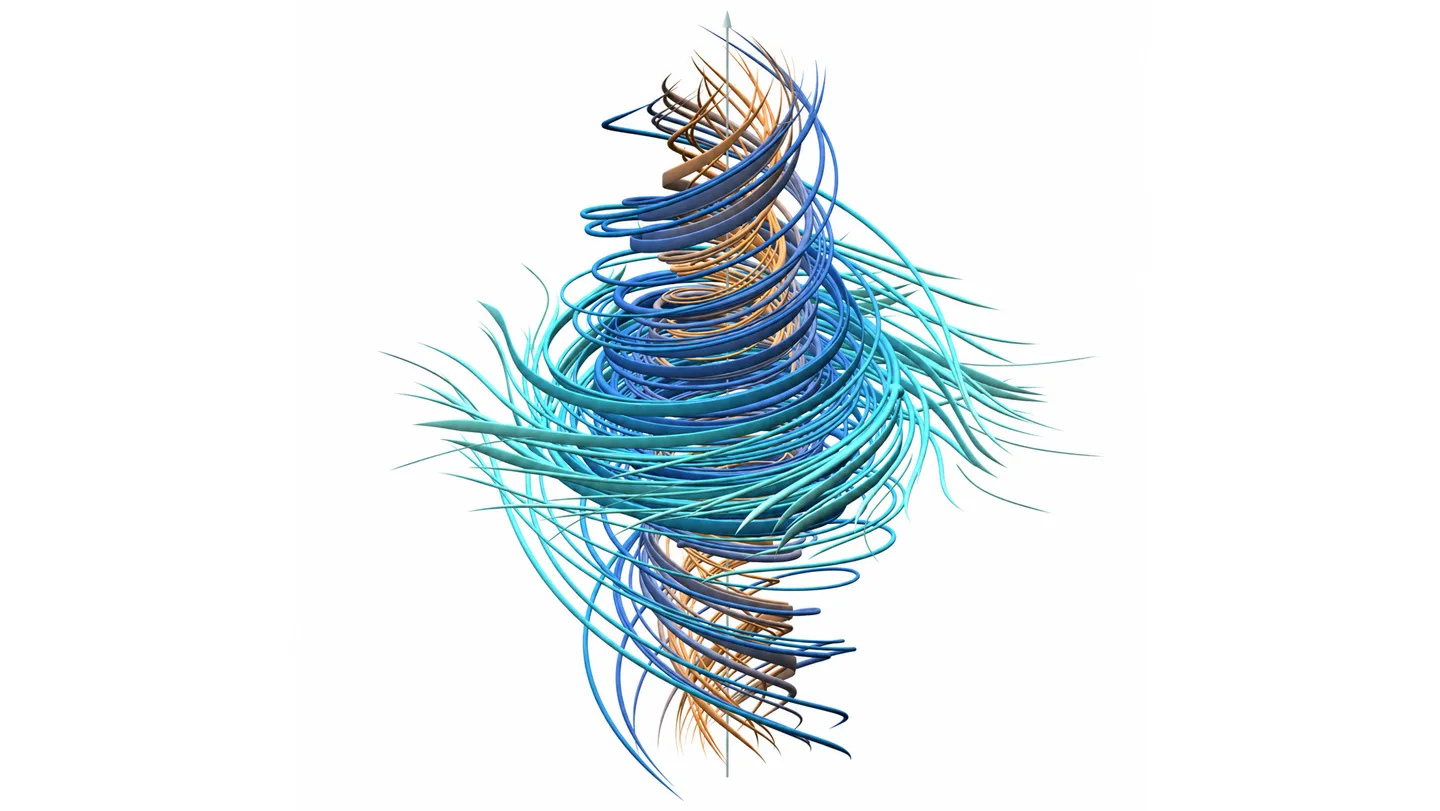
There is a quiet, almost poetic obsession that has haunted the highest echelons of mathematics and physics for over a century. It begins with something we all witness every day—the swirl of cream in a cup of coffee, the chaotic tumble of a mountain stream, the invisible eddies of air buffeting an airplane wing. These are not just random movements; they are the physical manifestation of the Navier-Stokes equations. For generations, these equations have served as the grand, complex rulebook for fluid dynamics, capable of describing everything from the blood coursing through our veins to the violent fury of a hurricane. On paper, they look deceptively simple—a handful of symbols that balance momentum, pressure, and viscosity. Yet hidden within this elegant mathematical skeleton lies a terrifying question that has turned the most brilliant minds into insomniacs: do these equations actually always work? Or do they reach a point of catastrophic failure—a “blow-up” where the numbers spiral into infinity, rendering the math useless and our physical predictions void? This is not a trivial academic puzzle. It is a Millenium Prize Problem, a one-million-dollar bounty offered by the Clay Mathematics Institute, a graveyard of careers, and a testament to how much we still don’t understand about the simple act of water flowing. For decades, human mathematicians—armed with chalk, intuition, and sleepless nights—have beaten against this wall, trying to prove that the equations hold up under all conditions, or to find the subtle, cruel scenario where the universe breaks its own mathematical legs.
Paragraph 2: The Lonely Titans and the Silent Swarm
For years, the fight against the singularity was a human fight. Imagine the great minds of the twentieth and twenty-first centuries—rival mathematicians in different countries, each convinced they had found the fatal flaw or the saving grace. They would spend years crafting proofs, only to find a flaw on page eighty of a manuscript. They would run simulations on supercomputers that would chug and wheeze for weeks, only to crash as the numbers grew violently large. It was a slow, methodical, and often heartbreaking war of attrition against a torturously non-linear system. The problem is that fluids are inherently chaotic; a slight change in a tiny vortex can cascade into a massive change in the overall flow, making it almost impossible to guarantee stability over infinite time. But now, the battlefield has shifted. The lonely titan with a chalkboard has been joined by a silent, tireless legion: the agents of OpenAI. Instead of a single human mind or a single computer program, OpenAI has unleashed thousands of autonomous AI agents onto this problem. These aren’t just one large language model answering a question once. These are digital collaborators, a veritable swarm of problem-solvers, each one exploring different angles, testing different boundary conditions, and conversing with one another in rapid-fire algorithmic dialogue. It is the equivalent of filling a monstrous library with ten thousand hyper-intelligent graduate students who never sleep, never eat, and never suffer from ego, all working simultaneously to crack the world’s toughest math problem.
Paragraph 3: Inside the Digital Brainstorm
To humanize the process, imagine walking into a colossal, chaotic research institute. The main hall is a cacophony of debate, but instead of human voices, it’s the rapid exchange of data packets. In one corner, an “explorer” agent is tasked with imagining the most bizarre boundary conditions possible—what happens if a fluid hits a perfect corner at a specific speed? What if viscosity is inverted? In another corner, a “verifier” agent is scrutinizing the logical steps of a proposed proof, looking for the infinitesimal gap that would invalidate a thousand preceding steps. A third group acts as “historians,” scouring the vast archives of prior human attempts, matching them against current hypotheses. These agents aren’t just using brute-force arithmetic; they are engaging in a form of synthetic creativity. They generate ideas, test them immediately in a simulated environment, and if they fail, they learn and mutate their approach. This mirrors the very human process of brainstorming, but amplified a million-fold. Where a human mathematician might take a year to explore ten potential avenues, this swarm can explore ten million in the same amount of time. It is a cognitive expansion pack for the human mind. The AI isn’t necessarily thinking in terms of “beauty” or “elegance” the way we do, but it is desperately, obsessively looking for the breaking point—that specific, hideous configuration of velocity and pressure that causes the mathematical fabric to tear, revealing a singularity where the equations can no longer describe reality.
Paragraph 4: The Philosophical Echo and the Fear of Replacement
This shift from the solitary genius to the digital hive minds forces us to confront a deeply uncomfortable, existential question. If OpenAI’s thousands of agents crack the Navier-Stokes problem, what does that say about the nature of mathematical discovery? For centuries, the discovery of a proof was considered the highest form of human creativity, a dance between intuition and logic that felt almost spiritual. It was a reflection of the human soul, complete with its quirks, biases, and flashes of divine insight. When a machine achieves this, we have to ask: has it merely performed a high-speed search of a giant solution space, or has it truly understood the problem? The human emotional reaction is a mixed bag. There is immense relief that the tiresome waiting is over, excitement for the applications that will follow, but also a pronounced sense of grief. It feels like watching a beloved marathon runner, who spent decades training, being overtaken by a robotic cheetah that doesn’t sweat or feel the burn in its lungs. The solution, found by a swarm of agents, is likely to be ugly by human standards—a sprawling, computational proof that is technically correct but impossible for a single human being to grasp in its entirety. It will lack the poetic brevity of a Erdős or a Ramanujan. We will file it away in a digital vault, symbolized by a binary string, rather than a handwritten manuscript. This is the humanization of a potential tragedy: we might finally get our answer, but the answer might not belong to us in the way we always dreamed it would.
Paragraph 5: The Tangible Stakes and the Safety of the Skies
But beyond the lofty philosophical debates, there is a very real, very gritty reason why this question about breaking points matters to the person sitting in their living room, reading about the weather or boarding a flight. The Navier-Stokes equations are not just academic abstractions; they are the backbone of our modern technological infrastructure. If they break down under extreme conditions—if they generate singularities where the math must fail—it means our predictions might be fundamentally flawed at the edge of known parameters. For an engineer designing a supersonic jet, a singularity could represent a condition where turbulent flow becomes so violent that the standard models of drag and lift no longer apply, a scenario that could lead to catastrophic structural failure. For climate scientists, a breakdown might mean that under the extreme heat of a runaway greenhouse effect, our models of atmospheric flow become useless, unable to tell us when a storm will hit or how far the sea levels could realistically rise. The search for a breakdown isn’t about destroying the beauty of the equations; it’s about finding the safety rail. It is the difference between sailing a ship with a map that says “here be dragons” and actually charting the location of the reef. If the AI agents find a counterexample—a specific scenario where the equations explode into infinity—we can build safeguards around that scenario. If they prove the equations are globally stable, we can trust our simulations with absolute, unwavering confidence. Either way, the frantic work of these digital workers is directly tied to the physical safety of our bodies: the planes we fly, the water we drink, and the storms we hope are accurately forecast.
Paragraph 6: The Dawn of a New Age of Discovery
As the swarm of OpenAI agents continues its relentless search, the world waits with bated breath. We don’t know yet whether they will find the needle in the mathematical haystack—whether they will present us with a decade-old proof they’ve rediscovered, a new counterexample hiding in the corner cases, or a definitive proof of stability that has eluded us for so long. But regardless of the outcome regarding the equations themselves, something monumental has already occurred: the paradigm of human problem-solving has permanently shifted. The use of thousands of autonomous agents represents a collaboration that scales beyond the capacity of any single brain, yet is driven by the original directive of the human engineers who built it. It suggests a future where the hardest questions in science—dark matter, quantum entanglement, the origin of consciousness—might not be answered by a single “eureka” moment, but by the grinding, relentless coordination of millions of calculated “Ah-has” from AI. We are entering an age of intellectual democracy where the wisdom of the crowd is no longer limited to people. The story of Navier-Stokes, once a story about the limits of fluid mechanics, has evolved into a story about the limits—and the expansion—of intelligence itself. Whether the equations ultimately break down or hold firm, the walls of human mathematical dogma have been broken down, and the fluid of digital thought is rushing in. The answer, when it comes, will be a testament not just to the power of code, but to the audacity of human curiosity that asked the question in the first place—and then built an army to answer it.