



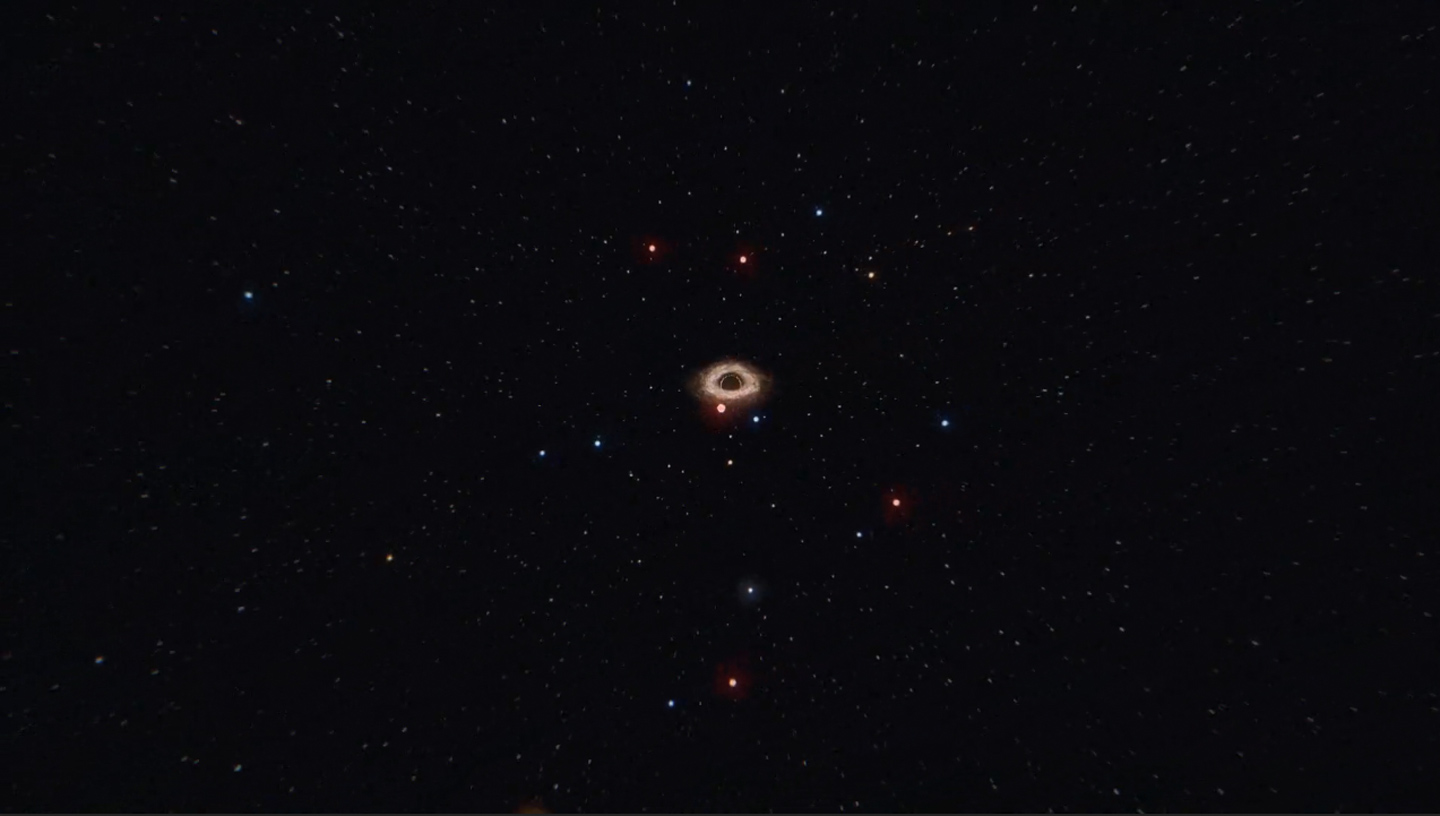
There’s a new speed demon in the Milky Way, and it has just given astronomers something to cheer about. The star, cataloged as S301, tears through space at a dizzying 25,000 kilometers per second — roughly 8 percent of the speed of light. That alone would make it one of the fastest objects ever seen. But its real claim to fame is where it lives. S301 orbits dangerously close to Sagittarius A*, the supermassive black hole at the center of our galaxy, making it the closest stellar companion to that gravitational monster ever discovered. This isn’t just a cosmic curiosity. The star’s location and motion turn it into a natural probe, a kind of living sensor that could reveal one of the black hole’s most stubborn secrets: how fast it spins. Astronomers have been hunting for such a star for decades, and now that it has appeared, their excitement is palpable. “The star which we have discovered has such a great potential, and we’re really all excited about it,” says Stefan Gillessen of the Max Planck Institute for Extraterrestrial Physics in Garching, Germany, one of the researchers behind the find. The discovery, reported in Nature on August 19, is the kind of breakthrough that reminds us how much of the universe still waits to be understood. It is also a reminder that even the most familiar parts of the cosmos, the night sky we have looked at for centuries, are still full of surprises.
What makes S301 so special is not just its speed but its orbit, a long, narrow loop that carries it closer to the black hole than any known star. The star is about 50 percent larger than the Sun, so it is not a shy little object; it is a massive, bright traveler that happens to have picked the most extreme address in the galaxy. It was first spotted in images taken in 2023, but astronomers did not jump to conclusions. They combined those images with two more years of observations and with historical data stretching back to 2017, carefully mapping the star’s path through space. What emerged was an 8.7-year orbit that swings S301 within just 1.7 billion kilometers of Sagittarius A* — a distance only slightly farther than Saturn’s orbit around the Sun. For a star circling a black hole, that is practically skimming the edge. The discovery was made by the GRAVITY+ collaboration, a team that uses the European Southern Observatory’s Very Large Telescope Interferometer in Chile. This remarkable instrument combines light from multiple telescopes to see objects four billion times fainter than the human eye can detect. It is like having a cosmic magnifying glass so powerful that it can watch individual stars dance around an invisible void, capturing details that were unthinkable just a generation ago. The patience and precision required to find and track S301 are staggering, and they reveal how far astronomy has come.
The big prize here is not the star itself but what it can tell us about the black hole. Scientists have already measured Sagittarius A’s mass, which is about four million times the mass of the Sun, by watching the orbits of stars around it. But mass is only half the story. Spin is the other half, and it has been far more difficult to pin down. A black hole’s spin is written into the shape and behavior of the space around it. If Sagittarius A is rotating, it should subtly twist and drag spacetime along with it, a phenomenon predicted by Einstein’s theory of general relativity. That twisting would gradually alter the orbit of a nearby star, causing its path to wobble or shift in a measurable way. The effect is tiny, which is why scientists need a star as close as S301. Its orbit is so tight that the black hole’s rotation should leave a visible fingerprint on the star’s motion over time. By tracking S301 year after year, astronomers will eventually gather enough data to calculate the black hole’s spin directly from the orbit itself. Gillessen and his colleagues estimate that this could happen within the next fifteen years or so. That might sound like a long wait, but in astronomical terms it is the blink of an eye, especially for a measurement that has eluded scientists for decades.
Why does spin matter so much? Because a black hole’s spin is essentially a record of how it lived. A fast spin suggests that the black hole has been feeding in a steady, orderly way, pulling in material from a smooth, consistent source over long periods. A slower spin, on the other hand, suggests a more chaotic history, a black hole that grew by swallowing clumps of gas and stars from all directions, like a diner grabbing random bites from a messy buffet. That distinction is not just a detail for physicists; it helps astronomers understand how supermassive black holes grow and how they shape the galaxies around them. Spin is also thought to influence the powerful jets and winds that black holes sometimes blast into space. Those outflows can heat gas, push material around, and even regulate the birth of new stars in a galaxy. So learning how fast Sagittarius A* spins is not just about understanding one object. It is about understanding the hidden engine at the heart of our galaxy and how it has affected everything around it over billions of years. This is why the discovery of S301 has generated so much excitement among astrophysicists. It offers a rare chance to connect a black hole’s past to its present, and to read the story of the Milky Way in the motion of a single star.
Other methods for measuring black hole spin exist, but they come with complications. One approach looks at X-rays emitted by superheated gas swirling near some black holes; another uses gravitational waves produced when two black holes collide. Both have been valuable, and both have taught scientists a great deal. But they are indirect measurements, dependent on models and assumptions that leave room for debate. “They’re still, in my opinion, good measures, but they are indirect,” says astronomer Christopher Reynolds of the University of Maryland in College Park, who was not involved with the study. “This [star] gives us the opportunity to make a much more direct measurement.” Laura Brenneman, an astrophysicist at the Harvard-Smithsonian Center for Astrophysics who also was not part of the team, agrees that spin carries deep meaning. A fast spin, she explains, suggests the black hole has been consuming material in a regular manner, while a slower spin indicates it fed from a more chaotic buffet. The direct measurement that S301 makes possible would be a major step forward, offering a cleaner, more reliable number than anything derived from distant X-rays or gravitational wave events. It would also bring Einstein back into the conversation. General relativity makes specific predictions about how a black hole should spin, including a maximum limit. If Sagittarius A* turns out to have no spin at all, or somehow exceeds that limit, the theory would face a serious challenge. Scientists do not expect such a surprise, but the possibility is part of what makes the chase so thrilling.
In the end, this discovery is about more than a single star or a single black hole. It is a story of human curiosity and persistence, of teams working across borders and decades to piece together the story of the cosmos. S301 has been flying around the center of the Milky Way for millions of years, silent and unnoticed, while humans built telescopes, developed theories, and learned to ask the right questions. Now, finally, we can watch it. We can measure its orbit, feel its speed, and use it as a key to unlock one of the most mysterious objects in the universe. The black hole at the center of our galaxy is not a simple void; it is a dynamic, spinning giant that has shaped the Milky Way in ways we are only beginning to understand. And thanks to this newly discovered star, we are closer than ever to seeing it clearly. The next fifteen years will be an exciting time for astronomers, as S301 slowly reveals the black hole’s hidden spin through the patient, almost poetic dance of its orbit. It is a beautiful reminder that the universe does not give up its secrets easily, but it does give them up to those who watch closely, think carefully, and wait with wonder. In a cosmos full of speed and chaos, this one star has become a quiet messenger from the edge of a black hole, carrying news we are only now ready to hear.