

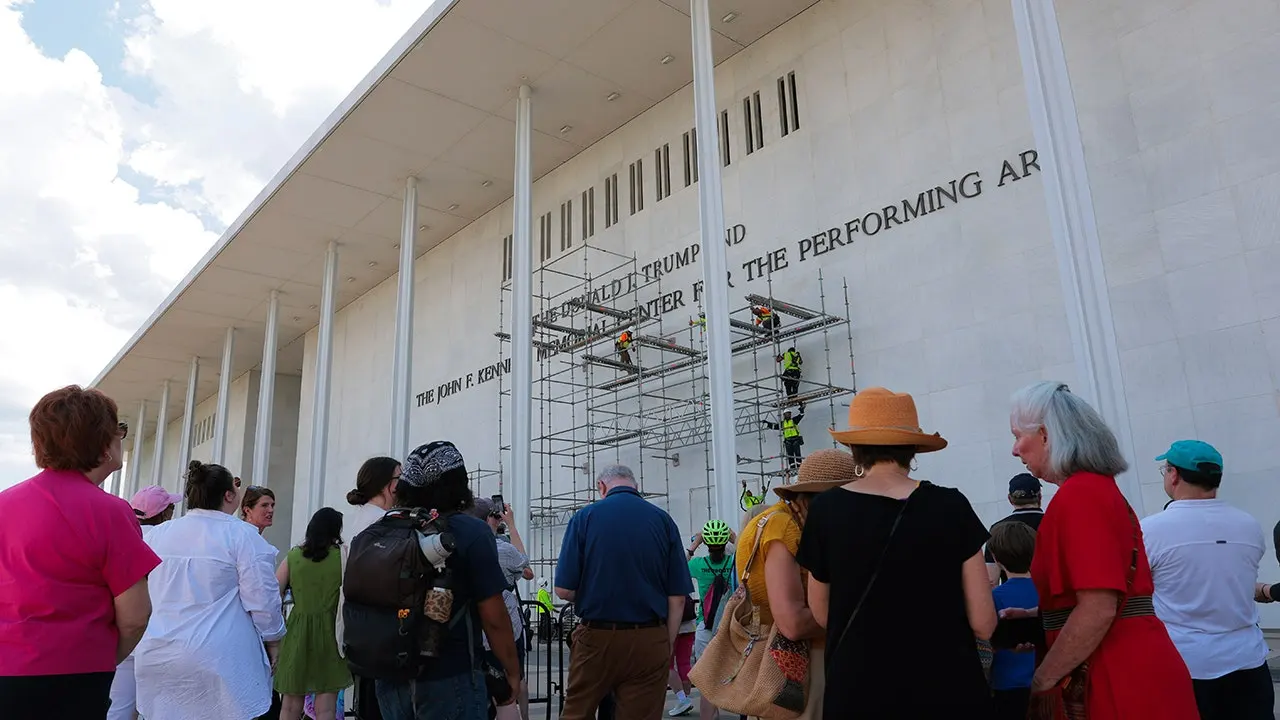
As the sun began to dip below the horizon on a tense Friday in Washington, D.C., casting a warm amber glow over the Potomac River, the grand, marble-clad facade of the John F. Kennedy Center for the Performing Arts became the backdrop for a high-stakes legal and cultural showdown. Nearby, industrial metal scaffolding grew like a web around the building’s exterior, signaling the physical manifestation of a fierce institutional battle. High above the entrance, brass letters spelling out the name of former President Donald Trump remained bolted to the stone, a stark visual symbol of a bitter dispute that has divided the center’s leadership and local politicians. Just hours after the Kennedy Center’s governing board filed an emergency petition desperately seeking to pause a federal court order to strip the Trump branding from the facility, a three-judge panel of the U.S. Court of Appeals for the District of Columbia Circuit dealt a swift blow to the board’s efforts. By denying an immediate administrative stay, the appellate court signaled that the physical identity of one of America’s most treasured cultural landmarks would have to undergo a rapid, court-mandated stripping of the Trump name even as the legal battle over its long-term future rages on in the background.
This dramatic confrontation in the appellate courts is the latest chapter in a wider ideological war over who holds ultimate authority over the naming rights of America’s premier national civic spaces. At the heart of the current legal battle is a May 29 ruling by U.S. District Judge Christopher Cooper, who determined that the Kennedy Center board had vastly overstepped its bounds when it voted to append the former president’s name to the historic venue. In a detailed and legally rigorous opinion, Judge Cooper made it perfectly clear that when Congress established the cultural center in the mid-20th century, it specifically dedicated the institution to the enduring legacy of President John F. Kennedy, intending the name to remain a permanent national tribute. According to Cooper’s interpretation of the governing statute, only the United States Congress possesses the constitutional power to alter the official name of the property, leaving the board’s unilateral decision to rename it the “Trump-Kennedy Center” legally null and void. In his subsequent refusal to issue a stay, Cooper rejected the board’s plea to halt the transition, setting a strict 14-day timeline for the physical and digital eradication of the Trump name from all signs, pamphlets, and official branding—a countdown that has forced the center into an uncomfortable race against the clock.
In their urgent appeal to the D.C. Circuit, lawyers representing the Kennedy Center board painted a picture of administrative chaos and financial waste if they are forced to comply with the order immediately. The board argued that the physical labor required to dismantle the custom-made signage on the building’s exterior, alongside the cost of updating digital portals and promotional materials, would drain vital resources that could never be recovered from the government if they ultimately win their appeal on the merits. They characterized the forced removal as a premature disruption that could damage ongoing philanthropic efforts, disrupt operations, and breed immense public confusion if the name is stripped now, only to be re-installed later following a successful appeal. Furthermore, the board’s legal team raised significant constitutional questions regarding whether Representative Joyce Beatty, the Democratic congresswoman from Ohio who initiated the lawsuit, even had the proper legal standing to challenge the board’s decision in the first place, arguing that an individual board member should not have the power to single-handedly overturn a collective, institutional vote in federal court.
On the other side of this high-profile divide stands Representative Joyce Beatty, whose fierce opposition to the board’s decision reflects a deeply held belief about the nature of public monuments and historical preservation. Beatty, who serves as an ex officio member of the Kennedy Center board, has argued passionately that the institution is a public trust belonging exclusively to the American people and the legacy of the nation’s 35th president, rather than a canvas for modern partisan branding. Her legal challenge was born out of a determination to prevent what she and her supporters viewed as a politicization of a space meant to unite Americans through the shared appreciation of the arts. When the district court ruled in her favor, Beatty celebrated the decision as a victory for historical integrity, asserting that the Kennedy Center’s singular identity should never have been leveraged as a political trophy. This clash highlights a deeper cultural anxiety in contemporary America, where the lines between history, public funding, and the polarizing figures of modern politics are increasingly blurred, turning historic preservation into a legal combat zone.
The origins of this controversy stretch back to a controversial, unanimous board vote in December, a decision that was intrinsically tied to a massive financial windfall secured during the Trump administration. According to Roma Daravi, the Kennedy Center’s Vice President of Public Relations, the decision to honor Trump on the building’s exterior was a direct expression of gratitude for a monumental $257 million federal funding package that Trump championed and Congress approved, which was designed to fund urgent major restorations for the aging landmark. Under the board’s direction, fundraising efforts reached historic heights, smashing records with a stunning $23 million haul that far surpassed fundraising totals from the Biden era. Supporters of the renaming pointed to these impressive financial metrics as proof that associating the center with Trump’s legacy was not only a fitting tribute to his administration’s financial patronage but also a powerful catalyst for the venue’s long-term material survival and structural revitalization. From the board’s perspective, appending the name was a pragmatic, appreciative gesture meant to secure the physical future of a national treasure, rather than a divisive partisan statement.
Now, with the appellate court refusing to issue an administrative stay, the board faces a humbling reality as workers prepare to take down the letters under the watchful eyes of the public and the media. While the D.C. Circuit has not yet ruled on the broader request to pause the order for the entire duration of the appeals process, the strict briefing schedule it has introduced—requiring Beatty’s response by June 22 and the board’s final reply by June 29—ensures that the legal debate will carry on into the heat of the summer. In the meantime, the physical landscape of the Kennedy Center must change to reflect the district court’s original directive, leaving the scaffolding in place as a quiet monument to a nation still actively debating how to honor its past while navigating the complex realities of its present. As lawyers prepare their next round of briefs, the empty spaces left behind on the marble walls will serve as a stark reminder of the complicated intersection of art, money, and political power in the heart of the nation’s capital.