






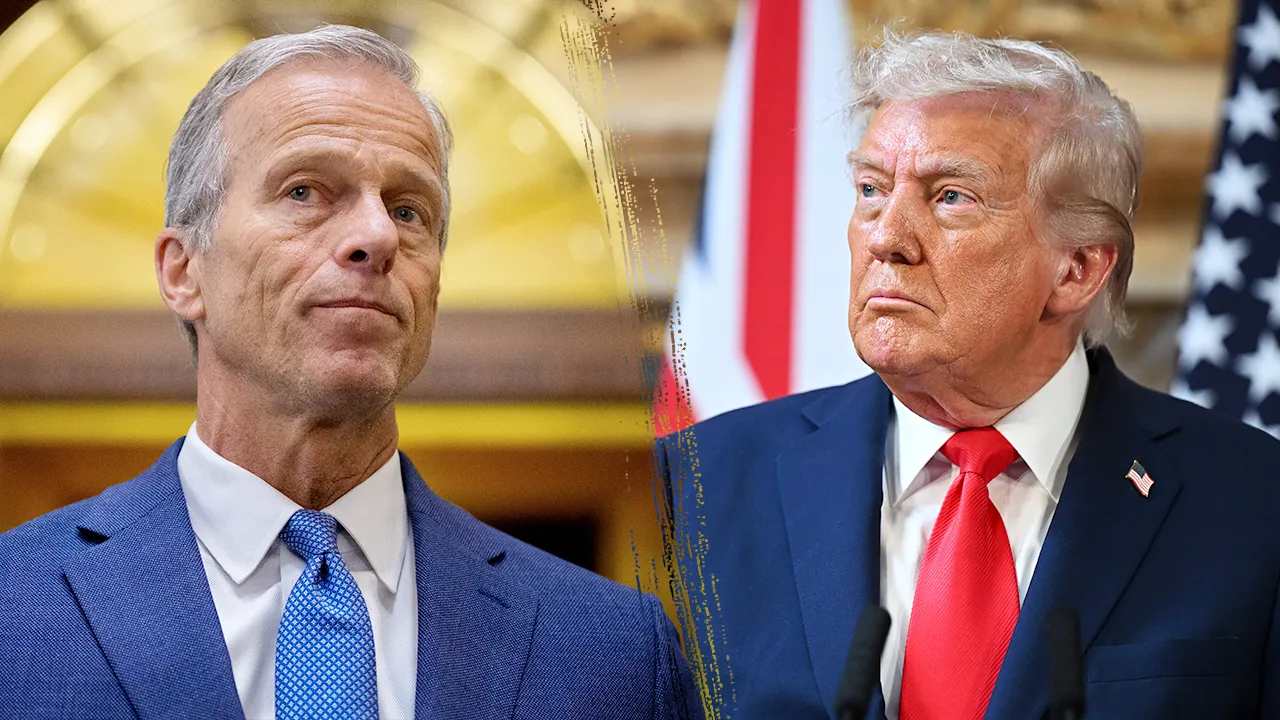
The halls of the United States Capitol have long been home to a delicate, often exhausting dance between raw political ambition and the stubborn constraints of institutional mechanics. Today, that tension is playing out in a deeply personal drama between President Donald Trump and Senate Majority Leader John Thune. For months, Trump has trained his focus on a single piece of legislation, treating the SAVE America Act not just as a policy goal, but as the crowning jewel of his legislative vision and a definitive test of Republican loyalty. For Thune, a soft-spoken institutionalist from South Dakota who inherited the monumental task of leading a fractured Senate GOP, this demand has transformed into a grueling trial of political survival. The growing rift between the two men stems from a rare and risky action in modern conservative politics: Thune has dared to look at the president and say “no.” It is a dynamic that reveals the immense psychological and professional pressure of trying to govern in an era where policy goals are frequently treated as tests of absolute personal fealty. While Trump commands the spotlight with sweeping declarations of what should be done, Thune is left with the agonizing task of counting heads, managing fragile coalitions, and facing the hard, unyielding reality of legislative math. The resulting friction has exposed deep hairline fractures within the Republican Party, revealing a quiet civil war over whether the Senate should remain a deliberative, rule-bound body or transition into an direct instrument of the executive branch’s will.
At the heart of the impasse is the SAVE America Act itself, a sweeping voting and election bill that Trump has championed with absolute, uncompromising vigor. To Trump, the bill represents an essential safeguard for the nation’s democratic processes and a symbolic vindication of his long-standing grievances regarding the electoral system. To Thune, however, the bill is a legislative impossibility under the current rules of the Senate. In a chamber where passing contentious legislation requires a supermajority of sixty votes to overcome a filibuster, Thune simply does not have the numbers. A persistent bloc of moderate Republicans remains unconvinced, while Senate Democrats stand in a unified wall of opposition. When pressed on the president’s insisting assertion that the votes were easily accessible if only the leadership pushed harder, Thune offered a dry, telling assessment: “That must be a different form of math.” This simple phrase highlights the profound disconnect between the two men. Trump approaches governance through the lens of a dealmaker and a populist leader who projects absolute willpower to bend reality to his desires, believing that obstacles are merely proof of a lack of resolve. Thune, conversely, is bound by the cold, unforgiving arithmetic of the Senate floor, where bills live or die by the hard count of individual senators. For Thune, trying to pass the bill without the requisite votes is not just a strategic error; it is a mathematical impossibility that threatens to shut down the government and distract from other critical party victories, such as a historic, record-breaking pace of judicial and administrative nominee confirmations.
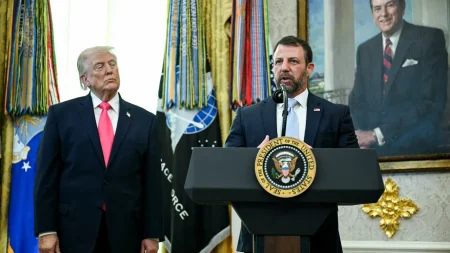
The personal toll of this ideological clash became glaringly apparent on the public stage when Trump openly questioned Thune’s leadership capabilities. Asked by reporters about the stalled progress of the SAVE America Act, Trump did not hold back his frustration, warning that the stagnation was “too bad” for Thune and “too bad for the Republican Party.” More pointedly, when asked if Thune was still the right man to lead the Senate GOP, Trump signaled a dramatic shift from his previous endorsements, offering a chilly, conditional response: “Well, we’re going to find out, and I’ll let you know.” For any politician, but especially for a Senate leader trying to maintain order within a highly volatile caucus, such public wavering from the head of the party is a dangerous vulnerability. The comments immediately triggered a media circus in the corridors of the Capitol. As Thune navigated his way to and from the Senate floor, hounded by a pack of reporters thrusting microphones in his face, the physical and emotional exhaustion of the situation was palpable. When asked to react to Trump’s public warnings, Thune sought to re-establish the constitutional boundary between the president and the legislature, quietly noting that his position was not granted by executive decree. “I don’t know what you say on that,” he replied, keeping his composure under intense pressure. “That’s a decision made by my colleagues.” This quiet deflection illustrated the sheer exhaustion of a modern legislative leader who must constantly translate the high-octane rhetoric of the executive branch into the sober, procedural language of a divided Senate.
Yet, as the pressure from the White House intensifies, Thune has found a vital source of resilience in the quiet, fierce solidarity of his Senate colleagues. Many senators recognize the impossible nature of the hand Thune has been dealt, and they are increasingly willing to say publicly what many will only whisper under their breath. Senator Roger Marshall of Kansas stood firmly in Thune’s corner, insisting to reporters that “it’s wrong to blame Thune for this… This is not his fault.” The defense of Thune is not merely a matter of personal affection; it is an act of institutional self-preservation. Senator Thom Tillis of North Carolina spoke directly to this dynamic, expressing a hope that the current and incoming class of senators would demonstrate “some independence and courage” and recognize the extraordinary skill Thune has shown in navigating an almost impossible political landscape. These senators understand that Thune’s primary job is often to act as a human shield, absorbing the public anger of a demanding president to protect vulnerable members from taking career-ending votes on hopeless legislation. By defying the narrative that Thune is failing, his colleagues are attempting to preserve the Senate’s traditional authority to govern itself, rather than allowing its internal leadership structure to be dictated by public social media posts and television interviews. It is a fragile coalition of traditionalists who believe that the longevity of the American system relies on a Senate that can occasionally slow down, deliberate, and, when necessary, push back against administrative overreach.
To fully appreciate the gravity of Thune’s current struggle, one must look at the immense shadow cast by his predecessor, Mitch McConnell. For decades, McConnell ruled the Senate GOP with an iron grip, insulating his members from public pressure and serving as the ultimate master of parliamentary strategy. When Thune emerged victorious from a crowded, intensely competitive internal election to replace McConnell—fending off strong challenges from Senators John Cornyn of Texas and Rick Scott of Florida—he knew he was inheriting a deeply divided conference in a radically transformed political landscape. The transition of power was a vulnerable moment, and Trump’s current attacks are designed to test the resolve of the new leader. Interestingly, the empathy for Thune’s position extends even to those who recently ran against him. Senator Rick Scott, reflecting on the brutal realities of the job, conceded that leading the Senate GOP under these circumstances is a highly exhausting and often thankless endeavor. “John’s a smart guy,” Scott noted, recognizing the sheer scale of the challenges facing his former rival. “He is working really hard. So I think he shouldn’t — you know, it’s tough to be the leader… We’ve got a lot of issues we haven’t addressed, so it’s hard. I assumed it was gonna be hard.” This rare admission of professional empathy from a political rival underscores a profound truth: the role of Senate Majority Leader has become one of the most punishing and complex jobs in Washington, requiring a leader to balance the demands of a populist base with the unyielding, archaic rules of a centuries-old institution.
Ultimately, the clash between Donald Trump and John Thune is about much more than a single piece of voting legislation; it is a defining struggle over the future of the Republican party and the very nature of American governance. Despite the public undermining and the relentless pressure to capitulate to the president’s demands, Thune has made it clear that he will not be driven from his post, signaling his firm intention to seek another term as the top Republican in the Senate. This quiet defiance represents a crucial stand for the constitutional principle of the separation of powers. It asserts that the Senate is a co-equal branch of government, designed by the Founders to be a cooling saucer that tempers the immediate, populist passions of the executive branch. As the nation watches this political chess match unfold, the ultimate question is whether Thune’s pragmatic approach—defined by a deep respect for parliamentary rules, internal consensus, and basic mathematical realities—can survive in a political ecosystem that increasingly demands absolute submission and views compromise as betrayal. The answer to that question will shape not only the remaining years of Trump’s presidency but will also determine whether the United States Senate retains its historic identity as a deliberate, independent legislative body, or if it will finally yield to the gravitational pull of a centralized presidential power.