
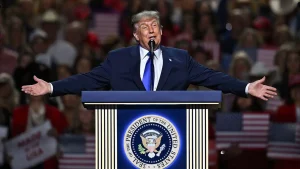





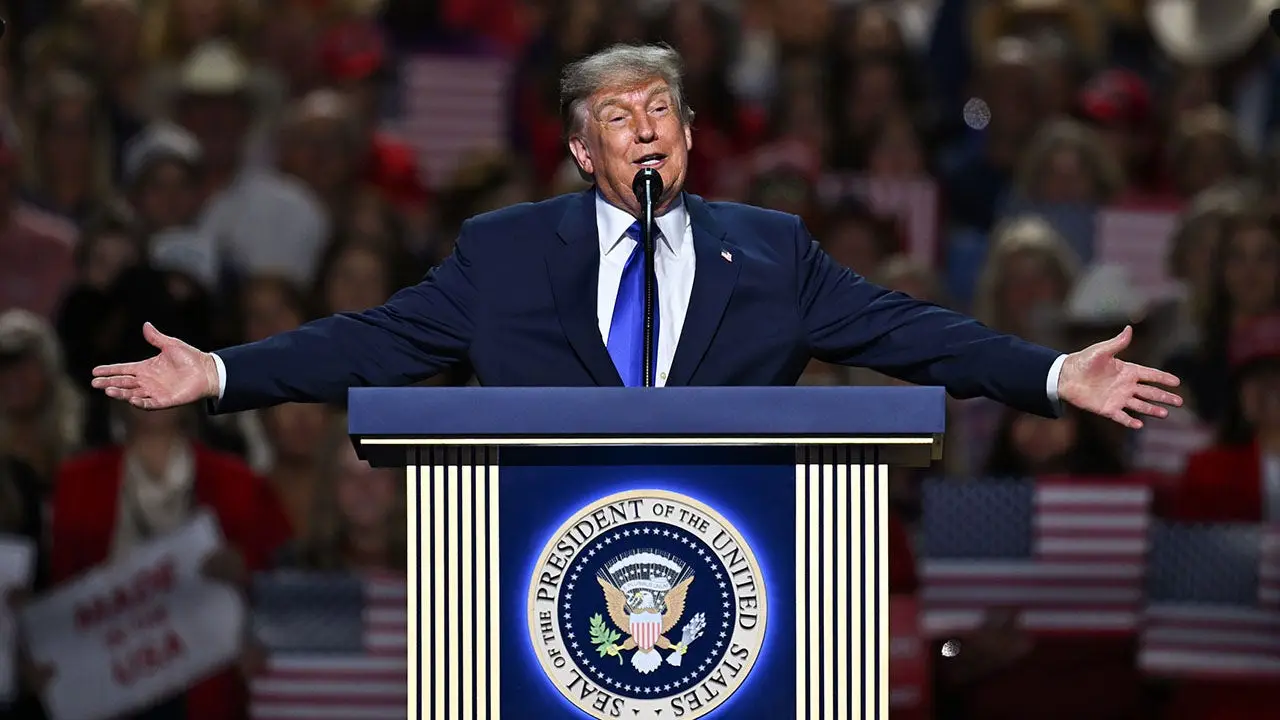
DALLAS — The lights were hot, the crowd was roaring, and President Donald Trump took the stage on the first day of the GOP’s midterm convention looking every bit like a man who refuses to be treated as a lame duck. Instead of a typical convention speech full of policy recaps and poll-tested applause lines, Trump gave supporters something they never expected: a personal promise that sounded more like a corporate shareholder announcement than a campaign rally. “I can make this promise to you, and here is my promise,” he said, leaning into the microphone as the arena leaned in with him. “If the Republicans win the House of Representatives and the United States Senate, both of them, because of our economic — tremendous economic success like in history, we’ve never had anything like what’s happening. But because of our tremendous strength and success economically — I will issue a dividend to every adult citizen in the United States of America for $5,000.” The room erupted. Trump smiled and added the kicker: “It will be called the ‘Trump dividend.’” It was a stunning moment, the kind of promise that has never been made in American political history, and it instantly transformed the convention from a routine midterm rally into something far more personal and high-stakes. Supporters weren’t just being asked to vote for Republican candidates anymore; they were being asked to vote for a share of the national treasure, a payout that Trump framed as a reward for the country’s economic strength. Whether or not the dividend ever becomes reality, the message was clear: Trump was putting his own name, his own legacy, and his own promise on the line in November.
From there, Trump opened his speech by grading his own performance since returning to office in January 2025, and, unsurprisingly, he gave himself high marks. “I’m doing a great job,” he said, drawing cheers from a crowd that seemed eager to agree. But he quickly pivoted to a more reflective and even urgent theme: the historical curse that haunts every president’s party in midterm elections. “But I say, why is it that no matter how well you’re doing, we see not a president — Democrat or Republican — almost never wins the midterms?” Trump asked, his voice carrying a note of genuine frustration. “We’ve got to change that because we have something going that’s so good we can’t let that string be broken. So I’m asking you to pretend that I’m on the ballot. I’m on the ballot, just one more time.” That framing was classic Trump, turning an election about congressional seats into a referendum on himself, but it also reflected a real strategic anxiety. History is not on the GOP’s side, and Republican leaders from Speaker Johnson on down have been quietly trying to downplay expectations. Trump, though, has never been one for quiet downplaying. He doubled down, crediting Republican lawmakers for helping him pass what he called the largest tax cuts in American history and listing the benefits in plain, pocketbook terms. “Our Republican Congress puts thousands of dollars into the pockets of working families with the largest tax cuts in the history of our country,” he said. “So we had the largest in history. We gave you no tax on tips, no tax on overtime and no tax on Social Security for our great seniors.” Then came the warning. If the GOP loses its majorities, Trump warned, all of it would vanish. “Because if we lose, you’re going to lose your border,” he said. “You’re going to lose your tax cuts. You’re going to lose your safety and security. You’re going to lose your wealth.” It was a stark, almost apocalyptic vision, but delivered with the confidence of a leader who genuinely believes the country is on the edge of something great.
Yet for all the soaring promises and triumphant rhetoric, the economic backdrop is more complicated than Trump’s speech suggested. Fox News polling shows that voters are underwater on his handling of the economy, with 65 percent disapproving of his approach to inflation and the cost of living. Those numbers are sobering, and they reflect the real-world pain many families are feeling at the grocery store and the gas pump. Trump did not ignore the elephant in the room entirely. He defended the military conflict in Iran, acknowledging that he has taken criticism over rising gas prices tied to the war, but insisting, “I’m right.” His argument was simple: Iran was one month away from securing a nuclear weapon, and stopping that was worth the economic pain. Inflation has climbed from 2.4 percent to 3.4 percent since the war began in February, and gas prices have risen alongside it, squeezing American families just as summer travel season ends and the midterms loom. But the Republicans who spoke to Fox News Digital on the convention floor were not worried about the polls or the price spikes. They saw the bigger picture, or at least they said they did. “I believe that Trump is doing the right thing,” one RNC attendee said. “The tariffs are bringing a lot of money back, you know, correcting the national debt. And that’s gonna improve everything across the board.” Another attendee, Jacquez Jones of Texas, echoed that sentiment with a dose of patience. “I feel like as soon as we bring this conflict in Iran to a close, we’ll start seeing the full effects of President Trump and the greatness that he’s done as far as the economy, the great thing of tariffs, and some of the products of the Trump economy in the golden age.” It was a striking disconnect between the national mood and the mood inside the convention hall, but it also revealed something important about Trump’s base: they are willing to give him time, trusting that the pain now will pay off later.
Trump, of course, is not one to linger on uncomfortable topics when he can pivot to a favorite one. And few topics are more favorite to him than the border. He turned his attention to Texas’ high-profile U.S. Senate race between Republican state Attorney General Ken Paxton and Democratic state Rep. James Talarico, and he made his endorsement unmistakable. “We have to elect Ken Paxton,” Trump said, before immediately tying Paxton’s race to the broader issue of border security, which has defined both of his administrations. “Together, we’re going to continue to have — we have the strongest borders now in the history of our country,” he declared. Then came the numbers, delivered with the kind of sweeping certainty that has become Trump’s trademark. “We have the lowest level of illegal immigration ever recorded in our country,” he said, adding that zero illegal immigrants have entered the country through Texas in sixteen months. “And therefore zero have been admitted into Texas where they used to be running around, running rampant, killing people, destroying many houses and farms, and ruining property values and creating havoc all over the state of Texas,” he said. It was a stark, visceral description designed to remind voters in the border state what life was like before Trump returned to office, and to frame Paxton as the candidate who would keep it that way. For the crowd in Dallas, this was the message they came to hear. Border security has long been a rallying cry for Trump’s movement, and pairing it with a specific Senate race made the stakes feel tangible. Talarico, whom some Republicans have derided as a “fake” moderate, was cast as part of the radical wave threatening to undo all of that progress. Trump didn’t just want to win Texas; he wanted to make Texas the symbol of what happens when a state takes border security seriously.
Trump also took a victory lap on foreign policy, and one announcement in particular seemed to fill him with special pride. After the arrest of former Venezuelan President Nicolas Maduro, Trump boasted about what he called “the biggest oil deal” ever, a deal so massive that it might be “the biggest deal in the history of our country.” “65 billion barrels are ours,” Trump said, marveling at the scale. “And you know what they say it is lifetime 500 years.” The crowd cheered, but Trump was just getting warmed up. He quickly transitioned from foreign policy triumphs to domestic political warfare, and his language grew sharper and darker. “In this election, the Democrats have nominated the most extreme and dangerous group of candidates for the House and Senate ever to seek office,” he said. “These people are radical left communists. Many of them. Not all of them, but many of them in state after state. The Democrat establishment has been overthrown and replaced by crazed lunatics and radicals. They call themselves Democrat socialists. But actually they’re communists. They’re not socialists. They’re long beyond socialists.” To back up his claim, Trump pointed to the Democratic Socialists of America and its proposals to abolish prisons, ICE, the Border Patrol, the U.S. Senate, and even the presidency itself. It was a red-meat moment, the kind of fiery denunciation that has become a staple of Trump rallies. And it was exactly what some supporters hoped to hear. Alex Stone of Kansas City, Missouri, had told Fox News Digital earlier in the day that he wanted Trump to expose the left for who they really are. “Tell the truth about who they are, what they believe and what they plan on doing,” Stone said. “Democratic Socialists of America with El-Sayed in Michigan, in particular, these people want to destroy people like myself. They want to destroy people like President Trump and many of the other people here. If they get into power, what is going to happen to us?” Trump’s speech answered that question with a resounding warning: disaster, unless Republicans turn out.
In the end, Trump closed his speech not with a detailed policy agenda or a list of legislative achievements, but with a call to unity and resilience. He acknowledged that the fight ahead would be ugly, that the pundits and the media and the “radical left communists” would throw everything they had at him and the Republican Party. “The pundits, the fake news media and the radical left communists will say anything they can to try and stop us,” he said. “But in this election, all that matters is that we are united, we are together, and what we say counts.” It was a fitting end to a speech that had veered from unprecedented promises to dark warnings to personal boasts, all wrapped in the unmistakable voice of a man who still commands the party’s center of gravity. Trump’s role in this midterm cycle has been unusual for a former and current president, but he has embraced it fully, acting as both the party’s chief fundraiser and its loudest megaphone. He knows that history is against him, but he has never cared much for history’s odds. Instead, he asked voters to do something that has rarely been done before: to treat a midterm election as a presidential election, to imagine his name on the ballot, and to go to the polls with the same passion and urgency as if he were running again himself. Whether the “Trump dividend” ever materializes remains to be seen, but for one night in Dallas, it didn’t matter. The crowd believed. They cheered. They left the arena convinced that their votes were not just for a congressman or a senator, but for a share in something bigger, a movement, a promise, and a man who still believes he can deliver the impossible. That, perhaps, is the real magic of Trump’s political appeal: even in a midterm election, he makes every vote feel like it will change history.