


The Grand Arrival in Beijing
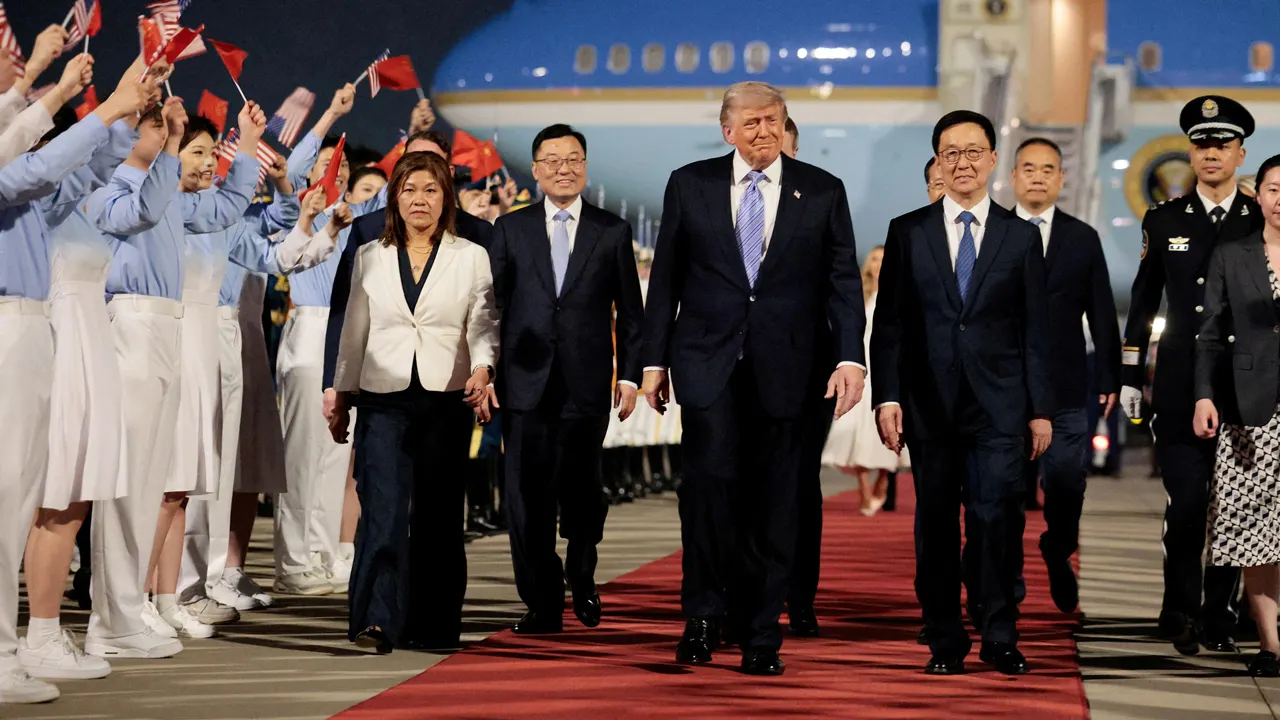
As the wheels of Air Force One touched down on the tarmac in Beijing on Wednesday, President Donald Trump was greeted with the kind of pageantry reserved for heads of state in the heart of Asia. It wasn’t just any welcome—this was a red-carpet affair straight out of a diplomatic blockbuster. A military honor guard stood at attention, their uniforms crisp under the crisp Beijing air, while a spirited military band played anthems that echoed through the terminal. And then there were the children, oh, the children—lines of them, waving American stars and stripes alongside the red banners of China, chanting “Welcome, welcome! Warm welcome!” in melodic unison. It felt like a scene from a feel-good movie, a bridge between two cultures united in this moment of protocol. Trump stepped off the plane, his tall frame silhouetted against the afternoon sky, to be greeted by a lineup of dignitaries who embodied the thin veneer of friendship between nations. Leading the pack was United States Ambassador to China David Perdue, alongside Chinese Vice President H.E. Han Zheng, the Chinese ambassador to the U.S. H.E. Xie Feng, and Executive Vice Minister of Foreign Affairs H.E. Ma Zhaoxu. The air buzzed with anticipation, not just for the handshakes and smiles, but for what this encounter symbolized: a chance to hit the reset button on one of the world’s most volatile relationships.
You could almost hear the echoes of history here, because this wasn’t Trump’s first rodeo in China. Back in 2017, during his inaugural state visit, the atmosphere was similarly electric. First Lady Melania Trump had joined him then, and together they soaked in the pomp of personal diplomacy that Xi Jinping orchestrated. There were tours of the ancient Forbidden City with its towering red walls and labyrinthine halls, a night at the Peking opera where acrobats and singers transported them to another era, and a formal gathering in the opulent Great Hall of the People, where the echoes of past leaders seemed to whisper from the arches. It was a masterclass in hosting, designed to show the U.S. president the depth and richness of Chinese culture. But beneath the glitz, it was clear this wasn’t just tourism; it was a high-stakes gambit. Trump and Xi walked together through gardens and dined on elaborate banquets, their wives posing for photos that papered global headlines. The optics were flawless, a facade of camaraderie that masked the trade talks brewing underneath. At the time, the world watched as two giants—one the superpower with its democratic ideals, the other an economic behemoth rising in authoritarian certainty—tried to find common ground. Yet, as the visit wound down, questions lingered about whether all this pageantry could translate into real, durable progress.
What really captured the headlines in 2017 were the business deals, a flurry of announcements that promised to boost economies on both sides of the Pacific. The White House proudly trumpeted more than $250 billion in commercial pacts and cooperative pledges, painting them as a win for American workers, farmers, and ranchers. Imagine the buzz: Qualcomm won a $12 billion deal to supply cellphone chips, Boeing secured $37 billion in contracts for its jets, and other companies—ranging from tech giants to agricultural exporters—signed on for increased exports and investments. It was hailed as a economic thaw, a bridge over troubled waters. “These deals will create jobs for American workers, farmers, and ranchers,” the White House declared at the time, envisioning stimulus flowing into American communities like a river feeding parched lands. But it wasn’t just about dollars and cents; there was a darker thread woven into the visit. North Korea’s nuclear ambitions loomed large, a specter that Trump and Xi addressed head-on. They pledged mutual commitment to “maximum pressure” on Pyongyang, agreeing that the rogue state shouldn’t cross the nuclear threshold. China, ever the enforcer in the region, had already cranked up the screws earlier that year—suspending coal imports from the North and pressuring its banks to pull back. Trump hailed this as a breakthrough, a testament to personal diplomacy where leaders leaned in and rallied allies. For a moment, it felt like they were on the cusp of something historic, bending the arc of geopolitics with sheer willpower.
Yet, as we all know now, those heady days gave way to a bitter hangover. The 2017 summit didn’t halt the slide into acrimony; if anything, it seemed like the prelude to a trade war that would dominate headlines for years. Just a year later, relations soured sharply when Trump’s administration slapped tariffs on Chinese imports, punishing what they saw as unfair trade practices, intellectual property theft, and market distortions. Beijing retaliated in kind, tariffs piling on tariffs, turning what should have been economic synergy into a standoff that bled both sides. North Korea didn’t abide by the promises either, pushing forward with missile tests and nuclear escalations despite the so-called maximum pressure. Cooperation between Washington and Beijing eroded, as broader suspicions festered—China accused of subsidizing its industries while ignoring human rights concerns, the U.S. branded as bullying emerging markets. The deals from 2017, once heralded as transformative, became footnotes in a story of escalating friction. There were attempts at detente, like the vague trade truce in late 2019, but cheating allegations and COVID-19 only widened the rift. Trump, ever the dealmaker, viewed this as a negotiation tactic, but critics saw it as recklessly endangering global supply chains. The rising tensions over Taiwan added fuel, with China’s increasing militarization around the island heightening fears of accidental clashes. And Iran? A wild card, with Beijing quietly supporting Tehran’s economy while Washington sanctioned Hezbollah ties. By the time of this latest visit, the U.S. had escalated its tariffs globally, prompting retaliation that included China’s tightening of rare earth mineral exports—vital for American tech and defense. Trump threatened even steeper duties, up to 100%, if Beijing dared step out of line. It was a vicious cycle, where economic warfare bled into strategic positioning, leaving allies nervous and markets jittery.
Fast-forward to now, and Trump’s return to Beijing feels like a Hail Mary, a chance to salvage what’s broken before it’s too late. Accompanying him is an illustrious entourage of American titans—figures whose names keep boardrooms and markets on edge. There’s Elon Musk, the rocket-man behind Tesla and SpaceX, bringing his futuristic vision; Tim Cook from Apple, overseeing the gadgets that connect us globally; Larry Fink and Stephen Schwarzman from BlackRock and Blackstone, finance wizards managing trillions; Kelly Ortberg of Boeing, Brian Sikes of Cargill, Jane Fraser of Citi, Larry Culp of GE Aerospace, David Solomon of Goldman Sachs, Sanjay Mehrotra of Micron, and Cristiano Amon of Qualcomm—these aren’t just CEOs; they’re proxies for American innovation and commerce. Their presence screams intent: Trump means business, pressuring Xi to tear down barriers that stifle U.S. firms in China. He wants real access, fair play, so entrepreneurs can drive growth without bureaucratic handcuffs. “American businesses can supercharge China’s economy if you let them play freely,” goes the pitch, a carrot alongside the tariff stick. Iran looms as another headache, a war zone where China invests while Trump eyes leverage. Despite rumors of discord—Beijing’s subtle aid to Tehran versus Washington’s Iran sanctions—Trump’s been downplaying rifts, signaling Xi for cooperation. Taiwan remains the elephant in the room, a flashpoint so delicate it could ignite wildfires. With U.S. support for Taipei strengthening Navy patrols and arms sales, China’s moves feel like a powder keg. Trade disputes pile on, with billions in tariffs warping supply chains for everything from electronics to corn. Yet, amid the brinkmanship, there’s optimism: perhaps personal chemistry and executive muscle can forge a path forward, stabilizing ties between the two economic leviathans.
As the clock ticks toward Thursday, the stakes couldn’t be higher. Trump and Xi are slated for closed-door bilateral talks, a summit where history might be rewritten—or repeated. They’ll break bread at a formal banquet, toasting with smiles that mask the weight of mortality, their first in-person powwow since 2018. What emerges could redefine global trade, security, and rivalry. Will this yield more than 2017’s mirage—a lasting thaw instead of a prelude to freeze? Fans of diplomacy hold their breath, wondering if the red-carpet welcome is a genuine olive branch or just protocol. From North Korea’s nukes to Taiwan’s freedoms, from Iranian proxies to tariff titans, every topic drips with potential for progress or peril. Accompanying Melania (who skipped this trip, ironically), Trump’s team is ready to roll up sleeves, but experience warns caution: deals evaporate in the heat of geopolitics. Yet, hope persists, because in the theater of global power, personal rapport can bend nations. As our world teeters on the edge of multipolarity, this visit might just be the fulcrum that tips the balance back toward stability. One thing’s clear: eyes from London to Tokyo are glued to Beijing, as the dance of dragons resumes. Whether Trump and Xi orchestrate harmony or amplify discord remains to be seen, but the audience is captive, betting on a script where human connection trumps cold calculation. In the end, it’s not just about flags and handshakes; it’s about forging a fragile peace in an uncertain age.