

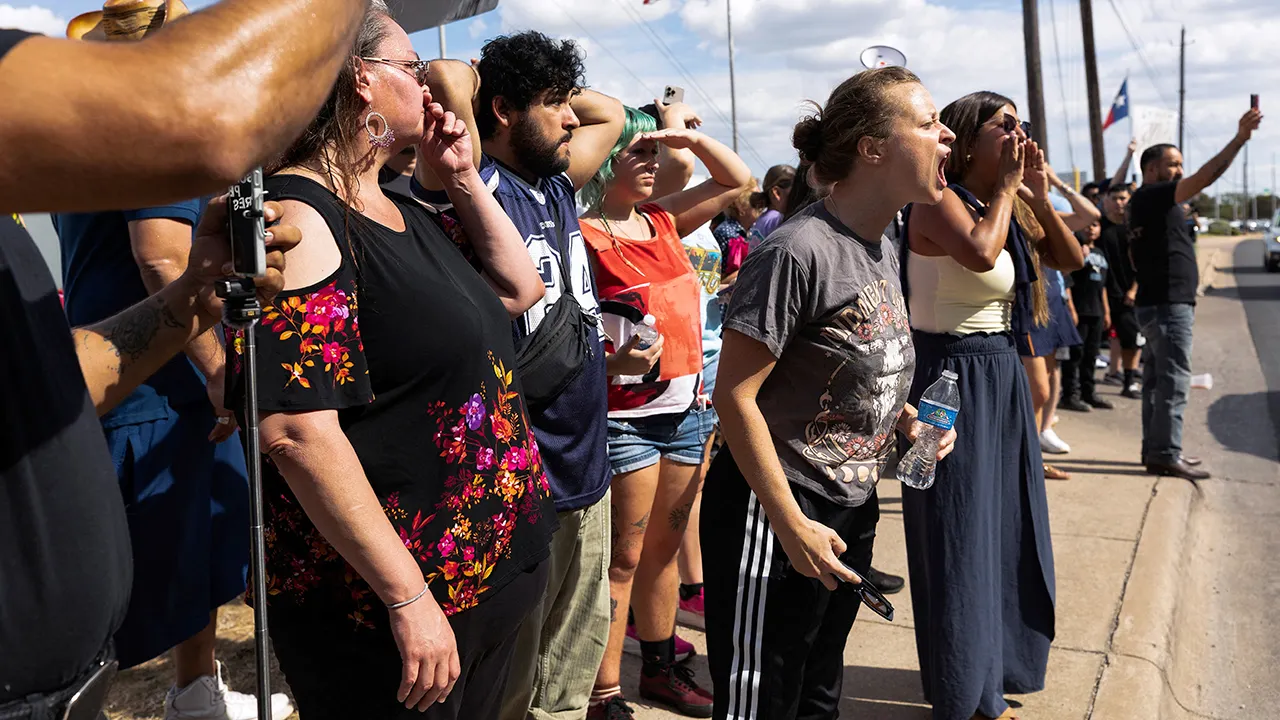
It began, by all appearances, as a local tragedy, the kind that briefly flashes across a city’s collective attention before fading into the blur of policy debates and official statements. On a Sunday afternoon in Austin, Texas, an Immigration and Customs Enforcement agent fired a weapon during a traffic stop near Anderson Square and Research Boulevard, leaving a 28-year-old Venezuelan man, Wilber Rafael Garcés Pérez, wounded and hospitalized in serious but stable condition. The details were fragmentary: local police said they had no role in the shooting, federal authorities took charge of the investigation, and the FBI was called in to help piece together exactly what happened. For residents of that North Austin neighborhood, the news landed with the particular shock that accompanies sudden violence in your own backyard. But before the sun set, that shock had been transformed into something far larger and far more choreographed: a crowd waving Mexican flags, blocking streets, lighting fireworks, chanting against ICE, and demanding that the wounded man be released from federal custody. Local media described the demonstration as a spontaneous outburst, noting that what began with a handful of people across from the scene grew over several hours into a significant rally. The word “spontaneous” felt right on television. It implied that ordinary residents, outraged by a broken-news story, had rushed to the intersection on their own, driven by raw emotion and a shared sense of injustice. But the truth, as a closer examination would reveal, was considerably more organized. The protest was not simply an expression of communal grief. It was a carefully amplified political operation, coordinated by a network of far-left socialist and communist groups with national reach, established media platforms, and long-standing ideological alliances with governments in Cuba and Venezuela. The shooting provided the spark, but the fire had been laid well in advance.
The story of how the protest came together begins with the quiet work of organizations that most Americans have never heard of, and it raises uncomfortable questions about what “spontaneous” really means in the age of hyper-coordinated political activism. Within hours of the shooting, at around 4:19 p.m. local time, the national account of the Party for Socialism and Liberation posted an explosive message on X: “BREAKING. MAN SHOT BY ICE AGENTS IN AUSTIN.” The post called on residents to protest immediately and declared, in capital letters, “ICE OUT OF AUSTIN NOW!” Minutes later, the group’s Austin chapter shared the same graphic on Instagram, coordinating with its national headquarters and four Texas chapters in Houston, San Antonio, Dallas-Fort Worth and Waco. By the following evening, that single post had received more than five thousand likes, two thousand reposts, and over two thousand shares. Almost simultaneously, the Austin chapter of the Democratic Socialists of America posted a graphic labeled “Emergency Demonstration/Vigil,” urging supporters to gather at a nearby Research Boulevard address from 5 p.m. to 8 p.m. for a “spontaneous” protest against “another instance of ICE and police violence.” The word “spontaneous” was now being used by the organizers themselves, even as they were actively mobilizing their networks to show up at a specific location at a specific time. Around the same hour, the Freedom Road Socialist Organization, an openly Marxist-Leninist group that describes itself as building “a new, revolutionary, communist party,” published its own dramatic material, including a graphic declaring “ICE SHOOTS AN UNARMED CIVILIAN” and another framing the shooting as part of a broader pattern of “ICE violence and killings.” Within a day, that post had generated hundreds of likes and shares. These were not the actions of isolated neighbors reacting to a headline. They were the coordinated moves of a political infrastructure designed to turn a law-enforcement incident into a national rallying cry.
What made the Austin protest particularly striking, however, was not just the speed with which these groups mobilized, but the uniformity of their message. Within hours, they were using nearly identical language: the shooting was “ICE terror,” it was “police violence,” it was part of a pattern of killings. They promoted the same location, the same hashtags, the same calls to action. A pro-communist media platform called BreakThrough News, which is operated by a nonprofit funded by Neville Roy Singham, a communist American-born tech tycoon living in Shanghai, published a “BREAKING NEWS” report with the headline: “Austin erupts in protest…” At 5:44 p.m., the Party for Socialism and Liberation posted a live video from the scene, announced a crowd had gathered, and synchronized the footage on Instagram with Rage Against the Machine’s song “We’ve Got to Take the Power Back.” The message accompanying the video described “Austinites flooding the streets where man shot by ICE,” a phrase carefully crafted to create the illusion of an unplanned uprising. Later that evening, at 8:27 p.m., the group issued an expanded statement headlined “Justice for Wilber Rafael Garcés Pérez,” demanding the man’s release from custody and the arrest of the ICE agent, while explicitly urging supporters to “follow the example of Minneapolis earlier this year until ICE terror is defeated!” The identical statement spread through the group’s Texas and national Instagram accounts, accumulating more than ten thousand likes and thousands of shares by Monday evening. By then, the protest was no longer just at the site of the shooting. New calls to action were moving activists to the Pearsall Detention Center, where the wounded man was reportedly being held, with urgent posts declaring, “WE NEED YOU BOOTS ON THE GROUND…!!!” It was a masterclass in political amplification, and every step bore the fingerprints of organizations with explicit revolutionary goals.
The groups behind these efforts are not merely concerned with immigration policy, and their presence in Austin was not an accident of circumstance. The Party for Socialism and Liberation describes itself in its official manifesto as a “revolutionary socialist” movement that “will open the way to communism and the end of class society.” It views police and state institutions as tools of capitalist rule and calls for a workers’ government to replace the existing system. The Freedom Road Socialist Organization is even more explicit, declaring that it aims to replace capitalism through socialist revolution and identifying itself as part of the communist movement. It has sent delegations to support communist regimes in Cuba and Venezuela, and in July it publicly saluted the Communist Party of China on the anniversary of its founding. The Democratic Socialists of America, while not as openly revolutionary, plays an essential role in this ecosystem by providing a broader layer of street-level organizing, political amplification, and mainstream credibility. Together, these organizations form what amounts to a political machine. They share activists, they share coalitions, and they share unapologetic support for authoritarian governments that the United States has long opposed. The Party for Socialism and Liberation and the Freedom Road Socialist Organization, for example, have participated in joint “solidarity” missions to Cuba and Venezuela, with the Party’s self-described communist co-founder, Brian Becker, saying that the delegation traveled “as comrades in solidarity.” This is not the language of liberal reform. It is the language of revolution, and it is a reminder that for some of the people organizing these protests, the shooting of one man is not merely an injustice to be remedied, but a useful moment in a larger struggle to dismantle the American system itself.
The network that helped fuel the Austin protests is now the subject of congressional scrutiny. Lawmakers have been investigating a web of organizations funded by Neville Roy Singham, the Shanghai-based tech tycoon, for allegedly working to foment an image of “chaos” in the United States. Singham’s money has flowed to a cluster of activist groups and media outlets, including BreakThrough News, the People’s Forum, CodePink, and the ANSWER Coalition, all of which have played roles in anti-ICE protests and pro-communist campaigns. BreakThrough News, which published the “Austin erupts in protest” headline, is one of Singham’s media ventures, and its coverage of the shooting helped spread the story to a national audience before mainstream outlets had even finished their first reports. Congressional investigators have pointed to protests from Minneapolis to the Delaney Hall detention center in Newark, New Jersey, where secret signal chats reportedly revealed how anti-ICE agitators coordinated riots. The pattern, they argue, is consistent: a police or ICE incident occurs, the network activates its social-media channels, national groups amplify the message, local chapters provide boots on the ground, and media outlets funded by the same network provide the narrative frame. It is a seamless loop, and it has been used to create the impression that the country is erupting in spontaneous outrage when, in reality, much of that outrage is being generated by a small, highly disciplined political movement with a very different vision for America’s future. None of this diminishes the legitimate questions that surround the Austin shooting. The use of deadly force by a federal agent is always a matter of serious public concern, and Austin officials have rightly called for transparency and an independent review. Federal authorities say the ICE agent’s actions are being investigated, and the full facts have not yet been released.
What the Austin protests reveal, however, is that there is a significant difference between a community responding to a tragedy and a political operation using that tragedy as a stage. The ordinary residents who gathered at the intersection may have been genuinely angry and genuinely frightened. They may have had legitimate questions about ICE tactics, about the treatment of undocumented immigrants, and about the use of force by federal agents. But they were not the ones printing emergency protest flyers, coordinating social-media campaigns across four Texas cities, or connecting the shooting to a global revolutionary struggle. They were not the ones comparing the event to protests in Minneapolis or calling for the overthrow of capitalism. Those messages came from organizations with names like Freedom Road and Party for Socialism and Liberation, groups that have spent years building the infrastructure to turn isolated incidents into political theater. They have mastered the art of appearing spontaneous while acting with precision. They have built networks of activists, media platforms, and international alliances that allow them to project far more power than their actual numbers would suggest. And in Austin, as in Newark and Minneapolis, they demonstrated how quickly a single shooting can be transformed into a national movement, with all the emotional weight of a genuine uprising but none of the organic authenticity that the word implies. The investigation into the shooting will continue, and the true facts may eventually come to light. But the investigation into the forces that shaped the protests is already revealing something just as important: the “spontaneous” outrage you see on your screen is often not spontaneous at all. It is manufactured, funded, and distributed by people who believe the system itself must be destroyed, and who will use every tragic event they can find to move that goal forward. The grieving families and frightened neighbors deserve better than to have their pain turned into propaganda. And the American public deserves to know who is really organizing the protests they are being told to see as the voice of the people.