

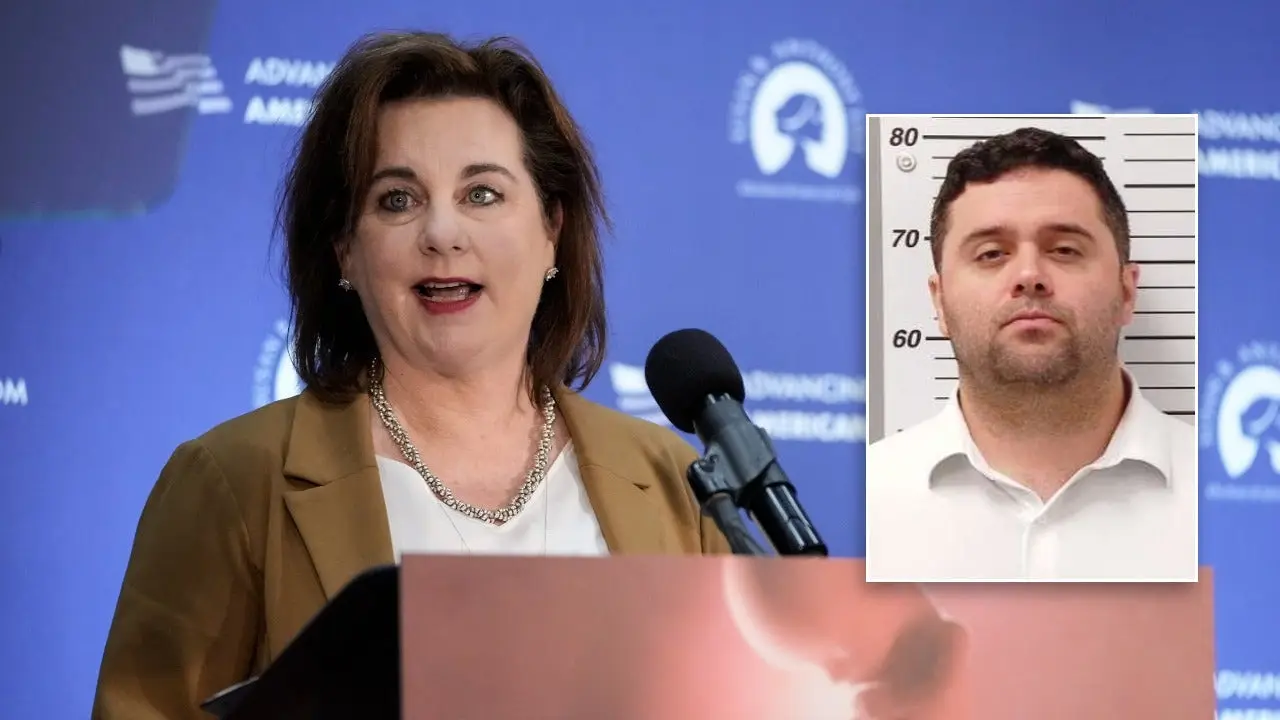
Jona Affholder woke up on a December night in Ohio believing she was safe in the home of the man she loved. She was pregnant, she wanted her baby, and she had every reason to expect that the relationship she had entered in early October 2024 would continue. Instead, Hassan-James Abbas, then a surgical resident at the University of Toledo, became her worst nightmare. According to prosecutors, Abbas had already begun plotting after learning of the pregnancy. He used his estranged wife’s identifying information to illegally obtain mifepristone and misoprostol, the two drugs whose combined effect is to terminate early pregnancies by blocking progesterone and inducing contractions that expel the fetus. What happened next was not a private conversation or a difficult decision. It was a physical assault. Abbas invited Affholder to his home in Holland, Ohio, offered her hot chocolate and tea—behavior prosecutors noted was out of character—and then climbed on top of her, held her down, and forced crushed abortion pills into her mouth. When she fought back and tried to call 911, he took the phone from her hand and hung up. He took her keys. He blocked her escape while every minute brought the drugs closer to completing their intended purpose. In Affholder’s own words, published in a Daily Wire op-ed, she “rushed to the kitchen, trying to rinse the powder from her mouth,” but Abbas continued to restrain her, “buying each minute for the drugs to do their intended purpose of killing our kid.” When he finally assumed the drugs had done their work, he returned her belongings. She went straight to the hospital, where she began hemorrhaging and ultimately lost the child she had so desperately wanted.
The legal aftermath of that horrifying night has become a national flashpoint. Abbas was arrested the next day, and he initially pleaded not guilty. But in May 2026, he entered a no-contest plea to four felony charges: disrupting public services, unlawfully distributing abortion-inducing drugs, identity fraud, and using deception to obtain a dangerous drug. As part of the plea agreement, prosecutors dropped charges of abduction and tampering with evidence, including the allegation that Abbas drove away and threw the remaining pills from his car window. The penalty for this sequence of calculated violence was six months in prison. Marjorie Dannenfelser, president of SBA Pro-Life America, sees that sentence as an indictment of a legal and cultural system that has not yet understood the danger of chemically forcing abortion on women. “The fact that this guy got only six months in prison for his crime says a lot about the state of our culture right now,” Dannenfelser told Fox News Digital. “This was a very much wanted pregnancy. She could support the baby on her own and didn’t need his help. But he had other ideas in mind.” The contrast with other violent crimes is glaring. Ohio law treats rape as a serious felony with penalties that can stretch for years or even life, depending on the circumstances. But a man who uses his medical knowledge, his physical strength, and a mail-order prescription to end his girlfriend’s pregnancy without her consent walked away after half a year.
The implications of that light sentence extend far beyond one case. Under current FDA rules, a patient does not need to see a physician in person to receive an abortion pill prescription. A telehealth visit is enough, and the medication can be mailed by a certified pharmacy directly to a home address. That accessibility has expanded reproductive options for millions of women, but it has also created a terrifying new avenue for abuse. An abuser can obtain mifepristone and misoprostol without the knowledge of his partner, conceal them in food or drink, and effectively make the decision to end a pregnancy for her. This is not a hypothetical. In February 2024, Mason Herring of Texas received the exact same sentence—six months—for slipping misoprostol into his then-wife’s drinks. In that case, the baby survived but initially faced severe developmental delays. Two cases, two states, two women whose bodies were violated through abortion drugs, and identical punishments that seem painfully disproportionate to the harm inflicted. For Dannenfelser, these are not isolated incidents; they are warning signs of a legal structure that treats coerced abortion as a lesser crime. She is demanding that political leaders address the issue directly, especially in Ohio, where voters are choosing a governor and a senator. “If you are Amy Acton running for governor, if you are Sherrod Brown running for the Senate, you need to answer for this because their Republican opponents are very much for limiting these drugs or controlling them at least,” Dannenfelser said. Fox News Digital reached out to both campaigns for comment.
Dannenfelser also turned her attention to the advocacy organizations that might be expected to defend a woman’s right to choose. She challenged Planned Parenthood and other pro-choice groups to explain their relative silence in cases like Affholder’s. “Where are the advocates, the feminists, the people who are against the coercion of women, the people who are ‘my body, my choice,’ the people who say that medical care is all that they’re really looking for,” she asked. Planned Parenthood does not appear to have issued a public statement specifically about Affholder’s case, although the organization has explicitly condemned the act of administering abortion drugs to women without their knowledge or consent. Fox News Digital reached out to Planned Parenthood for comment. But for Dannenfelser, a general condemnation is not the same as advocacy. The movement that built its identity on bodily autonomy has been muted when the autonomy of a woman who wanted to keep her baby was violently taken away by the father of that child. It is easy to say that abortion should be safe, legal, and rare. It is harder, and perhaps uncomfortable, to confront the reality that abortion pills can be weaponized by men who refuse to accept a woman’s decision to have a child. If “my body, my choice” is genuine, then the fight against coerced abortion should be central to the reproductive rights agenda. Instead, Dannenfelser argues, these cases expose a moral blind spot, one that leaves women like Jona Affholder alone to live with the consequences of a choice that was never hers to make.
The path to justice, in Dannenfelser’s view, begins with federal enforcement. She called on the Department of Justice to take a more active role in prosecuting cases of forced abortion, and she expressed hope that Attorney General Todd Blanche would act. “We do have every hope that the attorney general will move on this, and he’s referenced it at the Dallas convention that people who are pushing death in a pill will be disappointed,” she said. “That is the surest way to justice.” Her call was amplified by Senator Bernie Moreno, a Republican from Ohio, who wrote directly to Blanche demanding action. “My constituent was held down and force-fed crushed-up mail-order abortion pills,” Moreno wrote. “Unsurprisingly, reckless Biden-era mail-in abortion policies are responsible for this hell-on-earth tragedy.” Moreno’s letter frames the issue as a policy failure: the expansion of mail-in abortion, including shield laws that have allowed hundreds of thousands of abortion pills to be shipped into states with abortion restrictions, has created an environment where bad actors can obtain these drugs without meaningful oversight. Dannenfelser has also predicted that the Trump administration’s nominee to lead the Food and Drug Administration could bring renewed scrutiny to the risks of abortion drugs. Those risks are no longer merely medical. They include coercion, assault, and the destruction of wanted pregnancies by individuals who understand the law has not kept pace with the technology.
At its core, this story is not just about abortion policy. It is about a woman who wanted to be a mother, and a man who decided, without any right, that she would not be. Jona Affholder fought for her unborn child with every tool she had: her hands, her voice, her determination to reach a phone and call for help. She lost that fight in a hospital room, bleeding and grieving. The criminal justice system then asked her to accept that six months in prison was enough. For Dannenfelser, the sentence is a mirror held up to a culture that has grown numb to the distinction between a true choice and a forced one. “The fact that this guy got only six months in prison for his crime says a lot about the state of our culture right now,” she repeated. The law has long recognized that a woman’s body cannot be controlled by a man, whether through violence, coercion, or legal command. Yet when the weapon is a pill and the victim is pregnant, the system too often blinks. Ohio’s rape laws would have punished Abbas far more severely if the assault had fit an older definition of violence. But because the drugs did the work, the crime seemed, to some eyes, less real. That is a profound failure of imagination and of law. A woman who is held down and force-fed abortion pills has suffered an assault as intimate and brutal as any other. She has lost not just a pregnancy but trust, agency, and a child she already loved. Six months is not justice. It is a measure of how far society still must go to protect the most vulnerable moment in a woman’s life—and to make clear that no man, no matter how cunning, has the right to take that choice away.