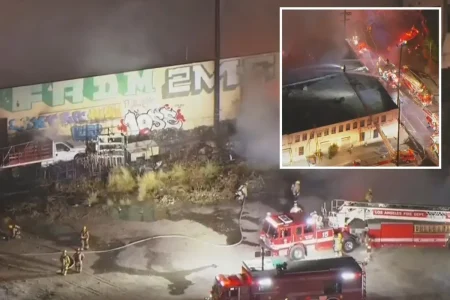





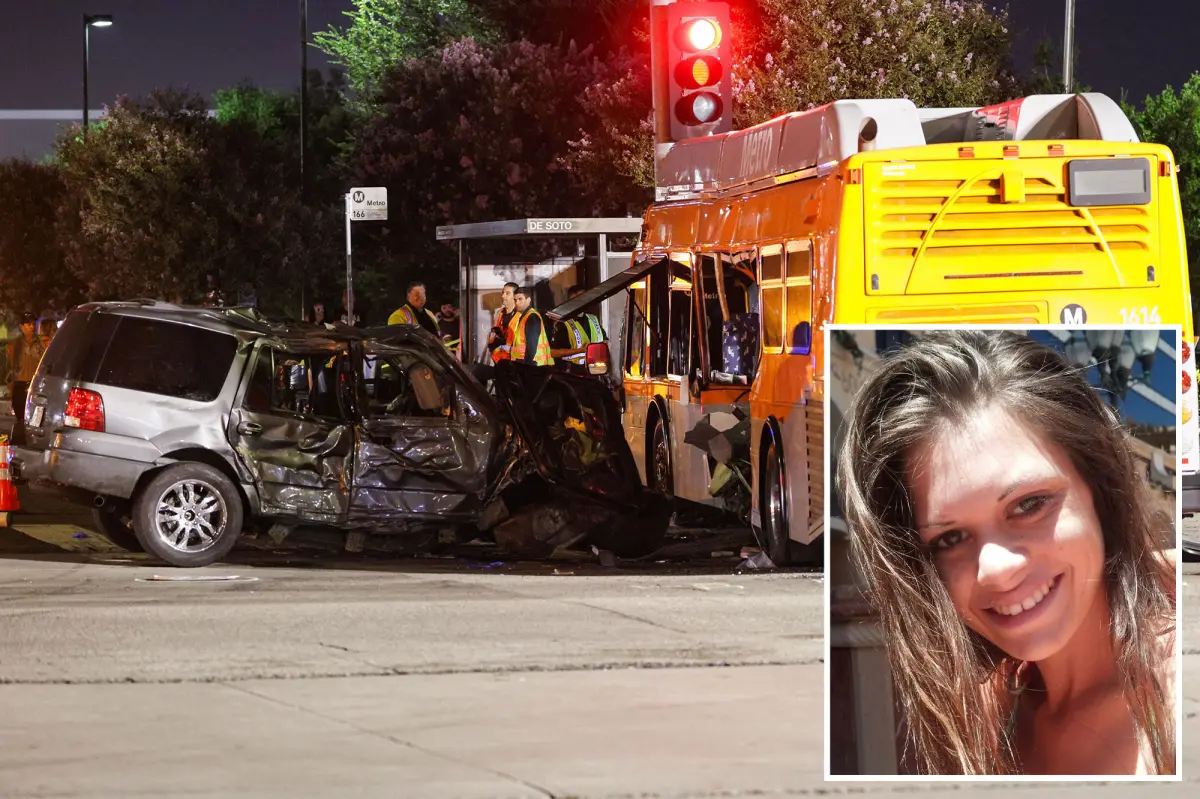
On a bright Tuesday afternoon in the San Fernando Valley, the ordinary rhythm of a rush-hour commute was violently shattered in a matter of seconds. A silver Ford Expedition came barreling through a busy Chatsworth intersection, running a red light and slamming directly into the side of a Los Angeles Metro bus. The impact was catastrophic, embedding the SUV into the bus and sending debris scattering across the pavement. When the dust settled, two people aboard the bus were dead, five others were injured, and a chain of events had been set in motion that would claim three more lives in a way no one could have imagined. The driver, 36-year-old Bailee Lynn Rios, was later arrested and charged with two counts of second degree murder. Los Angeles County District Attorney Nathan Hochman announced the charges on Thursday, telling reporters that Rios was allegedly under the influence of drugs at the time of the crash, with methamphetamine and drug paraphernalia later discovered in her wrecked vehicle. What began as a single moment of reckless choice had become a tragedy of staggering proportions, leaving families shattered and an entire city grieving.
The charges against Rios paint a devastating picture of negligence and loss. In addition to the two murder counts, she faces charges of driving under the influence and reckless driving, and if convicted, she could spend the rest of her life behind bars. Hochman did not mince words when describing the case, calling the deaths entirely preventable. He stressed that Rios did not have to get behind the wheel that afternoon, did not have to drive while impaired, and did not have to blow through that red light on the wrong side of the road. Each one of those decisions, he said, led directly to the loss of innocent life. Rios was hospitalized immediately following the crash and remained there for days, unable to appear at her initial arraignment on Thursday for medical reasons. Her bail was set at $4.03 million, a figure reflecting the severity of the charges and the danger prosecutors believe she posed. The court proceedings were rescheduled for Friday morning, but for the families of the victims, no court date could ever undo the pain of losing the people they loved in such a sudden and violent way. The legal system would now have to wrestle with accountability, but for those left behind, the ache was immediate and overwhelming.
What made this tragedy even harder to comprehend was the bizarre and horrifying ripple effect that followed the bus crash. As news of the collision spread, NBC’s NewsChopper 4 was dispatched to cover the scene from above. The helicopter, carrying reporter Eliana Moreno and pilot George Marciniw, was flying over the area when it suddenly plummeted to the ground near Whiteman Airport in Pacoima. The crash killed both Moreno and Marciniw instantly, and tragically, a bystander on the ground named Edy Gutierrez Mejia also lost his life. The helicopter accident sent shockwaves through the city and the nation, but nowhere was the grief more acute than inside the newsroom at KNBC, where colleagues found themselves covering the deaths of their own friends and coworkers while mourning in real time. The loss of Moreno, a young reporter with a bright future, and Marciniw, an experienced and beloved pilot, was a devastating blow to the journalism community. In the days that followed, mourners left flowers and tributes at Whiteman Airport, the same place from which the ill-fated helicopter had taken off just hours earlier. It was a sobering reminder that tragedy often does not travel alone—it multiplies, touching lives far beyond the initial scene.
Amid the chaos and sorrow, the identities and stories of the victims began to emerge, and their families spoke with heartbreaking tenderness about the people they had lost. The two bus passengers killed in the initial crash were named by the Los Angeles County Department of Medical Examiner as 31-year-old Gage Weida and 46-year-old Daniel Castillo. Castillo’s family released a statement describing a father who brought love, laughter, joy, and light into the world. They said they were incredibly blessed to have loved him and to have been loved by him, and their words carried the weight of a grief that no sentence could fully capture. Weida’s family described him as a kind, caring, and selfless son, and his girlfriend, Autumn Reiff, shared an emotional tribute on social media that moved thousands of people. She wrote about how young and in love they were, how he was her other half, the person closest to her, someone who loved her unconditionally and who she loved back just as fiercely. The couple had been together for nearly a decade, and Reiff’s pain was palpable in every word. She pleaded to be woken up from what she called this bad dream, saying her head hurt from crying and that her world was shattered. She even asked why the Lord could not have taken her first. Her words captured the raw, unfiltered agony of losing a partner, a future, and a lifetime of shared memories in an instant.
In the wake of the tragedy, investigators and journalists began trying to understand who Bailee Lynn Rios was and what might have led her to that intersection. Her close friend Brad Aragon spoke to reporters, revealing that Rios had been struggling with serious concerns in the days leading up to the crash. He said she had been spending time with people she knew she should not be associating with, and that he had planned to help her navigate those troubled waters. A text message Rios sent him at 1:24 p.m. on Tuesday, just hours before the collision, revealed her fear and vulnerability. In the message, she told him she was honestly scared, but she assured him she would still come see him. Aragon described the exchange as serious, not a joking matter, and said he was worried about her. Less than five hours later, her SUV smashed into the Metro bus, forever altering the lives of countless people. The portrait that emerges is not a simple one. Rios is not a monster in the abstract, but a woman who made catastrophic choices while struggling with substance use and fear. That does not excuse her actions or diminish the devastation she caused, but it humanizes her in a way that is uncomfortable and necessary. It reminds us that the people who cause such pain are often themselves caught in webs of addiction, desperation, and poor judgment, and that the loss of life is always a tragedy with many layers.
As Los Angeles begins to heal, the memories of those killed are being honored in quiet and public ways. The makeshift memorial at Whiteman Airport stands as a testament to Moreno, Marciniw, and Mejia, while the families of Weida and Castillo cling to the love they shared and the moments they will never get back. The crash also left five other people injured, some of whom were thrown from the bus, and their physical and emotional recoveries are just beginning. For everyone touched by this event, the grief will not fade quickly. It will linger in empty chairs at dinner tables, in unanswered texts, in the silence that follows a sudden, violent goodbye. What happened on that Tuesday afternoon was not a random act of fate. It was the result of a series of decisions, each one avoidable, each one carrying enormous weight. The district attorney called the deaths preventable, and they were. But that knowledge offers little comfort to those who must now learn to live without the people they loved. In the end, this story is not just about charges and bail amounts or legal maximums. It is about the fragility of life and the ripple effects of a single terrible moment. It is about a young woman who was scared and struggling, and the innocent people in the path of her fear. It is about a reporter and a pilot who died doing their jobs, and a bystander who was simply in the wrong place at the wrong time. And it is about a city left to make sense of the senseless, holding flowers, shedding tears, and hoping that something good can somehow grow from so much sorrow.