






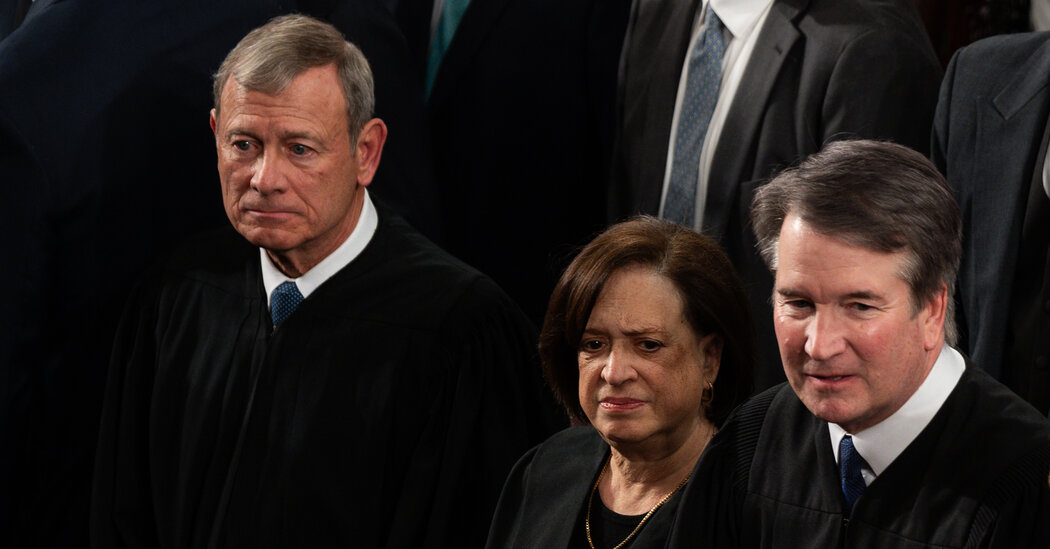
On a quiet evening last week, the grand, wood-paneled conference rooms of the Supreme Court transcended their usual atmosphere of austere legal deliberation to host a warm, nostalgic gathering of legal minds. Among the approximately one hundred guests who met for cocktails in the courtyard before moving indoors for a formal dinner was Vice President JD Vance. Yet, on this particular night, the intense spotlight of national politics was momentarily dimmed; Mr. Vance attended not as a powerful executive envoy or a combative political campaigner, but simply as a supportive husband. His wife, Usha Vance, an accomplished corporate litigator, was the guest of honor as a former clerk for Chief Justice John G. Roberts Jr., having served in his chambers nearly a decade ago. In a room filled with brilliant legal minds reminiscing about late-night brief writing and historic cases, the Vice President navigated the crowd as a self-described “plus-one,” seated away from the head table where his wife’s former boss presided. The Chief Justice, ever the custodian of judicial traditions and institutional propriety, kept his welcoming remarks strictly focused on the extended family of his past clerks, offering no special recognition or grand political gestures to the nation’s second-in-command. This soft-spoken, intensely private gathering offered a rare human glimpse behind the heavy velvet drapes of the nation’s highest court, serving as a peaceful but momentarily awkward intermission in what has otherwise become a relentless and highly public struggle for power between the executive branch and the judiciary.
Beneath the polite clinking of wine glasses and the sharing of old memories lies a deeply fraught, psychological dance that has come to define the relationship between the Trump administration and the court. For Donald Trump, power is rarely seen through the lens of constitutional abstracts or independent civic duties; rather, it is viewed as something deeply personal and transactional. To his mind, the justices he successfully appointed during his first term—Neil M. Gorsuch, Brett M. Kavanaugh, and Amy Coney Barrett—are expected to behave as loyal allies rather than independent arbiters of the law. This expectation has created an exhausting, systemic whiplash within American governance, as the administration vacillates wildly between charm offensives and public intimidation. When the court acts as a constitutional speedbump to his policy goals, the President’s resentment bubbles over, revealing his frustration with the only institution capable of truly dismantling his sweeping agenda. Abigail Jackson, speaking for the White House, defended this volatile approach by asserting that the American public has always loved the President’s unvarnished, direct style, framing his outbursts as a form of authentic transparency. Yet, behind the scenes, this approach has transformed the traditional separation of powers into a high-stakes psychological drama, leaving legal experts and citizens alike wondering how long an institution built on trust can withstand such persistent, personalized pressure.
The fragility of this relationship was laid bare in February, following a major legal defeat for the administration when the Supreme Court invalidated its sweeping tariff policies. Incensed by the ruling, President Trump bypassed traditional diplomatic channels and called an immediate press conference, openly castigating the justices as “fools and lap dogs” and declaring that his own appointees who voted against his policies were an embarrassment to their respective families. Standing beside the President during this extraordinary tirade was Solicitor General D. John Sauer, whose traditional designation as the “10th Justice” is meant to symbolize a sacred bond of honesty and mutual respect between the executive and judicial branches, highlighting the surreal irony of the moment. While past presidents have certainly expressed frustration with adverse rulings, this level of raw, personal animosity was entirely unprecedented in modern political history. Despite the public vitriol, however, a fascinating internal contradiction emerged: the administration quietly and fully complied with the court’s decree, initiating the process to refund roughly $160 billion in collected tariffs with interest. This dual track—loud, performative rebellion for the political base, coupled with silent, logistical compliance behind closed doors—characterizes an administration that understands the legal finality of the court even as it seeks to destroy its public moral authority.
This volatile dynamic was on display during subsequent high-profile events, where the administration sought to alternate its public lashes with luxurious displays of hospitality. Just days after his tariff-related outburst, Mr. Trump showed a completely different face at the State of the Union address, greeting the attending justices with polite smiles, handshakes, and cordial pleasantries rather than the venom he had unleashed online. This oscillation continued into the spring, when the White House hosted a prestigious state dinner honoring King Charles III and Queen Camilla of Great Britain. Intriguingly, the administration invited all six of the justices appointed by Republican presidents, including those who had recently drawn the President’s ire, while completely omitting the court’s three liberal justices. This selective social embrace was widely interpreted as an attempt to foster a sense of tribal loyalty among the conservative supermajority, particularly on the eve of a historic case regarding the administration’s immigration policies. The pressure deepened when the President took the unprecedented step of attending oral arguments in person for the birthright citizenship case, sitting in the public gallery instead of the traditional ceremonial seat reserved for visiting heads of state. His abrupt departure mid-argument, followed by social media complaints that the court had not formally recognized his presence, served as a stark, physical reminder of his desire to dominate the court’s physical and psychological space.
Faced with this constant barrage, the justices have had to carefully navigate their response, balancing their duty to defend the judiciary with the necessity of remaining above the political mudslinging. For the most part, they have chosen a path of dignified, institutional silence, refusing to engage with personal insults or social media provocations while using highly controlled public appearances to gently reassert their independence. Justice Neil Gorsuch, during a recent tour to promote his children’s book, addressed the loyalty question head-on by stating simply that his sole oath is to the United States Constitution and the laws of the land, entirely separate from any political patron. Chief Justice Roberts has been similarly defensive, using academic lectures to warn that hyper-partisan, aggressive rhetoric directed at the bench is inherently dangerous to the stability of the republic. Former clerks and legal scholars, such as Colleen Sinzdak and Harvard Professor Richard Lazarus, observe that the justices are actively trying to project an image of normal, steady operation, continuing to attend state dinners and social functions to prove they cannot be intimidated. However, Lazarus also warned that the President’s personal attacks are fundamentally out of bounds, eroding institutional trust and creating genuine safety concerns for the justices and their families, leading some to argue that attending White House social events under such circumstances risks compromising the court’s perceived neutrality.
This ongoing constitutional drama ultimately brings the focus back to JD Vance, whose quiet role as a supportive husband at the clerk reunion stands in stark contrast to his assertive intellectual opposition to the court’s power. Despite his own elite legal background as a graduate of Yale Law School, Mr. Vance has emerged as one of the most intellectually articulable critics of judicial supremacy, publicly arguing that the Chief Justice is fundamentally wrong to believe the court should act as a check on executive power. In his view, the judiciary should practice extreme deference to the political judgments of a president, framing the court’s independence not as a vital constitutional safeguard, but as an undemocratic obstacle to the populist will. This philosophical divide between a traditional, rule-of-law judiciary and an increasingly assertive, executive-centric populism is the true battleground of modern American governance. As the Supreme Court prepares to hand down monumental decisions on birthright citizenship and executive authority in the coming weeks, the tension is no longer just about legal interpretations; it is about the very nature of democratic balance. In this highly charged atmosphere, even a warm, private dinner among former colleagues in a quiet corner of Washington becomes a loaded event, proving that in today’s political landscape, the personal, the political, and the constitutional are irrevocably intertwined.