






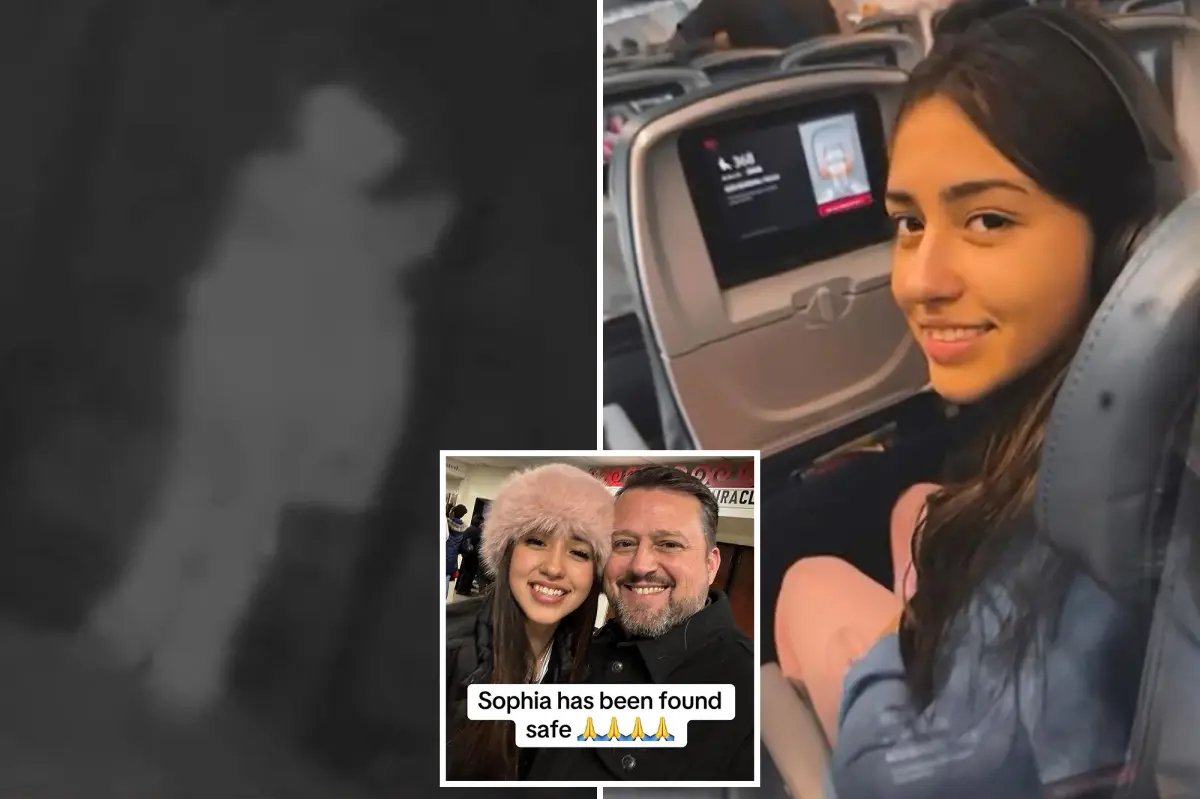
At the end of every missing-child story, there is a moment that no one outside the family can fully understand: the moment when the lost person is seen again, alive, and the hard knot of fear begins to loosen. For Rick Cover, that moment happened on a plane, somewhere between New Jersey and Florida, as he looked over at his sixteen-year-old daughter Sophia sitting beside him. Two weeks earlier, she had walked off their property in Golden Gate Estates in the middle of the night, captured only by a security camera as she disappeared into the dark. There was no note, no argument, no warning, no signal that anything was wrong. One moment she was there; the next she was gone, swallowed up by the night, and for more than ten days her family was left in a state of suffocating uncertainty. Then, on August 11, she was found safe at a friend’s house in New Jersey, nearly 1,200 miles from home. And now, impossibly, she was right there in the seat next to him. On Wednesday, Rick shared a video collage of the two of them together, smiling, as they flew back to Florida. “I don’t even know if there are enough words to express the gratitude I feel right now,” he wrote. It was a simple sentence, but it carried the weight of everything he had been through. He went on: “Today, I’m sitting on a plane, bringing Sophia home. After everything that has happened, just being able to look over and see her sitting beside me is something I will never take for granted.” There is a particular kind of gratitude that only comes after fear, a gratitude that doesn’t erase the trauma but lives alongside it. That was what the video showed. A father and daughter, smiling, not because everything made sense, but because they had each other again. The worst had not happened. The nightmare had ended, or at least changed shape. And for now, being together was enough.
To understand how significant that plane ride was, you have to go back to the night Sophia disappeared. Around midnight on July 31, a home security camera recorded her leaving her family’s home in Golden Gate Estates, a community in southwestern Florida where neighbors know each other and the streets are quiet. The footage showed a teenage girl walking away from the only home she had known, her figure framed by the dim glow of outdoor lights, and then vanishing into the darkness. No one saw her get into a car. No one saw her meet anyone. She simply drifted out of view, and then she was gone. By morning, her absence had been noticed, and the initial confusion quickly turned into panic. This was not the kind of story where a parent assumes the child just went to a friend’s house; this was a child who had left in the middle of the night without a phone, without a clear plan, without any way for her family to reach her. The police were called, and a massive search effort unfolded with remarkable speed. State and federal officers joined local authorities, and the investigation began to expand outward, from the neighborhood to the region to the entire country. Volunteers gathered, organized search parties, and walked through woods and fields under the hot Florida sun. Helicopters beat the air overhead. Officers went door to door, hoping for a neighbor who had seen something, heard something, or maybe caught a glimpse of Sophia on his own security cameras. But the trail was cold. There were no credible sightings in those first difficult days, no cell phone pings that led anywhere useful, no ransom notes, no messages, no cryptic final texts. There was only the image of a girl walking into the night and a family standing in the aftermath, waiting for the phone to ring with news that never came.
For her father Rick, those days were a slow suffocation. He stayed in front of cameras, spoke to reporters, made desperate public pleas, and did everything a parent can do when their child is missing. But every interview ended the same way, with a father who had no answers and no power to change the situation. He was not afraid to show his fear. In one heartbreaking moment, he told The Post that he believed “someone has my daughter.” That sentence captured the darkest possibility a parent can face: not that she had chosen to leave, but that someone else had taken her, coerced her, harmed her. Without evidence, without communication, without a single piece of information about where she might be, his mind had no choice but to wander into terrifying territory. The public followed along, holding their breath. Every day a missing teen is gone increases the likelihood of a tragic ending, and the passage of time becomes a kind of torture. Rick did his best to stay strong, but the strain showed in his words, in the tired lines of his face, and in the way he spoke about Sophia with a mixture of love, anger, and desperation. He clung to hope, but hope is a difficult thing to hold when you are standing in the middle of an empty search area, with the heat beating down and the phone not ringing. The support from the community helped, perhaps more than he knew. People shared the missing-person flyers, organized search efforts, posted prayers, and left meals at the family’s door. But none of it could bring Sophia home. Only something unknown and beyond his control could do that. So he waited. He waited through long terrible nights and endless mornings. He waited until the days started to blur together, and he waited even as the first hopeful energy of the search began to fade into something more grim. And then, when he had almost reached the limit of what any human being can endure, the news came.
On August 11, eleven days after she disappeared from Florida, Sophia Cover was found safe at a friend’s house in New Jersey, more than a thousand miles away. The relief was immediate and enormous, but so were the questions. How had a sixteen-year-old who had been seen leaving her home in Golden Gate Estates in the middle of the night ended up in one of the most densely populated states in the country? Who were these friends? Did she know them before, or had she met them along the way? Why did she leave, and why didn’t she contact anyone during those long, frightening days? None of that was explained in the initial reports. The word “safe” was repeated over and over, as if saying it enough times could erase the uncertainty underneath. But the human mind doesn’t work that way. The relief was real, but it was also complicated. For every person who celebrated the news, there was another wondering what exactly had happened. Trust, once shaken, is not restored simply because the missing person is found. And for a parent, the question of why can be just as painful as the question of where. Still, for a moment, the Cover family allowed themselves to simply breathe. Sophia was alive. She was unharmed. She had not been lost forever to the darkness that swallows so many missing children. That was the miracle they had prayed for. The fact that she had been staying with friends in the Garden State seemed almost absurd, like something out of a movie, and yet the image of her “popping up” at that house was enough to loosen the knot that had been tightly bound around their chests for two weeks. The mystery was far from solved, but the worst-case scenario had not happened. That alone felt like a second chance, even if the path forward was still unclear.
In his Wednesday Facebook post, Rick Cover addressed those questions directly, without hiding from the fact that there is still much to understand. “There is a lot to unpack,” he wrote. “There are a lot of questions that still need answers, and over the next week I will share more about Sophia’s journey and what happened.” That promise is important. It acknowledges that simply bringing Sophia home is not the end of the story. It is the beginning of a different kind of work, the work of understanding, healing, and rebuilding trust. But Rick was also careful not to rush the process. “But for right now, I’m going to decompress,” he said. “I’m going to be her dad. I’m going to hug my little girl, get her home to her brothers and sisters, and start getting to the root of how we ended up here so we can begin moving forward.” Those words may be the most meaningful in the entire update. They show a father who knows that the first priority is not interrogation but connection, not explanation but presence. He didn’t say he had all the answers. He didn’t promise to make sense of it all overnight. He simply said that he wanted to hold his daughter, bring her back to her siblings, and slowly, gently, figure out what happened. That is the essence of good parenting in a crisis: putting the relationship before the investigation, the person before the problem. There will be time for difficult conversations. There will be time to reconstruct the timeline, to understand how she got to New Jersey, to address any choices that were made, and to work through whatever emotional or psychological weight this journey may have left on Sophia’s shoulders. But that time is not now. Now is the time for hugs, for home, for brothers and sisters who have been waiting in a state of dread for the return of their sibling. Now is the time to let the reality of reunion settle in.
The Cover family’s story is far from unique in its outline, but it is singular in its details, as every family’s story is. A teenager walks out the door and vanishes. A community mobilizes. The days pass in waves of hope and despair. Then, without warning, the missing person is found, and everyone must learn to move on from a trauma that happened while they were apart. For Sophia, the journey back to Florida is not just a flight. It is a re-entry into a life that she left behind on a dark July night. For her father, it is a chance to be present in a way he might never have fully appreciated before. “I don’t even know if there are enough words to express the gratitude I feel right now,” he wrote, and perhaps that is the truest thing he could say. Gratitude is not neat. It is often tangled up with fear, anger, confusion, and exhaustion. But it is real. It is the emotion that remains after the adrenaline fades and the first shock of reunion softens into something calmer. The road ahead may not be easy. There may be counseling, difficult conversations, new boundaries, and a long process of rebuilding trust. There may be public scrutiny, media attention, and a thousand judgments from strangers who think they know what happened. But none of that matters as much as the simple fact that Sophia is alive and being brought home. Her brothers and sisters will see her face again. Her father will hear her laugh. The family will sit together, maybe around a table, maybe in front of the television, and slowly begin to piece their lives back together. They will not forget those two weeks, but they may emerge from them with a deeper appreciation for the ordinary, the unremarkable, the everyday moments that once seemed so easy to take for granted. The questions will remain, at least for now. But for a father on a plane, with his daughter beside him, the biggest answer has already arrived.