

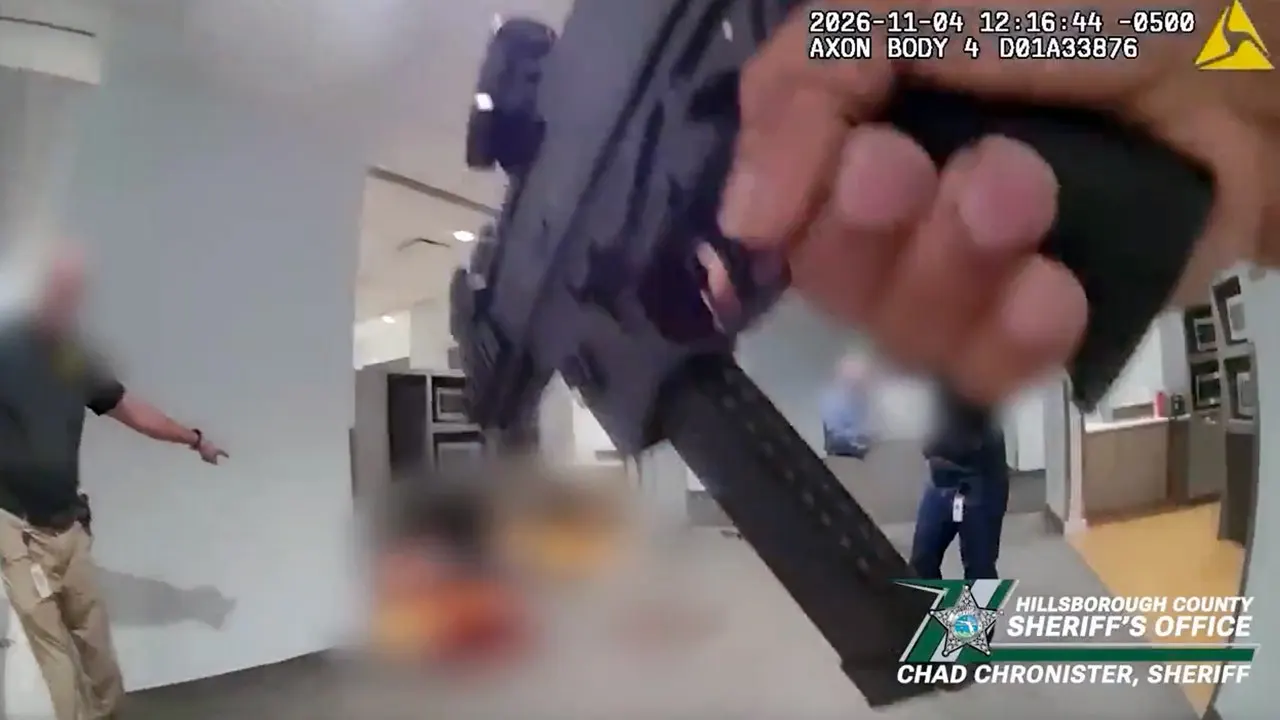
Newly released body camera footage offers a gripping, unsettling window into the chaos that unfolded on a Wednesday afternoon at a Citibank campus in Tampa, Florida, when a gunman turned an ordinary workday into a scene of terror. The Hillsborough County Sheriff’s Office published edited bodycam video and 911 calls, capturing the frantic moments as deputies rushed into the sprawling business complex, searching for a shooter who had already killed a woman and was moving through the building. In the footage, the raw tension is palpable: officers move quickly, their voices clipped with urgency, asking bystanders for descriptions of the suspect, trying to piece together where the threat was and how to stop it before more lives were lost. Then comes the moment every responder was hoping for: a voice announces, “Shooter is down.” The words land like a release valve, but the footage makes clear there was nothing routine about getting there. It was a scene of smoke, sirens, running footsteps, frightened employees, and the stark reality that a peaceful campus had become a combat zone in a matter of minutes. The video humanizes the officers behind the badges, showing their split-second decisions, their focus, and their relief as they begin escorting dazed employees out of the building, their hands on shoulders, guiding them to safety. It also honors the seriousness of the moment: a woman was dead, a gunman was mortally wounded, and hundreds of people had witnessed violence they will never forget.
The chain of events that led to that deadly standoff began when the suspect drove a vehicle through a fence at the Sabal Park Office Development, a sprawling business hub that houses multiple offices, including a Citibank facility. The crash was not accidental; authorities say the suspect deliberately drove onto the property, barreling into an outdoor seating area where employees often gathered to eat, take calls, or enjoy a bit of sunshine between meetings. There, he encountered a woman and fatally shot her in what investigators later described as the first act of violence in a rampage that was meant to continue inside. After the shooting in the outdoor area, the suspect made his way into the building’s cafeteria, a space that should have been filled with casual conversation and the clatter of lunch trays. Instead, it became the next stage of a nightmare. The released bodycam footage shows deputies arriving at the scene, their patrol units converging on the campus from multiple directions. One deputy is heard asking bystanders for a physical description of the suspect, trying to determine whether the shooter was still roaming the grounds or had already entered a structure. Another officer reports that a vehicle had crashed through the property and that the suspect was inside the cafeteria. That information changed everything; the deputies had a clear target, but they also knew they were moving toward an armed individual who had already demonstrated a willingness to kill. The moments captured on camera are tense and chaotic, but they also reveal the discipline of law enforcement officers trained to move toward danger while civilians move away. They did not know if the shooter had hostages, accomplices, or explosives. They only knew that people were in danger and that every second mattered.
The 911 audio released by the sheriff’s office adds another layer of urgency and heartbreak. Dispatchers began receiving calls about shots fired at 12:11 p.m., and within moments, the emergency lines were flooded with terrified voices describing gunfire at the Citibank campus. Some callers were hide-and-go-seek quiet, whispering from offices and closets, afraid that the sound of their own voice would give away their hiding spot. Others were frantic, trying to provide details while struggling to process what was happening in real time. The dispatchers, calm and methodical despite the chaos, gathered critical information and coordinated a massive law enforcement response. Deputies arrived within one minute of the initial calls, an astonishingly fast reaction time that likely saved lives. The audio captures the behind-the-scenes coordination as authorities worked out a plan to enter the building, clear the hallways, and neutralize the threat. It is a reminder that for every heroic moment caught on body camera, there were unseen heroes in a darkened dispatch room, guiding officers from the other end of a phone line, comforting callers, and making sure help was on the way. The 911 tapes also reflect the sheer unpredictability of a shooting in a place where people expect to be safe. A cafeteria, a meeting room, a parking lot, a grassy area outside an office building, these are not supposed to be the scenes of mass violence. But on that Wednesday, in Tampa, they were. And the people who called 911 did exactly what they were supposed to do: they asked for help, and help came.
At the center of this story is a security guard whose brave actions brought the rampage to an end. According to the Hillsborough County Sheriff’s Office, an armed Citibank security guard exchanged gunfire with the suspect inside the building. The precise details of that confrontation are still being examined, but the outcome is clear: the security guard’s bullets struck the suspect, who was later pronounced dead at Tampa General Hospital. The phrase “shooter is down” that deputies announced on bodycam video was the result of that security guard’s courage. It is impossible to know how many lives were spared because that guard chose to stand his ground, to return fire, and to end a threat that could have grown far deadlier. The bodycam footage shows officers moving through the building after the shooting was over, their weapons raised, their eyes scanning every corner, until they found the suspect incapacitated and confirmed that the threat was neutralized. Then the focus shifted to the living: deputies escorted employees out of the campus, guiding them past emergency lights and police tape, helping them find a place to breathe, to call their families, and to process the fact that they had survived. The sheriff’s office praised the security guard, calling his actions heroic and essential. Without him, authorities said, the suspect could have continued firing into crowds of employees, and the death toll could have been much higher. That moment of deliverance is a powerful thread running through this tragedy: for all the horror of a woman being killed, there was also a story of an everyday security guard, someone armed and trained, refusing to let the violence go on.
The scale of the response was staggering, and it underscores how seriously law enforcement treats a mass shooting threat. The Hillsborough County Sheriff’s Office said more than 3,200 people were on the campus when the shooting unfolded, making it a densely populated area with high potential for mass casualties. Over 400 law enforcement personnel responded, including 367 sheriff’s deputies, along with officers from municipal agencies and state law enforcement. They converged on the Sabal Center from every direction, establishing a perimeter, clearing buildings, and helping terrified employees escape. Sheriff Chad Chronister summed up the gravity of the situation and the pride he felt in his deputies and the security team. “Thanks to the brave actions by the security team on-site and more than 365 deputies, this unhinged suspect was stopped before he could harm anyone else,” he said in a statement. The sheriff’s words resonate not just because they acknowledge the heroism of law enforcement, but because they highlight the fragile line between order and chaos. A gunman drove through a fence, crashed into an outdoor seating area, killed a woman, and then entered a cafeteria with the apparent intention of killing more. That is a nightmare scenario. But it was interrupted. The response was not perfect in the sense that no one could bring the victim back, but it was effective in the most important way: the threat was stopped, and the building was secured before the toll could rise any further. The deputies who responded within sixty seconds, the dispatchers who handled terrified callers, the security guard who fired back, they all played their part in a chain of survival that held.
In the aftermath, the community is left to grapple with the emotional weight of what happened. There will be counseling for employees, debriefings for first responders, and memorials for the woman whose life was cut short. There will be questions about how the suspect chose the campus, whether there were warning signs, and how such a breakdown in safety could occur at a place that was not a military base or a police station, but an ordinary office park full of people trying to do their jobs. The body camera footage and 911 calls released by the sheriff’s office offer more than just evidence for an investigation; they offer a deeply human look at how ordinary people respond when their world suddenly turns violent. There is fear in the voices of the callers, resolve in the voices of the deputies, and grief in the silence that follows the sound of gunfire. But there is also hope, or at least something close to it, in the way the community has responded. The security guard did not hesitate. The deputies did not wait. The dispatchers did not lose their composure. In the middle of one of the worst moments a person can experience, dozens of people acted with bravery, professionalism, and compassion. That is what the newly released footage ultimately documents. It is a record of violence, yes, but it is also a record of courage. And as the Tampa community begins to heal, those images will serve as a reminder that while darkness can strike anywhere, so too can light. The woman who died deserves to be remembered not just as a victim, but as a person who was part of a community that refused to be broken. And the heroes who responded deserve to be honored for doing what they were trained to do, what they were called to do, and what they did without thinking about their own safety. The story of the Citibank shooting is still being written, but the bodycam footage ensures that the truth of that day, the terror, the bravery, and the fragile hope that followed, will never be forgotten.