





It was a Tuesday afternoon like any other in North Lauderdale, Florida—warm, bright, and filled with the mundane activities of daily life—when a devastating flash of violence shattered the ordinary routine of a bustling Walmart parking lot on West McNab Road. At around 12:28 p.m., amid the hum of idling engines and the clink of shopping carts, a dispute erupted over something incredibly fleeting and minor: a vacant parking space. In our fast-paced modern world, where the pressures of daily life often simmer just beneath the surface, driving and parking have increasingly become flashpoints of frustration. Yet, no one shopping that afternoon could have anticipated that a simple disagreement between two strangers would rapidly escalate into a fatal tragedy. The victim of this sudden escalation was Bart Diguglielmo, a 62-year-old Army veteran who had survived the trials of military service only to lose his life on a patch of hot asphalt outside a retail store. This heartbreaking incident serves as a stark and painful reminder of how quickly routine interactions can devolve into irreversible disasters, leaving families shattered, communities in mourning, and onlookers traumatized by the suddenness of the loss.
For Bart Diguglielmo, life was defined by service, resilience, and the quiet dignity of a veteran who had transitioned back into civilian life. To those who knew him, he was more than just a statistic or a name in a police report; he was a husband, a friend, a neighbor, and a man who had dedicated a portion of his youth to defending his country. The transition from the structured, high-stakes environment of the military to the everyday rhythm of suburban Florida is a journey shared by many veterans, who often seek nothing more than peace, safety, and a quiet retirement. On that fateful Tuesday, Diguglielmo was simply running errands, navigating the same crowded spaces we all do, completely unaware that his path would cross with someone else’s mounting frustration. The sheer tragedy of his death lies in the terrible contrast between his background—having weathered the inherent dangers of military service—and the mundane, domestic setting of his final moments. His death has cast a long, somber shadow over North Lauderdale, forcing a community to grapple with the painful reality that a man who survived so much could have his life cut short over a mere convenience.
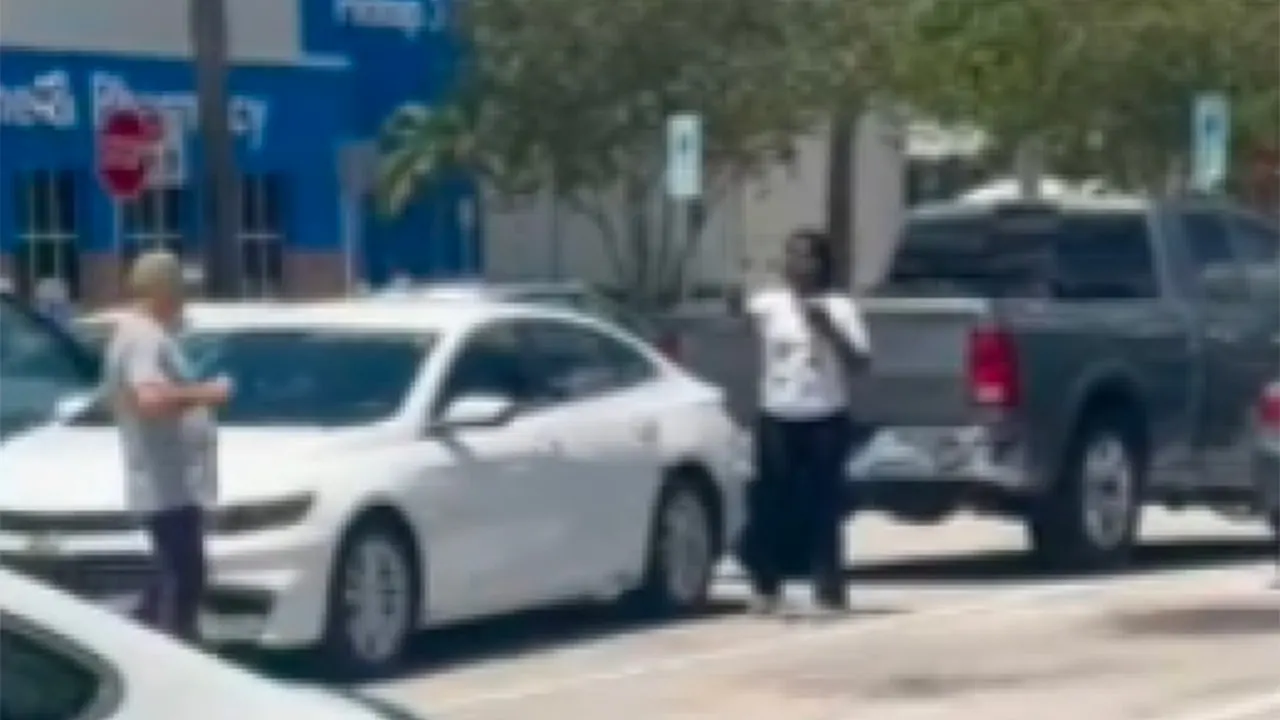
The terrifying sequence of events that led to Diguglielmo’s death was captured on multiple cellphones by stunned bystanders, illustrating the grim reality of our modern, digitally connected world where human tragedies are recorded in real-time. In one video obtained by Fox News, the initial tension of the confrontation is palpable, as a vehicle pulls out of a parking spot and leaves behind a void that quickly becomes the center of a deadly argument. A second video, captured by Local 10 News, reveals a deeply unsettling dance of escalation between Diguglielmo and an unnamed adult woman. The footage shows Diguglielmo walking toward the woman, who appears to be recording him with a cellphone in one hand. As the distance between them closes, the woman raises her other arm, pointing a handgun directly at him. For a few agonizing seconds, there is a static standoff—a moment suspended in time where a different choice, a deep breath, or a step backward might have changed everything. Instead, a single, sharp gunshot rings out, cutting through the ambient noise of the parking lot and instantly transforming a civil dispute into a scene of absolute horror.
The immediate aftermath of the gunshot, also preserved on silent bystander footage, paints a deeply distressing picture of physical vulnerability and shock. This silent sequence shows Diguglielmo doubling over at the waist, his body reacting to the catastrophic impact of the bullet before he slowly lowers himself onto the unforgiving pavement of the parking lot. Through the front of his shirt, a dark stain rapidly expands, representing the tragic, physical toll of kinetic violence. In a third video angle, the woman is seen backing away with her firearm still raised as Diguglielmo’s hands are lifted in the moments leading up to the shot, offering a disjointed and heartbreaking timeline of the confrontation. After the weapon was fired, the woman did not flee; instead, she remained at the scene, surrounded by the mounting chaos of sirens and shouting onlookers, waiting until the Broward County Sheriff’s Office deputies arrived to detain her for questioning. Though emergency responders rushed Diguglielmo to the Broward Health Medical Center in a desperate bid to save his life, his injuries proved too severe, and he was pronounced dead, leaving behind a legacy marred by a senseless end.
The legal and ethical questions surrounding the shooting now rest in the hands of the Broward County State Attorney’s Office, where prosecutors must carefully weigh the woman’s claim of self-defense against the video evidence and witness testimonies. According to the Broward County Sheriff’s Office, the shooter cooperated fully with homicide detectives, asserting that she felt threatened and fired her weapon in self-defense. In Florida, where laws regarding self-defense and the right to stand one’s ground are frequently debated and legally complex, prosecutors face the difficult task of determining whether the use of lethal force was a reasonable response to the physical presence of an unarmed, 62-year-old veteran. While the shooter’s identity has been withheld during the active investigation, the lack of immediate charges has left Diguglielmo’s loved ones in a painful state of limbo, waiting for a definitive legal interpretation of the tragedy. For the grieving family, the ongoing investigation is not just a search for facts, but a deeply emotional journey to understand how a trip to the local store could result in the permanent absence of a man they loved.
Ultimately, this tragedy forces us to look in the mirror and confront a disturbing societal trend where minor inconveniences are met with disproportionate, lethal rage. A parking space is, by its very nature, a temporary convenience—a spot occupied for an hour or two before being passed on to the next driver—making it a devastatingly trivial catalyst for the loss of a human life. It invites us to reflect on the vital importance of patience, empathy, and de-escalation in our everyday interactions, especially in an era where conflicts can escalate to deadly levels in a matter of seconds. As the pavement at the North Lauderdale Walmart is cleared and shoppers continue to park in the very spot where a veteran took his last breath, the local community remains profoundly changed. We are left with the sobering realization that behind the shocking cellphone videos and the clinical police reports lies a human heart that stopped beating too soon, and a family that must now find a way to heal in a world that feels a little colder, a little more hostile, and far more fragile.