






Terror in the Yaracuy Valley: Inside the Rare, Double-Strike Earthquakes That Shook Northern Venezuela
A Catastrophic Double Blow to Caracas and Northern Venezuela
Northern Venezuela has long existed at the mercy of volatile tectonic fault lines, yet the dual earthquakes that shattered the region on Wednesday evening stand as an extraordinarily rare and catastrophic event, representing one of the most powerful and terrifying seismic sequences to strike the country in over a century. At exactly 6:04 p.m. local time, as millions of residents across the capital city of Caracas were returning home from work, a massive magnitude 7.2 earthquake ruptured the earth’s crust just to the west of the metropolis, sending violent shockwaves through densely populated urban centers and unstable mountainsides. Before a terrified populace could even comprehend the scale of the initial shaking or safely evacuate swaying concrete high-rises, a second, even more ferocious magnitude 7.5 rupture tore through the earth just 39 seconds later. This rapid-fire succession of major earthquakes—geologically classified as a seismic doublet—has left a trail of widespread destruction, evoking dark memories for those who survived the September 2025 seismic events just southwest of this week’s epicenters, where a pair of magnitude 6.2 and 6.3 quakes injured upwards of 110 people and compromised numerous structures. This latest, far more powerful incident, however, has triggered a humanitarian and geological crisis of vastly greater proportions, leaving international scientists scrambling to analyze real-time telemetry while local authorities grapple with a disaster whose true scale of devastation has yet to be fully calculated in a region already under profound systemic strain.
Deciphering the Seismology of a Near-Simultaneous “Doublet” Rupture
In the complex nomenclature of seismology, when a sequence of closely timed earthquakes occurs, the most energetic event is designated as the mainshock, which casts the preceding magnitude 7.2 tremor in the role of a massive “foreshock” to the subsequent magnitude 7.5 event. What makes Wednesday’s doublet so incredibly peculiar and alarming to the global scientific community is not merely their shared geographic proximity—likely occurring along the same fault system or a highly interconnected cluster of fractures—but the unprecedented brevity of the intermission between them. Seismologists like Brandon Bishop of Saint Louis University point out that while seismic doublets are a recognized geological phenomenon, they typically observe a delay ranging from several hours to a few days rather than a mere matter of seconds, making this 39-second interval an extreme outlier in modern tectonic observation. This incredibly tight temporal coupling suggests a direct causal chain, a theory strongly supported by Harold Tobin, director of the Pacific Northwest Seismic Network at the University of Washington, who emphasizes that the ferocious seismic waves radiating from the initial 7.2 rupture almost certainly acted as a physical trigger, instantly overloading an adjacent, heavily stressed section of the fault and forcing it to fail. Indeed, rather than viewing these as two separate, isolated disasters, seismologists like Stephen Hicks of University College London argue that it is scientifically more accurate to conceptualize the event as a single, continuous, 50-second rupture process that cascaded into a monstrous, multi-phase failure, demonstrating how one localized break can rapidly feed into a much larger and more destructive geological beast.
The Physics of Rupture: Why the Venezuelan Crust Suffered Such Severe Trauma
To fully comprehend the sheer violence of this double blow, it is crucial to understand that the Richter and moment magnitude scales are logarithmic rather than linear, meaning that the margin between a magnitude 7.2 and a magnitude 7.5 earthquake represents an astronomical jump in physical power. Specifically, the second, larger rupture released approximately three times more seismic energy than its predecessor, compounding the stress on already compromised civil infrastructure and fragile natural geography. The destructive potential of both events was further magnified by their exceptionally shallow focal depths, which prevented the earth’s crust from absorbing and dissipating the seismic energy before it reached the surface, allowing raw, undiminished ground acceleration to rip through local communities. This energy was systematically amplified as it entered the Yaracuy Valley, a geologic basin heavily laden with thick, loose, water-saturated sediments that behave like a giant megaphone for seismic waves, causing the ground to shake with prolonged, violent intensity. This severe shaking triggered widespread, catastrophic landslides across the region’s steep topography and initiated the terrifying process of soil liquefaction—a state wherein solid ground temporarily loses its shear strength and behaves like a fluid, destabilizing the foundations of entire neighborhoods. As the physical rupture path zippered open eastward along the plate boundary, it effectively directed a concentrated beam of seismic energy straight toward the sprawling, densely populated basin of Caracas, delivering what experts describe as a catastrophic, direct hit to the nation’s political and demographic heart.
A Human Crisis Compounded by Economic and Structural Vulnerability
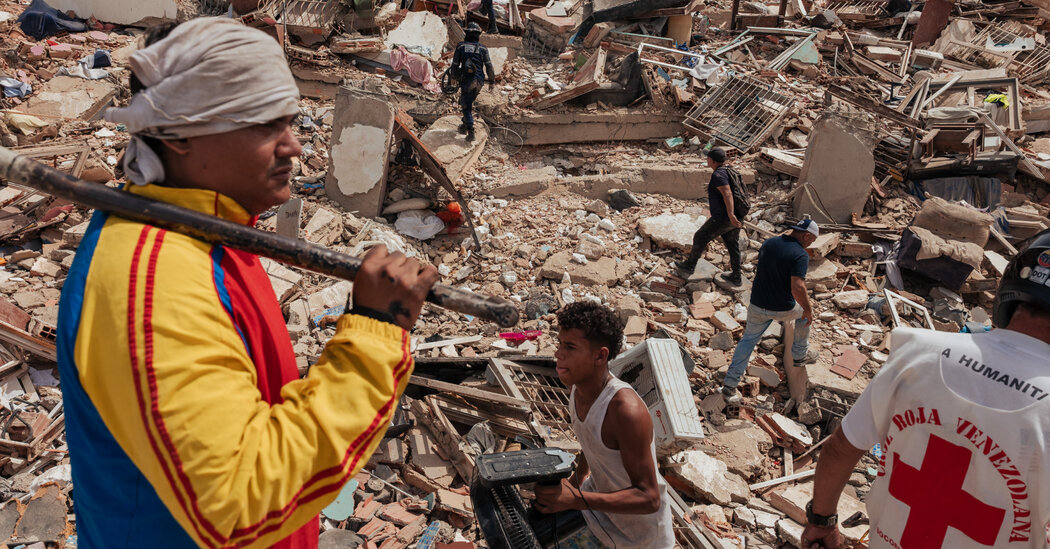
The physical geography of the disaster is only one half of the equation; the humanitarian toll is profoundly exacerbated by Venezuela’s long-standing socioeconomic struggles and the near-total absence of modern seismic defense systems. Unlike nations situated along highly active plate boundaries like Japan or Chile, which rely on sophisticated, real-time warning networks designed to broadcast alerts to mobile devices and shut down public utilities seconds before shaking begins, Venezuela lacks a technologically advanced early-warning infrastructure, leaving its citizens entirely defenseless in the critical moments before impact. This technological deficit is worsened by years of economic instability and political polarization, which have chronically underfunded local emergency management services, degraded hospital readiness, and led to the widespread neglect of municipal building codes designed to prevent structure collapse. In vulnerable coastal and mountainous suburbs like Catia La Mar, located just nineteen miles northwest of the capital, the consequences of this systemic neglect are painfully visible in the heaps of shattered concrete and pancaked brick homes that once clung to the steep, landslide-prone hillsides. For a population already grappling with basic shortages of medical supplies, water, and reliable electrical power, the sudden collapse of residential infrastructure converts a natural geological hazard into a complex, prolonged humanitarian emergency, where search-and-rescue operations are severely hampered by a depleted municipal response capacity and blocked mountain transit routes.
The Caribbean-South American Plate Boundary: Mapping the Fault Lines
Geologically, northern Venezuela is situated on a highly complex and chaotic tectonic margin where the Caribbean plate slowly grinds eastward relative to the South American plate at a rate of less than an inch per year, creating a highly dynamic zone of deformation. This slow-motion collision is further complicated by a localized subduction zone to the west, where the Caribbean plate is driven beneath South America, causing the overlying continental crust to fragment into a maze of smaller crustal blocks and active fault lines. Within a 155-mile radius of Wednesday’s double epicenters, the region has been rocked by seven earthquakes of magnitude 6.0 or greater over the past century, highlighting the perpetual peril underlying this beautiful landscape. Investigators are closely examining a trio of major, well-mapped fault systems that dominate this region: the Boconó Fault, the El Guayabo Fault, and the Morón Fault, with early epicentral data placing the magnitude 7.5 rupture near El Guayabo and the 7.2 event closer to Morón. While pinpointing the exact rupture plane is difficult due to localized seismic noise and institutional monitoring gaps, preliminary models indicate that the movement was predominantly strike-slip in nature, meaning two massive blocks of the Earth’s crust slipped horizontally past one another. This horizontal shear mechanism is notorious among geophysicists for producing incredibly intense, localized ground shaking directly along the line of rupture, drawing troubling comparisons to other destructive strike-slip systems like the East Anatolian Fault that devastated southern Turkey in 2023, the fault line that leveled Port-au-Prince, Haiti, in 2010, and California’s infamous San Andreas Fault.
Living in the Shadow of the Tremors: The Forecast for Aftershocks
As the traumatized population of northern Venezuela attempts to recover from the initial shock, they must now confront a prolonged and perilous secondary hazard in the form of a relentless stream of aftershocks, which are already actively rattling the region. According to official probabilistic forecasts issued by the United States Geological Survey (USGS), the affected area is projected to experience hundreds of smaller, felt tremors ranging between magnitudes 3.0 and 5.0 over the coming weeks, which will continue to compromise damaged buildings and trigger secondary landslides. More alarmingly, seismologists estimate a significant 24 percent chance of a magnitude 6.0 or greater aftershock striking the region within the next seven days, alongside a small but highly consequential 3 percent chance of another massive magnitude 7.0 event occurring. While aftershock sequences typically follow Omori’s Law, meaning their frequency and severity will progressively tail off over days, weeks, and even years, the immediate threat they pose to search-and-rescue teams and internally displaced persons remains critically high. This ongoing seismic instability ensures that the immediate atmosphere of panic and dread gripping the nation will not easily dissipate, as every rumble from deep within the earth threatens to bring down weakened structures and further complicate the massive regional recovery effort that lies ahead.