





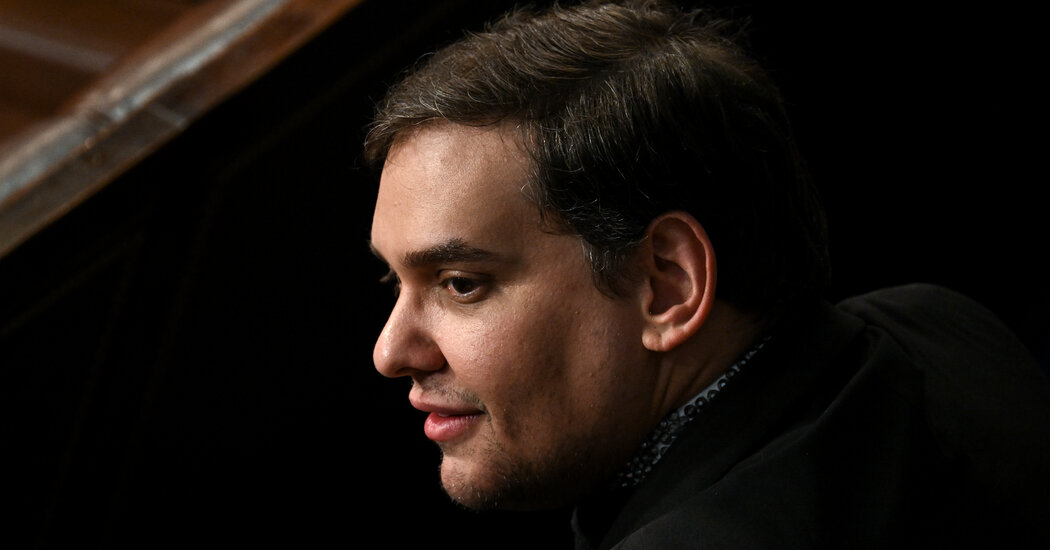
In the turbulent arena of modern American politics, few figures have captivated and confounded the public quite like former New York Representative George Santos. A man whose career has been defined by a surreal blend of reinvention, falsehood, and an insatiable desire for the spotlight, Santos found himself once again at the center of a federal firestorm, this time involving a bizarre financial gamble on his own physical presence. The stage was set in late February on the eve of President Donald Trump’s highly anticipated State of the Union address. To the online bettors occupying the digital trading pits of Kalshi, a rapidly growing prediction market platform, the question of whether the notorious former congressman would show up was not just a matter of political gossip, but a lucrative investment opportunity. Santos, ever the showman, leaned directly into the speculation. He took to his social media account on X, posting a playful video teasing his audience with the promise that he would be sitting high in the gallery to watch the address unfold. The post triggered a flurry of betting activity, driving up the perceived likelihood of his attendance. But while the public watched him play the tease online, a far more cynical transaction was quietly taking place behind the digital curtain. As the nation tuned in and the cameras panned across the historic chamber, Santos was nowhere to be found. He had skipped the event entirely. Around the same time, compliance systems at Kalshi flagged a deeply troubling pattern: someone had placed a substantial financial wager betting against George Santos showing up at the State of the Union. That bettor, according to individuals familiar with the matter, was none other than George Santos himself. It was a classic, albeit remarkably brazen, exercise in self-sabotage for profit—a move that humanizes Santos’s desperate relationship with fame and wealth, showing a man willing to turn his own life’s minor movements into a rigged casino game.
The discovery of Santos’s self-betting scheme sent immediate shockwaves through the executive offices of Kalshi, triggering a rapid chain of events that has now culminated in a major federal investigation. For a prediction market striving to prove its legitimacy to skeptical regulators, the prospect of a high-profile political figure manipulating a market based entirely on his own personal schedule was a worst-case scenario. Kalshi swiftly compiled its data and referred the matter to both the Department of Justice and the Commodity Futures Trading Commission (CFTC), the principal financial regulator tasked with overseeing the volatile world of derivatives and event-based prediction markets. The CFTC quickly launched a formal investigation into Santos’s trading behavior, looking to determine if his actions crossed the threshold into criminal market manipulation and insider trading. The legal questions at play are as fascinating as they are unprecedented: Can an individual commit insider trading by exploiting non-public information about their own physical location and future actions? While traditional insider trading typically involves corporate executives trading stock based on confidential merger talks, the rise of prediction markets has forced regulators to drastically expand their definitions of abuse. For Santos, who failed to respond to requests for comment, and Kalshi, whose spokespeople declined to speak publicly on the matter, the probe represents a critical test of whether the law can keep pace with digital platforms that allow users to monetize virtually any human event. The case highlights a deeper, more unsettling human truth about the gamification of our reality: when the most mundane details of our lives—such as whether a disgraced politician will attend a speech—are turned into tradeable financial commodities, the temptation to rig the outcome for personal gain becomes almost irresistible, blurring the lines between personal autonomy and financial fraud in an increasingly digitized society.
This rapidly unfolding investigation arrives at an incredibly sensitive moment for both the financial industry and the Trump administration, which currently faces intense scrutiny over its relationship with the fast-growing and highly lucrative prediction market sector. Platforms like Kalshi are no longer fringe operations patronized by niche statistics nerds; they have evolved into massive, multi-billion-dollar ecosystems that wield significant influence over public perception and political discourse. Unsurprisingly, this booming industry has cultivated deep and controversial ties to the president’s business and family networks. In early 2024, Kalshi made the strategic and highly eyebrow-raising move of appointing Donald Trump Jr., the president’s oldest son, as a “strategic advisor” to the company. This formal connection has cast a long shadow over the regulatory landscape, raising sharp questions about whether these platforms are operating with an unfair level of political protection. The integration of high-level political dynasties into commercial entities that allow the public to bet on government actions creates a fragile conflict of interest that critics worry could undermine the integrity of American financial markets. As prediction markets increasingly mirror actual financial exchanges, the pressure on regulators to police them effectively has reached a boiling point. The administration is caught in a difficult bind: it must actively champion the deregulation of financial technology to appease its free-market base while simultaneously proving to the public, the courts, and Congress that it can rigorously police the rampant insider trading, wash trading, and market manipulation that threaten to turn these platforms into unregulated gambling dens for political insiders. The Santos investigation has elevated these anxieties from abstract policy debates into a vivid, highly public demonstration of the potential for systemic abuse at the very intersection of political power, raw wealth, and speculative technology.
The internal dynamics at the CFTC have only added fuel to the fire, painting a troubling picture of an agency caught in a state of civil war over how to handle these powerful new prediction markets. A detailed investigation published by The New York Times revealed that under the current administration, the CFTC—a vital but historically low-profile financial watchdog—has consistently issued highly favorable rulings that have smoothed the path for prediction markets to expand their operations. However, this regulatory leniency has come at a severe human and organizational cost. Two senior career officials within the agency, who had spent years protecting retail investors and had raised serious, evidence-based alarms about the lack of oversight and potential for abuse in prediction market cases, were abruptly stripped of their duties. Late last year, these whistleblowers were placed on investigative leave, barred from entering their own offices, and subjected to internal investigations—a move that many within the agency viewed as a chilling attempt to silence dissent and clear the way for industry-friendly policies. The plight of these career public servants highlights the immense personal risk faced by individuals who attempt to uphold the rule of law against powerful economic and political interests. Responding to the fallout, Michael S. Selig, the chairman of the CFTC, insisted in a recent interview that the agency remains committed to holding wrongdoers accountable, promising that regulators would vigorously investigate any instances of market manipulation. Yet, the stark contrast between Selig’s reassuring rhetoric and the aggressive sidelined of internal critics has left many observers deeply skeptical. The tension within the CFTC underscores a profound crisis of institutional trust, suggesting that the very regulators tasked with policing George Santos’s alleged misconduct are themselves fighting an internal battle to preserve their own independence and prevent the complete capture of their agency by the industries they are meant to oversee.
To fully understand the sheer audacity of George Santos’s alleged betting scheme, one must examine the extraordinary and turbulent trajectory of his life over the past several years. Now 37, the former Republican congressman from New York first achieved national notoriety in 2023, when journalistic investigations exposed his entire biography as a breathtaking tapestry of fabrications, ranging from fake academic degrees and fictitious Wall Street careers to fabricated ancestral histories. Federal prosecutors quickly followed up with a sweeping criminal indictment, accusing Santos of utilizing a dizzying array of fraudulent schemes, including lying on official government disclosure forms, pocketing campaign funds to buy luxury designer goods, and stealing credit card information directly from his own political donors. History was made when his colleagues, disgusted by his actions, voted overwhelmingly to expel him from the House of Representatives, making him only the sixth member in American history to be ousted from the chamber. He was subsequently convicted and sentenced to serve seven years in federal prison. However, in a twist of fate that could only happen in the modern political era, Santos was granted a sudden reprieve in the fall when President Trump commuted his sentence, allowing him to walk free after serving only a fraction of his time. For most people, escaping a lengthy prison sentence would inspire a period of quiet reflection and a determination to stay as far away from controversy and legal jeopardy as humanly possible. But for Santos, a man seemingly addicted to the thrill of the grift and the warmth of the spotlight, the temptation to exploit his freedom proved too strong. The allegations that he immediately turned around and used a prediction market to cash in on his own notoriety show a human being incapable of breaking free from the patterns of deception that defined his rise and fall.
While George Santos is undoubtedly the most colorful figure to land in the crosshairs of prediction market investigators, his case is far from an isolated incident; rather, it is part of an alarming and rapidly expanding trend of insider trading that threatens the credibility of these digital platforms. Just in recent weeks, multiple high-profile cases have emerged, painting a picture of a financial frontier rife with exploitation. Last month, federal prosecutors and the CFTC brought charges against a Google employee who allegedly used highly sensitive, non-public data regarding search algorithm trends to make lucrative wagers on internet search outputs. Even more shocking was an April indictment involving a member of the United States Special Forces, who was charged with using highly classified, confidential military intelligence concerning a sensitive operation to capture Nicolás Maduro, the president of Venezuela, to net more than $400,000 in profits on a prediction market. These cases demonstrate that the vulnerability of prediction markets extends far beyond political performance art; it touches the core of national security, corporate integrity, and public trust. When intelligence officers can monetize military operations and tech workers can trade on proprietary data, prediction markets cease to be harmless forecasting tools and instead become dangerous incentives for corruption. As the Justice Department and the CFTC struggle to assert control over this electronic Wild West, the saga of George Santos serves as a powerful cautionary tale about the future of finance. It occupies a space where the human experience, public service, and political theater are stripped of their intrinsic value and reduced to mere numbers on a trading screen, open to the highest bidder and vulnerable to the manipulations of those who simply cannot resist the urge to stack the deck in their own favor. This leaves society to grapple with the profound moral hazard of placing a monetary price tag on truth, loyalty, and the very actions of those entrusted to govern.