




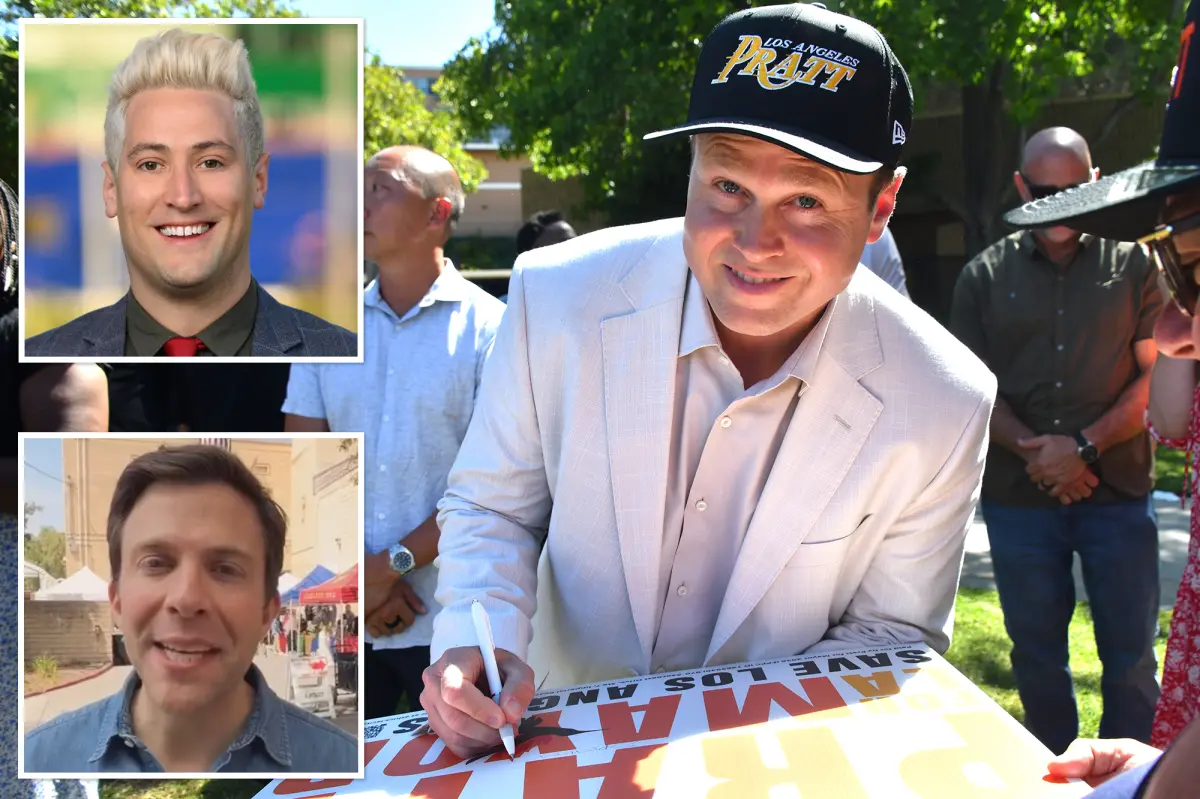
Spencer Pratt, the man who once built a career on reality TV chaos with his bleached-blond hair and penchant for screaming at his co-stars, has found an unlikely new calling in the political twilight zone of California. He didn’t survive the primary for Los Angeles mayor, but the universe has a twisted sense of humor—he has now been resurrected as a political bogeyman in one of the state’s most venomous Democratic-on-Democratic showdowns. The race for the 24th State Senate District, a deep-blue bastion encompassing the glitzy streets of West Hollywood and the sun-baked suburbs of the South Bay, has devolved into a trench warfare of poll-tested character attacks. At the heart of this maelstrom is an accusation so convoluted it could only exist in the modern social media era, involving a fake Instagram account, a Hollywood celebrity, and a deeply painful religious nerve. West Hollywood Councilmember John Erickson, a candidate with a carefully cultivated progressive resume, stands accused of operating a clandestine influencer-bot masquerading as a fan club for Pratt—one that bizarrely promoted his rival, Brian Goldsmith, while simultaneously lighting matchsticks soaked in antisemitic rage, hoping to burn Goldsmith alive in the court of public opinion. It is a story that reads like a twisted plot from a Bravo series, but the implications are deadly serious in the real world of legislative elections.
The accusations don’t come from a rival campaign staffer or a distant opposition researcher; they come from a young man who knows the emotional weight of the race firsthand. Zennon Ulyate-Crow, a Gen Z progressive who finished dead last in the June primary, has become the whistleblower—a disgruntled David pointing a trembling finger at what he perceives as a Goliath-level act of cowardice. After endorsing Goldsmith in the runoff, Ulyate-Crow’s Instagram account suddenly became a playground for trolls. An account labeled “Pratt Voters 4 Goldsmith” began to pepper his endorsement post with provocative comments. But it was the discovery mechanism that turned suspicion into near-certainty for Ulyate-Crow. Instagram, in its quasi-omniscient way, offers users the option to block an account along with any other associated accounts the algorithm believes belong to the same person. When Ulyate-Crow blocklisted Erickson’s verified political account, the system simultaneously flagged and blocked the anonymous “Pratt Voters 4 Goldsmith” account. When he unblocked Erickson—just to be sure—the fake account flickered back into existence like a digital poltergeist. It was the digital equivalent of finding a smoking gun in a locked safe. Although Ulyate-Crow failed to capture the screen recording of this ubiquitous quirk in time, he immediately posted a stark video to his own Instagram, which has since racked up over 14,000 views. Almost as if on cue, the offending account was “nuked,” erased from the digital ether, leaving behind only screenshots and a lingering stench of foul play.
The phantom account was a masterpiece of cynical, algorithmic interpolation. Its bio described a “coalition of Pratt supporters” inexplicably diving into municipal politics, backing Goldsmith as “a changemaker like Pratt, and backed by changemaker Caruso,” a nod to billionaire developer Rick Caruso. It proudly displayed both American and Israeli flags, which might ordinarily be a harmless expression of solidarity, but the content was anything but. One Instagram story declared with a perverse bluntness, “Everyone who opposes Goldsmith is antisemitic!” while tethered to a news report about gunfire and vandalism targeting two Jewish-owned bagel shops in Toronto. Another post made the inflammatory assertion, “There is no genocide in Gaza,” a phrase intentionally chosen to be a lightning rod, designed to elicit screams of outrage and provoke emotional responses that could be spun into a narrative of hostility. Ulyate-Crow explained his motivation for coming forward, describing a profound sense of betrayal and disgust. “On the very post where I endorsed Brian Goldsmith—specifically because of his moral character—his opponents spread borderline anti-Semitic, underhanded misinformation through a burner account called ‘Pratt Voters 4 Goldsmith’ to try and push people towards voting for himself,” he said, his voice echoing the disappointment of a young idealist watching the system corrode. “To me, I was really disheartened because you know I ran in the race to be the first Gen Z legislator in California, and in this moment, I felt like the adult in the room.”
Across the campaign trail, John Erickson has responded with the weary, practiced indignation of a man under siege. He flatly denies any involvement, claiming neither he nor anyone he knows created or used the account, and he has dared Ulyate-Crow to produce evidence stronger than a block-function quirk. “Making a claim or reporting on a claim like this without backing it up with evidence is irresponsible,” Erickson said, his tone vacillating between legalistic caution and political pique. He immediately pivoted to what he views as the obvious motive—opportunistic spite. “Remember, this comes a day after Zennon endorsed my opponent. So you are a smart man, I’m sure. Do the math.” It’s a reasonable logical deduction; in politics, endorsements often paint targets on backs, and the timing is convenient for a narrative of sabotage. However, this is not Erickson’s first rodeo with accusations of sweeping impropriety. Earlier in the year, West Hollywood Public Safety Commissioner Tod Hallman, a direct appointee of Erickson’s, publicly accused the councilman of threatening his position during a dispute over local political endorsements. Though Erickson denies threatening or firing Hallman—who remains on the commission—the pattern of contested authority creates a murky backdrop. When pressed about Hallman’s written assertion that Erickson made a “clear and direct threat,” Erickson defaulted to the same refrain about accusations without evidence, lamenting the current state of political warfare. He insisted he is simply busy running his own race, refusing to even comment on the celebrity who has inadvertently become his albatross: “I have no comment on Spencer Pratt. I’m busy running my own campaign.”
For Brian Goldsmith, the intended target of the alleged scheme, the incident has crossed a sacred line. The use of his Jewish identity as a political football—using bait about Israel and antisemitism to “rage-bait” voters—is a despicable tactic that speaks to the uglier undercurrents of modern campaign warfare. Goldsmith’s campaign was quick to condemn the anonymous account, issuing a statement that rings with hurt and outrage. “It’s pathetic that an anonymous Instagram account would exploit Brian’s Jewish identity to rage-bait voters and create more hate and division,” a spokesperson said. “Antisemitism has no place in our communities or our politics.” The race itself is a stacked deck of political titans. The 24th Senate District is the ultimate prize for Democrats—a safe seat replacing termed-out Senator Ben Allen, who is running for insurance commissioner. Erickson has forged alliances with the institutional labor wing, boasting endorsements from SEIU California, the California Teachers Association, and the Los Angeles County Federation of Labor, alongside a cavalcade of state lawmakers and county supervisors. Goldsmith, meanwhile, has assembled a constellation of national heavyweight stars: former House Speaker Nancy Pelosi, Hillary Clinton, Pete Buttigieg, former U.S. Senator Barbara Boxer, and Lt. Gov. Eleni Kounalakis, with Caruso also lending his name. The irony is that Caruso, the paragon of “changemaker” energy touted in the fake account, seems to be a pall of soot covering both sides of the torch.
The absurdity of Spencer Pratt’s involvement underscores the surreal nature of contemporary digital politics. Why would anyone hitch Goldsmith’s wagon to a reality star who is better known for launching “Speidi” into tabloid infamy than for any substantive policy positions? Perhaps the burner account creator believed Pratt’s quirky following could be weaponized to make Goldsmith seem unserious, or perhaps they simply delighted in the sheer chaos of the juxtaposition—conflating a council race with celebrity gossip to lower the discourse to a raucous, vitriolic roar. The posts about Israel were not random; they were surgical strikes designed to exploit the geopolitical volatility that has rocked college campuses and city councils alike since October 7th. By tying opposition to Goldsmith to antisemitism, the author hoped to either alienate pro-Palestinian progressive voters from Goldsmith or expose him to a backlash from pro-Israel donors, a classic bipartite political pincer movement. The fact that the account was deleted within hours of being publicly identified leaves a gaping hole in the evidentiary record—a digital hedgerow that allows plausible deniability, but which does nothing to quell the whispers and the lingering suspicion that ethics took a backseat to ambition in the race for a Sacramento desk.
This saga serves as a grim, humanizing mirror on the state of American politics. On one side, we have Ulyate-Crow, a young man fresh off his own electoral defeat, trying to cling to some semblance of integrity in a dirty game, expressing horror at watching his hero endorsement turn into a battlefield for hate speech. On the other, we have Erickson, a politician who views these accusations as yet another cynical ploy by a losing opponent, defending his name against internet-generated phantoms. And swirling around them both is the ghost of Spencer Pratt—a symbol of unearned fame and bizarre relevance, now twisted into a political Rorschach test for dirty tricks. Whether Erickson is guilty or innocent, the episode highlights the terrifying vulnerability of campaigns to anonymous online influencers, and the ease with which a single algorithm quirk can cast a shadow of doubt over a candidate’s moral compass. There is no grand podium close-out, no dramatic confession—we are left with warring interpretations, a deleted account, and a word-of-mouth trail of screenshots. Ultimately, the voters of the 24th District will have to weigh the evidence themselves, deciding whether they trust the emotional testimony of a defeated candidate or the repeated, weary denials of a councilman engaged in the fight of his career. And somewhere, deep in the weird recesses of the human psyche, Spencer Pratt continues to loom—a mythical, hair-gelled specter of absurdity forever haunting the California political landscape, a testament to the fact that in the internet age, the most unserious of celebrities can become the catalyst for the most serious of accusations.