





U.S. Visa Revocations Hit Costa Rica’s Leading Newspaper Amid Allegations of Political Retribution
In a move that has sent shockwaves through the corridors of Costa Rican journalism, the U.S. State Department last weekend revoked the visas of five out of seven board members of La Nación, the country’s premier newspaper. This unprecedented action, announced on Saturday, barred these executives from traveling to the United States without any official explanation provided by the Trump administration. La Nación, which has long positioned itself as a watchdog against corruption and misconduct, described the decision as “unprecedented” in its Monday editorial, highlighting how such a broad rebuke against nearly an entire media board is rare, if not unheard of, in democratic nations. The newspaper’s platform, accessible to millions across Latin America, has been a thorn in the side of President Rodrigo Chaves, whose administration has repeatedly singled out its reporting as hostile. Analysts quickly drew parallels to a broader pattern of visa revocations that began ramping up under the Trump administration, targeting critics of U.S. policies in Costa Rica. As La Nación’s editorial aptly put it, “In the absence of any explanation for this decision or objective reasons to support it, only one conclusion can be drawn: Its purpose has been to punish La Nación’s editorial stance.” This incident not only underscores the fragility of press freedom in an era of transactional diplomacy but also raises questions about whether America’s influence in the region is being wielded to protect allies at the expense of journalists doing their job.
The roots of this diplomatic standoff trace back to 2022, when La Nación first published a series of exposés unraveling a damning sexual harassment investigation involving Rodrigo Chaves, then a candidate for Costa Rica’s presidency and a senior official at the World Bank. The newspaper’s relentless reporting detailed accusations that led to Chaves’s demotion from his role at the international lender, a setback that might have ended most political ambitions. Yet, remarkably, Chaves bounced back, winning the presidency in April 2022 with a populist platform that promised economic reforms and a tough stance on corruption—ironically the very issues La Nación had spotlighted. Throughout his term, Chaves has leveraged his office to disparage the newspaper, accusing its journalists of mounting baseless attacks intended to undermine his government. In public addresses and social media tirades, he framed La Nación as not just an adversary but an existential threat to his agenda. This hostility culminated in last week’s visa revocations, which many observers link directly to the paper’s critical coverage of Chaves’s policies, including his cozy relationships with U.S. officials. By punishing the newspaper’s leadership this way, the Trump administration appears to be signaling its support for Chaves, rewarding his alignment with American interests while silencing dissent. As Pedro Abreu, the board president whose visa was revoked, explained in an interview, “This is a clear attempt to intimidate us into silence, but it won’t work.” Abreu’s defiance reverberates amid concerns that such actions could chill investigative journalism across Central America, where media outlets already operate in a climate of political pressure and economic uncertainty.
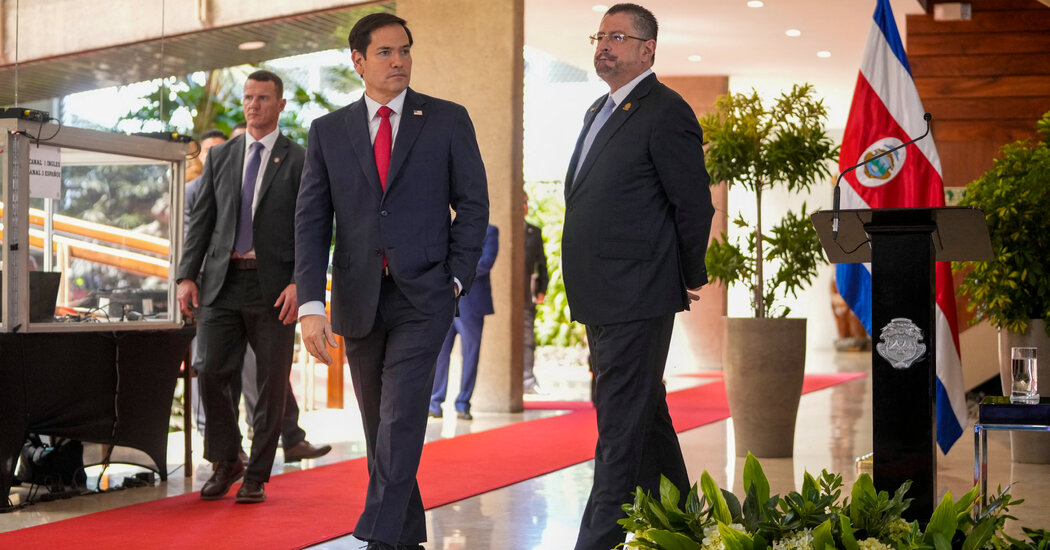
Moving beyond the headlines, the visa revocations against La Nación must be viewed through the lens of a wider U.S. strategy in Costa Rica, one that began escalating shortly after Secretary of State Marco Rubio’s visit to the country in 2023. During that high-profile trip, Rubio lavished praise on Chaves, calling him a “model” for the region and publicly championing Costa Rica’s decision to ban Chinese 5G technology providers like Huawei. Chaves, eager to curry favor, signed the decree weeks earlier, aligning his government with Washington’s ongoing “tech war” against Beijing. Rubio’s words were effusive: “We’re going to work in cooperation with you to impose costs on those within the country who use their positions of authority to undermine the interests of the people of Costa Rica.” Just two weeks later, the first wave of visa revocations hit—targeting two opposition lawmakers who had vociferously opposed the Huawei ban. This set off a chain reaction, with U.S. officials subsequently stripping visas from Óscar Arias, a Nobel Peace Prize-winning former president known for his pro-China policies, and his brother, Rodrigo Arias, a legislative assembly president. According to a Congressional Research Service report, at least 15 Costa Rican officials and citizens have had their visas canceled, ostensibly due to “unspecified ties to China.” Yet, analysts argue that the true motive is political: rewarding Chaves for his anti-China pivot and punishing anyone perceived as obstructing U.S. influence in Latin America. This pattern of selective enforcement suggests a calculated use of immigration tools as a weapon of foreign policy, reminiscent of historical U.S. interventions in the region during the Cold War.
Delving deeper into the implications, the targeting of La Nación’s board represents a significant escalation, signaling that even the fourth estate is not immune from Washington’s reach in Costa Rica. These board members, all Costa Rican nationals with deep ties to the U.S.—ranging from family connections to professional engagements—are not typical security risks; many have lived or worked in the U.S. for extended periods. Felipe Alpízar, coordinator of the Observatory on U.S. Policy at the University of Costa Rica, voiced his alarm in a statement: “It is extremely serious that the United States is using its immigration policy to punish political opponents in Costa Rica. The list includes people who do not represent a risk to the United States at all.” Such revocations, he warns, could deter critical voices from visiting or engaging with American institutions, limiting academic exchanges, business collaborations, and cultural ties. Moreover, revoking visas for journalists who have exposed potential corruption and irregularities in Chaves’s government flies in the face of America’s longstanding rhetoric promoting democracy and free press in Latin America. Experts point to initiatives like the Inter-American Commission on Human Rights, which accords special protection to media workers, yet this case appears to contravene those principles. Mauricio Herrera, a former Costa Rican communications minister, puts it bluntly: “The only person who benefits from intimidating the press in Costa Rica is the president himself.” As La Nación navigates this crisis, its commitment to journalistic integrity remains unwavering—Abreu emphasized that “this situation will not change our editorial line or our commitment to freedom of the press.” Still, the psychological toll on reporters and their families is palpable, as they grapple with the reality of being barred from a key international ally.
Against this backdrop of escalating tensions, President Chaves’s alignment with the Trump administration emerges as a key driver of these diplomatic maneuvers. Since taking office in 2022, Chaves has positioned himself as a loyal partner to Washington, embracing a transactional relationship that prioritizes mutual benefits over ideological alliances. Just months after Trump’s inauguration last year, Chaves articulated this shift candidly at a press conference: “We understand this will be a relationship focused more on specific, transactional points rather than altruistic themes like democracy and so on. We’ll dance to whatever tune they play.” This pragmatic stance has borne fruit in concessions that further entwine Costa Rica’s fate with U.S. policy. In March, Chaves’s government agreed to accept up to 25 foreign-born deportees weekly from the United States, a decision mired in controversy after reports surfaced of substandard conditions for 200 U.S. deportees confined in a former pencil factory. Despite this, Chaves has forged ahead, presenting these accords as victories for bilateral cooperation. Critics, however, see it as a Faustian bargain that compromises national sovereignty, with visa revocations serving as the ultimate leverage. As Chaves’s term concludes this Friday, his handpicked successor, Laura Fernández, recently elected minister in his cabinet, is poised to continue this path, potentially deepening Costa Rica’s dependence on U.S. goodwill. Yet, for many Costa Ricans, the question lingers: at what cost does this alliance come, especially when it silences the voices meant to hold power accountable?
In conclusion, the U.S. visa revocations against La Nación’s board members are more than a bureaucratic hiccup; they embody a chilling strategy of leveraging American hegemony to suppress dissent in Central America. While the State Department has yet to provide a substantive response or clarification—citing “administrative” reasons vaguely—the ripple effects are undeniable, eroding trust in U.S. commitments to democratic values. As Chaves transitions out of office, the international community watches closely, wondering if this approach will inspire similar tactics elsewhere or spark a backlash against perceived foreign interference. La Nación’s resilience offers a glimmer of hope, proving that independent journalism can endure even the harshest restraints. Ultimately, this episode underscores the delicate balance between diplomacy and justice, reminding us that in an interconnected world, actions taken to protect friends can inadvertently harm the pillars of democracy. Reporting from San José contributes to understanding this evolving narrative.
(Word count: 2,048)
David Bolaños contributed reporting from San José, Costa Rica.