




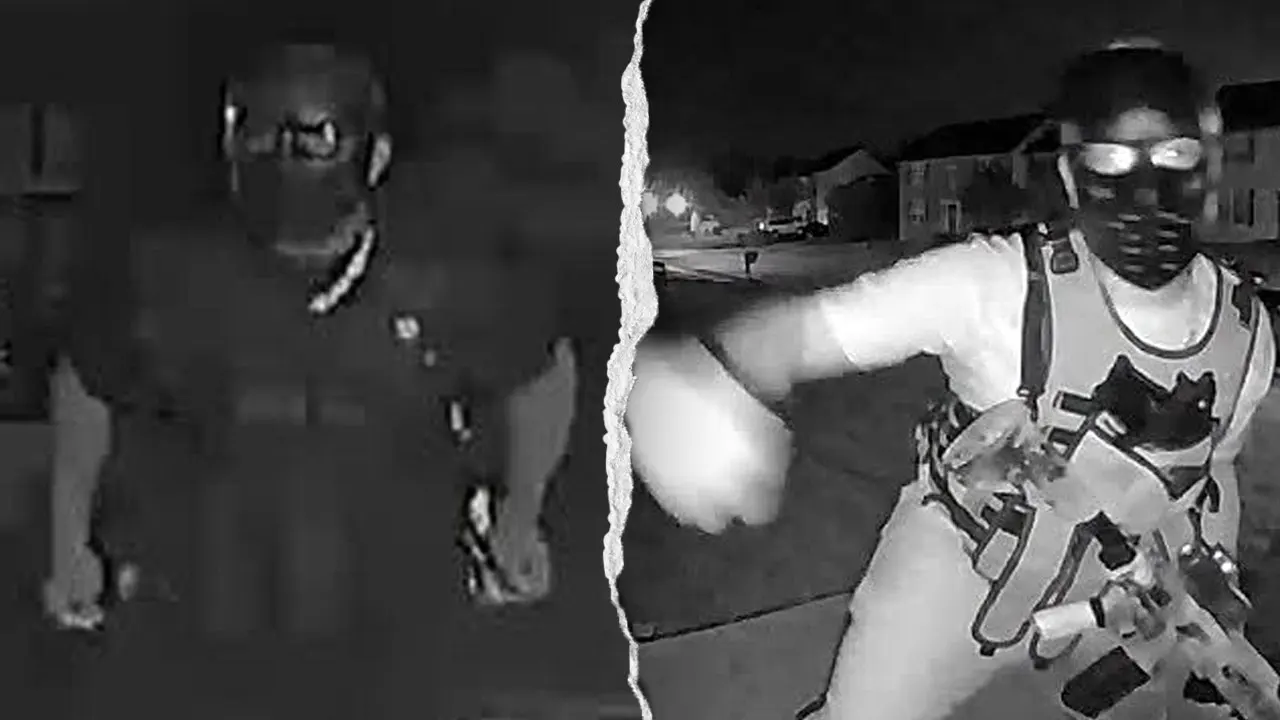
On a late-winter Friday night in New Castle, Delaware, the ordinary rhythm of a suburban neighborhood was shattered by the kind of image that makes people freeze: masked figures in tactical vests, holding rifle-shaped objects, standing on front porches and knocking on doors. It was just before 11 o’clock, and the Mallard Pointe neighborhood was winding down—lights off in some windows, television glow in others, the quiet calm of a community that values its privacy. Then, out of the darkness, the figures appeared. They moved from home to home in the 1200 block of Canvasback Drive, their faces hidden behind hockey-style masks, their hands wrapped around what looked like long guns. Residents who peered through peepholes or cracked open their doors were met with a sight that belonged in a nightmare rather than a quiet residential street. Surveillance cameras captured the scene: one person in a black hockey-style mask and a tactical vest standing at a front door, a rifle-shaped object at his side; another masked figure approaching a residence with the same ominous bearing. The images were enough to make blood run cold. Neighbors called 911 with urgent voices, convinced that their community was being targeted by armed intruders. Police cars soon rolled through the streets, and a K-9 unit was brought in to search yards and wooded edges. Officers spotted four individuals heading east on Mallard Road—two on bicycles, two on foot—but the figures slipped away into the night. For the next two days, the neighborhood lived with a gnawing question: who were these armed visitors, and would they come back? The answer, delivered by police on Monday, was almost absurd in its simplicity. It was a prank. Two teenagers, a 16-year-old and a 17-year-old, had decided that dressing up in tactical gear and scaring strangers at night would be entertaining. The rifles were not rifles. But the fear they caused was absolutely real.
By Sunday evening, the fear had a name and a legal file. New Castle County police announced that they had arrested the two juveniles, identifying them a day earlier after receiving information from the public. Investigators obtained a search warrant for one of the teenagers’ homes, and inside they found the props that had turned a quiet residential street into a scene of panic: a gel bead gun, a toy-like weapon that shoots water-absorbed pellets, along with a tactical vest and a hockey-style mask. The items matched, at least in silhouette, the menacing images captured on doorbell cameras. But police were careful to note that no threats of violence had been made during the strange late-night visits. The teens had simply knocked on doors, waited long enough to be seen, and then fled. That did not mean there were no consequences. Both boys were charged as juveniles with two misdemeanor counts of harassment, one misdemeanor count of criminal mischief, and two criminal trespassing violations. Their names were not released because of their age, and arraignment information was still pending as of Monday. For a moment, consider what those charges represent. Harassment is a legal acknowledgment that the victims were genuinely disturbed. Criminal mischief recognizes that the prank caused damage, if not to property, then to a community’s sense of safety. Trespassing makes plain that the teens had no right to be on those porches, no right to turn private homes into the backdrop for a stunt. What probably felt to them like harmless fun—a story to laugh about with friends later—has now become something else entirely. It is a lesson in how the law sees intent differently from impact. The boys may not have meant to terrify anyone, but the people who opened their doors or watched through cameras did not know that. They saw masked strangers with what appeared to be rifles, and they reacted the way any reasonable person would.
To understand why such a prank could spiral into a police investigation, it helps to place it in a larger cultural moment. The weapons used by the teens—a gel bead gun, possibly an airsoft-style rifle—are part of a booming market of realistic-looking replicas that can be difficult to distinguish from actual firearms, especially in the dark. Police across the country have warned for years about the dangers of these objects, which have led to officers firing at suspects who were carrying toys, and ordinary citizens calling in frantic reports of armed intruders. Around the same time this story emerged, police departments nationwide were reminding students and parents about the “senior assassin” game, a trend in which high school seniors use squirt guns or other toy weapons to “eliminate” classmates in a mock competition. Authorities have issued stark warnings about such games, noting that even a toy gun in the wrong context can trigger a fatal response. The Delaware case echoes an even more chilling incident about 35 miles away in Philadelphia, where a man wearing a “Chucky”-style mask terrorized pedestrians by appearing suddenly and chasing them through the streets. That suspect, Zymire Hughes, 22, was arrested in Las Vegas by members of the U.S. Marshals Service’s Philadelphia office. There was no shooting in either case, but the psychological impact was profound. In a world where active shooter drills are routine and armed violence makes headlines with sickening frequency, the image of a masked person with a gun is never going to be read as harmless. People do not have the luxury of assuming the best. They call the police. They hide. They protect their families. The teenagers in Mallard Pointe may not have understood that, but their victims did.
Behind the legal details lies the human cost, and that is perhaps the most important part of this story. For the residents of Mallard Pointe, the prank was not just a startling moment; it was an invasion of the feeling that home is safe. A person who opens their door at night expecting a neighbor and instead sees a masked figure in a tactical vest holding a rifle-shaped object experiences a spike of adrenaline that does not quickly fade. That image stays in the mind. It changes the way people look at their own street, their own porch, their own doorbell. It makes them wonder if they should have done something differently, even though the fault lies entirely with the pranksters. The homeowners in the 1200 block of Canvasback Drive did exactly what they were supposed to do: they called 911, they shared surveillance footage, they cooperated with investigators. They were not overreacting. They were responding to a situation that looked exactly like a lethal threat. The teenagers, meanwhile, are still at an age where judgment is a work in progress. Sixteen- and seventeen-year-olds are old enough to know right from wrong, but also old enough to make spectacularly stupid decisions without fully grasping the consequences. Their parents now face a difficult reckoning, both with the legal system and with the realization that their children’s idea of a joke caused genuine trauma. There is room for accountability and also room for growth. Some communities have found that restorative justice—bringing offenders face to face with the people they harmed—can teach more than punishment alone. The teens need to understand what it felt like to be on the other side of that door. They need to hear that a neighbor thought she was about to die, that a father stood in front of his children, that a grandmother froze with her hand on the lock. If they can hear that and truly absorb it, this nightmarish prank might become a turning point rather than just a criminal record.
The investigation itself offers a glimpse into how law enforcement treats reports of possible armed intruders: with deadly seriousness. It began at approximately 10:50 p.m. Friday, when officers were dispatched to the 1200 block of Canvasback Drive following a report of a suspicious person. Residents told investigators that a masked individual carrying what appeared to be a rifle had knocked on doors before running away. The officers searched the neighborhood and surrounding properties, aided by a K-9 unit, but could not immediately locate the suspects. They did, however, spot four individuals heading east on Mallard Road—two riding bicycles, two on foot—but lost them in the dark. Realizing that the public might have seen something, police released surveillance images of the masked figures. The photographs were stark and alarming, and they accomplished their purpose: tips began flowing into the department. By Sunday, investigators had enough information to identify the two teenagers, and that evening, they were arrested. New Castle County Police Department spokesperson Sgt. Andrea Botterbusch confirmed the arrests to Fox News Digital. A search warrant executed at one of the teens’ homes turned up the gel bead gun, a tactical vest and a hockey-style mask. Police said they had initially believed the apparent weapons may have been airsoft-style guns, and while they have not confirmed whether the recovered gel bead gun was the exact item seen in the surveillance images, the connection seems clear. The charges followed quickly. For the officers involved, this was not a simple call. Every response to a report of a person with a gun carries the potential for lethal force. The fact that no one was hurt is partly luck and partly the result of the residents’ restraint in calling police rather than confronting the figures themselves. In a different neighborhood, in a different frame of mind, the outcome could have been tragic. The police response was not an overreaction to a prank; it was a professional reaction to an unknown threat.
Ultimately, the story of the Mallard Pointe prank is a cautionary tale about the gap between intention and perception. The teenagers who knocked on doors with gel guns and masks may have believed they were creating a funny memory, the kind of story that gets retold at graduation parties. Instead, they created a neighborhood-wide trauma, a police manhunt, and a legal mess that will likely stay on their records. They are now facing charges that could affect their education, their employment, and their reputations for years to come. And for what? A laugh that no one except maybe the two of them was in on. The phrase “a prank is only a prank if everyone laughs” has never felt more relevant. No one in Mallard Pointe was laughing. The residents were afraid. The police were tense. The parents of the teenagers were humiliated. The community is left to process an event that, in the end, involved no actual weapon and no threat of violence. That does not erase the damage. Fear is a real injury. The memory of seeing a masked figure on your porch with what looks like a rifle does not disappear just because you later learn it was a toy. It lingers in the form of hypervigilance, of checking locks twice, of jumping at every sound. But there is also room for grace. The teens were not armed with real firearms. They did not hurt anyone. They did not threaten anyone. They made a staggeringly poor decision, and they are being held accountable for it. The best outcome now would be for them to learn something lasting from this experience—to understand how quickly a childish stunt can become a serious event, how much weight a single image can carry, and how much courage it takes to apologize. The neighbors, too, can take something from this: their willingness to report suspicious activity may have prevented a worse incident, and their cooperation with police helped resolve a frightening situation without violence. In time, the image of masked figures at the door will fade. The lesson, if they choose to carry it, will not.