





Madison Square Garden has long been hailed as the undisputed Mecca of basketball, a glittering arena of dreams in the heart of midtown Manhattan where legends are forged under the brightest, most unforgiving lights in the world. On a high-stakes Monday night, as the New York Knicks prepared to battle the San Antonio Spurs in Game 3 of the NBA Finals, the atmosphere inside the historic venue was already electric, charged with decades of pent-up championship longing from a fan base that lives and dies by every single possession on the court. Yet, the sporting narrative took a massive, unexpected detour into the realm of high political theater when President Donald Trump stepped into the arena to watch the game. Accompanied by his granddaughter Kai, Trump made history by becoming the first sitting United States president to ever attend an NBA Finals game in person. For a moment, the focus of the entire room shifted from the hardwood to the VIP seats as Trump stood during the National Anthem, saluting the New York Police Department officers who proudly carried the American flag onto the court. It was a scene of pure Americana, a collision of sports culture and executive power, but in a city as deeply complex and fiercely passionate as New York, the sudden presence of such a polarizing figure was never going to pass without a storm. For the loyal legions of the Knickerbocker faithful, the evening was no longer just about securing a crucial postseason victory; it had suddenly transformed into a high-stakes cultural referendum, setting the stage for an explosive clash between the leader of the free world and one of the loudest, most influential voices in modern sports media.
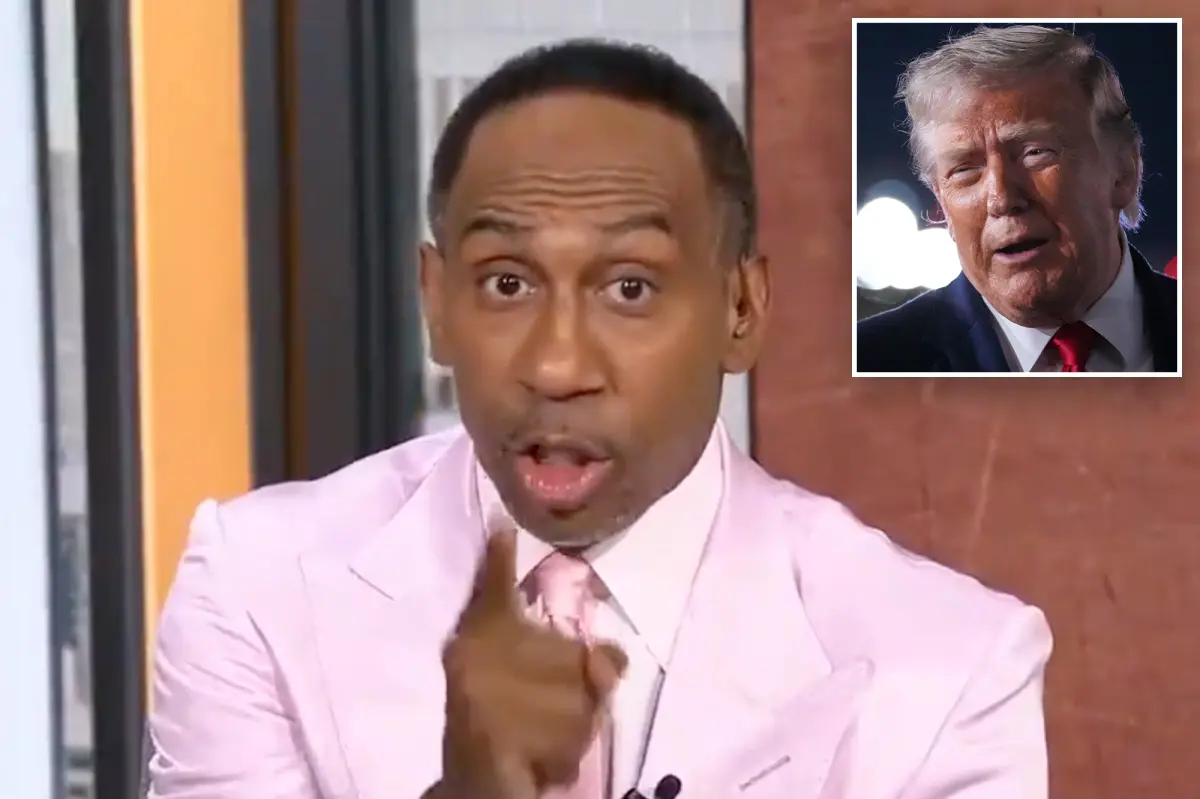
Enter Stephen A. Smith, the bombastic anchor of ESPN’s flagship morning show First Take, whose voice has served as the amplified conscience—and occasional megaphone—of disgruntled sports fans for decades. Renowned for his theatrical outrage and unmatched rhetorical flair, Smith did not merely express concern over the president’s surprise appearance; he erupted into an unhinged, classic on-air tirade that instantly went viral across the sports and political landscape. Speaking with a desperate, manic intensity that drew both nervous laughter and fascinated stares from his co-hosts, Smith insisted that the president had absolutely no business showing up to the World’s Most Famous Arena in the middle of a historic playoff run. To Stephen A., the timing of Trump’s arrival was not an act of sports fandom, but rather a display of calculated self-interest, branding the move as entirely selfish and narcissistic. He argued that the delicate, hard-earned momentum of the Knicks—who had been playing with an undeniable flow and rhythm—was being needlessly disrupted by the massive security apparatus, media circus, and sheer political gravity that inevitably follows a sitting commander-in-chief. In his trademark dramatic style, the analyst made a solemn, half-serious vow to his national audience: if the pressure of the moment, the distraction of the VIP guests, or the sheer cosmic bad luck of the president’s attendance caused the New York Knicks to drop the crucial home game, he would lay the blame squarely and unapologetically at the feet of the White House. Smith warned that “hell hath no fury” like him if the Knicks lost, promising to cling to the president’s back pocket “like white on rice” in the days to come, asserting that his criticism transcended partisan politics, as he would feel the exact same frustration whether the visiting president was Reagan, Clinton, Bush, or Obama.
As fate would have it, the sports gods seemed to take Stephen A. Smith’s warnings as a direct challenge, unfolding a dramatic narrative on the court that played right into the commentator’s hands. The game itself was a grueling, heart-stopping affair, characterized by aggressive defensive stands, spectacular offensive runs, and the grueling physical toll unique to the NBA Finals. With the San Antonio Spurs fighting desperately to claw their way back into the series, the Knicks struggled to maintain their footing, looking uncharacteristically out of sync during crucial stretches of the game, almost as if the heavy air of distraction inside the Garden was weighing on their shoulders. Despite a furious late-game rally that sent the home crowd into a frenzy, New York ultimately fell agonizingly short in a tight 115-111 defeat. The loss was a bitter pill to swallow for the thousands of fans packed into the historic rafters, cutting the Knicks’ series lead to 2-1 and snapping their dominant momentum just when they seemed poised to take a commanding stranglehold on the championship. Instantly, the prophecy of doom that Stephen A. had spun hours earlier on television seemed to manifest as reality in the minds of superstitious fans, creating an immediate media firestorm where sports analysis blended seamlessly with political superstition. The whispers and social media debates erupted into a roaring chorus, questioning whether the massive security presence, the altered pre-game routines, and the sheer spectacle of the president’s arrival had indeed cursed the home team, turning a painful athletic setback into a highly publicized referendum on the distracting nature of modern political fame. Throughout the four quarters of play, every eyes was split between the court and the presidential suite, where Trump sat alongside his family, absorbing the high-intensity drama of New York basketball. When the final buzzer sounded, confirming the disappointing defeat, the spotlight instantly shifted from the exhausted players walking off the court to the political titan who had watched it all unfold, setting the stage for an inevitable and highly personalized counteroffensive.
President Trump, never one to let a public jab go unanswered, did not wait long to execute a counter-strategy of his own as he prepared to leave the city. Just after midnight on Tuesday, on the tarmac at John F. Kennedy International Airport, the president was preparing to board his flight back to Washington, D.C., when reporters eagerly pressed him for a response to Stephen A. Smith’s biting pre-game remarks. Standing under the dark New York sky, with the engines of his aircraft humming in the background, Trump delivered a classic, disarmingly sharp rebuttal that showed his seasoned familiarity with the media landscape. Rather than engaging in a shouting match or displaying outward anger, Trump began by offering a patronizing compliment, describing the ESPN analyst as a “nice guy” before pivoting swiftly to dismiss his intellectual capacities entirely. Trump asserted that running for public office, particularly the presidency of the United States, requires a specific, high-level intelligence and cognitive aptitude—qualities he pointedly suggested that Smith conspicuously lacked. With a characteristic shrug and a dismissive tone, the president remarked, “You need a high IQ; I’m not sure Stephen has that,” effectively turning the sports commentator’s critique of his sporting presence into an evaluation of Smith’s own rumored political ambitions. By shifting the battlefield from basketball superstition to intellectual capability, Trump sought to neutralize the attack, reminding the public of the sharp divide between talking about games on television and managing the complex affairs of state. The brief exchange, which quickly took social media by storm, highlighted Trump’s instinctual ability to command the narrative, turning what could have been a trivial sports feud into a broader debate about leadership, competence, and public service. This sharp, late-night clapback not only drew laughter and outrage across different political factions, but it also cemented the reality that in the modern media landscape, no criticism is too small to escape the notice or the retaliatory wit of the former reality television star turned commander-in-chief, especially when it concerns his home turf of New York City.
The clash between Trump and Smith is particularly fascinating when viewed through the lens of modern American culture, where the boundaries between sports entertainment, celebrity status, and national politics have become almost entirely invisible. Stephen A. Smith has frequently teased, or been touted as, a potential outsider Democratic candidate for the 2028 presidential cycle, leveraging his massive platform, natural charisma, and ability to connect with everyday Americans to build a profile that extends far beyond the analyst’s desk. For years, Smith has presented himself as a self-styled Independent, an analytical centrist who claims to view the political spectrum without partisan blinders, which is why his fierce, emotionally charged denunciation of Trump’s attendance struck such a discordant note for some viewers. By inserting himself so aggressively into a political narrative during a sports broadcast, Smith effectively crossed a digital Rubicon, inviting the very kind of political scrutiny and direct presidential retaliation that he received at JFK Airport. This public sparring match illustrates how sports television has transformed into a secondary arena for political combat, where talking heads and elected officials trade jabs with the same intensity once reserved for campaign trails and legislative floors. As the lines continue to blur, public figures like Smith find that their sports-related grievances are no longer viewed in a vacuum, but are instead parsed, analyzed, and weaponized as indicators of their broader ideological leanings and potential viability for higher office in a highly polarized nation. The exchange served as a stark preview of what a hypothetical campaign trail matchup might look like between a veteran political brawler who mastered the art of populist messaging and a media powerhouse accustomed to winning verbal shouting matches on a daily basis. For the millions of viewers who watch First Take for pure escapism, the intrusion of national politics into a basketball championship was a reminder that in today’s society, there are virtually no safe harbors left untouched by the ongoing cultural cold war, where even support for a beloved home team is scrutinized for underlying political alignment.
As the dust begins to settle from this late-night battle of egos, the focus inevitably swings back to Madison Square Garden, where the New York Knicks must gather their composure and prepare for a critical Game 4 on Wednesday night. While the pundits engage in endless posturing over IQ tests, political optics, and the hypothetical “curse” of executive attendance, the actual players are left with the daunting task of defending their home court and maintaining their precious 2-1 series lead against a resilient San Antonio Spurs team. The basketball world eagerly watches to see if President Trump will make another appearance, or if the intense media fallout from Game 3 will prompt a quiet retreat to Washington, leaving the arena to the athletes and the pure sports enthusiasts who simply want to witness history on the court. Ultimately, this brief, explosive episode serves as a vivid snapshot of twenty-first-century American life: a place where a sitting president can attend a historic sporting event with his family, spark a national television controversy before halftime, receive blame for a hard-fought athletic defeat, and deliver a devastating airport tarmac rebuttal all within the span of twenty-four hours. As the Knicks and Spurs lace up their sneakers for the next chapter of their grueling series, the city of New York remains, as always, a dramatic stage where the worlds of sports, politics, and celebrity entertainment continue to collide in spectacular, unpredictable fashion. What remains certain is that neither Trump nor Smith is likely to back down from their respective positions, with both men thriving on the oxygen of public controversy and the passionate loyalty of their respective audiences. As the city braces for the next tip-off, the conversation echoing through the sports bars of Manhattan and the halls of Congress alike proves that while the championship trophy will eventually find a home, the endless, roaring debate over who truly owns the spotlight in New York is far from over.