


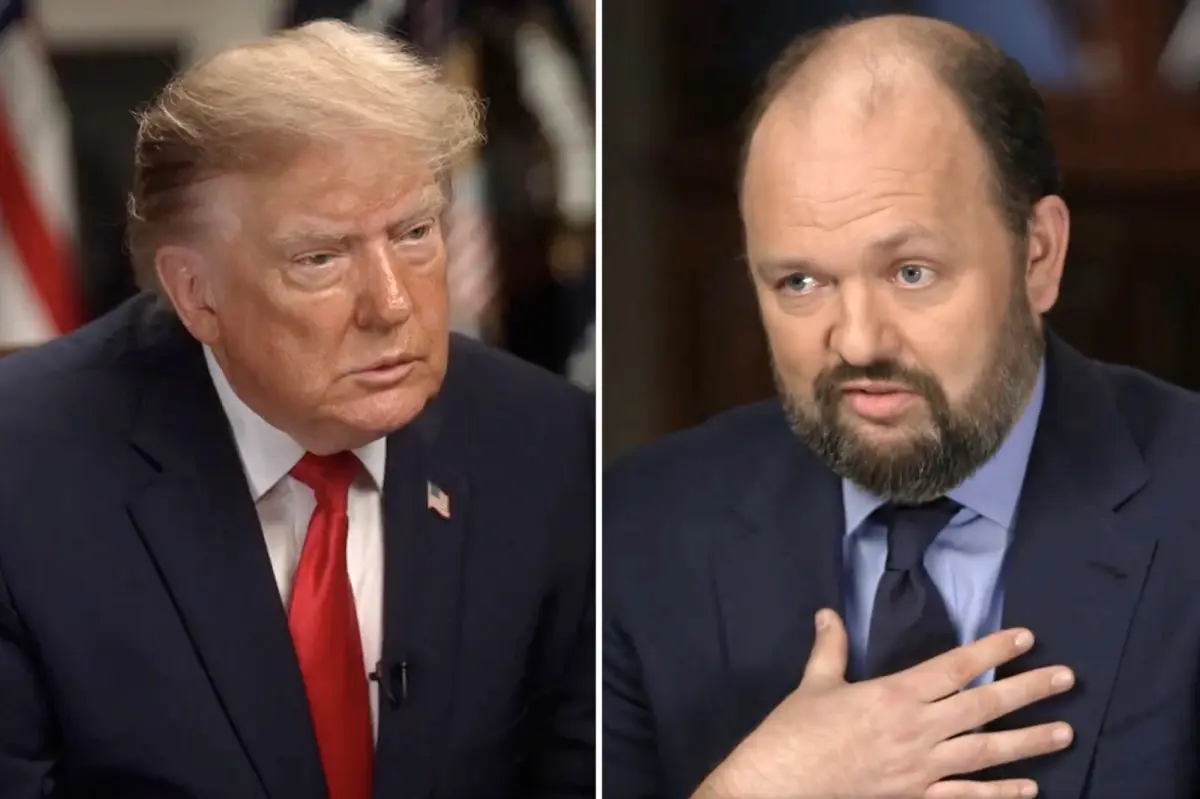
President Trump has always had a talent for making the extraordinary sound ordinary. When asked about the remarkable jump in his personal wealth since he returned to the White House, he offered what he called a simple explanation: “You should’ve had stock.” In an interview with Ross Douthat for “60 Minutes,” broadcast Sunday evening, Trump brushed aside the news that he had become more than $3 billion richer on paper since the start of his second term. He insisted that he spends almost no time thinking about his net worth. “I don’t care. I have a lot of money. Far more than I ever thought I’d have. And, I guess it’s gone up. I don’t even know,” he said. The president explained that his son Don Jr., “a very straight, good guy,” watches over the money. “I don’t even talk to him about it. He watches. He gives, they gave my money — I have a lot of cash. I’ve had a lot of cash, long before I came in here. I don’t take a salary, you know.” There was something almost paternalistic in his tone, as if the entire conversation about his billions was beneath him. But the reality underneath that casual dismissiveness is far more tangled. The estimated growth in his fortune from roughly $2.3 billion in 2024 to about $6 billion today did not happen because of a few smart stock picks. It happened through a series of ventures that blur the line between public office and private business: cryptocurrency tokens bearing his name, licensing deals with developers from the Persian Gulf to Southeast Asia, and investments tied to people connected to foreign governments. Trump’s message was simple: stop worrying, everyone should have bought stock. But the financial disclosures tell a different story, one that has already set the stage for political battles in the new Congress. The idea that he might have a conflict did not seem to occur to him. As far as Trump is concerned, the presidency is simply a new backdrop for a lifelong business career, and the money is just proof that the brand still works.
The numbers behind that dismissive answer are staggering, and they require some translation. According to Trump’s 2025 financial disclosures, released this past June, he made more than $1 billion in cryptocurrency income and tens of millions from new foreign real estate deals last year. Forbes now estimates his net worth at roughly $6 billion, up from $2.3 billion in 2024. That is not simply a bull market or a housing boom. The single largest piece of the crypto windfall was about $635 million from sales of the $Trump meme coin, a wildly speculative digital token launched through his company CIC Digital LLC just three days before he took office. The meme coin, which has no underlying business or utility, was essentially a trading card that people bought because of the president’s name. Trump also took in more than $236 million from selling cryptocurrency tokens through World Liberty Financial, a company founded by Trump, special envoy Steve Witkoff, and their sons in 2024. There was $65.6 million from a sale of equity in World Liberty, likely tied to a reported deal with companies connected to Sheikh Tahnoon bin Zayed al-Nahyan, the United Arab Emirates’ national security adviser. And he reported $205 million in proceeds from stablecoin investments, including selling part of Stablecoin Holdco, an entity linked to World Liberty and its issuance of the USD1 stablecoin. For people who don’t follow crypto, these terms can sound like gibberish. In simple language, the president’s business relationships after his reelection included trading in digital assets whose value was often tied to his political career. The disclosures also reported licensing fees from real estate projects around the world, adding tens of millions more. In other words, Trump’s financial empire was not merely sitting in a mutual fund; it was actively monetizing his presidency in new and aggressive ways. The “stock” he told people they should have bought doesn’t exist in the traditional sense. It was digital, volatile, and intimately linked to his brand.
The foreign real estate portion of Trump’s income is just as dizzying. The financial forms show millions of dollars flowing in from licensing agreements for building and golf course projects bearing his name. In Qatar, there was $5.25 million from a forthcoming golf club in Doha, part of a deal signed in April 2025. In Romania, $5 million came from a Bucharest Trump Tower project announced that July. Indian construction projects in Delhi, Gurgaon, Hyderabad, and Noida contributed nearly $8.5 million in licensing fees. A resort in Vietnam, approved by local officials last year, brought in another $5 million. In Dubai, where Trump is building an 80-story skyscraper announced in April 2025, licensing and management fees added about $13 million. Abu Dhabi contributed $10 million, and Saudi Arabia $9.2 million for luxury projects in Riyadh and Jeddah currently under construction. These are not small, passive investments. They are branding deals that depend on the president’s continued global prominence, and they create a complicated web of relationships with foreign developers, government officials, and investors. Trump acknowledged the tension in his “60 Minutes” interview, saying he has a company that his sons run. “It’s hard to say to them, ‘Don’t do anything anymore for four years because I’m president,’” he said. He then tried to normalize the situation by claiming that “every president has had this problem.” That is not exactly true. Modern presidents have typically placed their assets in blind trusts or divested from active business operations to avoid conflicts. Trump’s sons were not managing a family farm or a portfolio of municipal bonds; they were approving new licensing deals with foreign partners while their father sat in the Oval Office. The money from these deals flows through Trump’s own company, not a detached trust. The appearance of a president profiting from his office is precisely the sort of thing that ethics experts warn about, and the sheer number of countries involved makes the issue difficult to ignore.
The exchange between Trump and Douthat became increasingly tense as the reporter pressed the point. Douthat observed that it seemed like more people have continued doing business while serving in the administration than in previous presidencies. Trump did not mince words. “Well, I’m a bigger name than other presidents, whether we like it or not,” he shot back. That line captures the president’s worldview: his fame justifies the unusual money flowing into his family business, because no other president could generate this kind of demand. The interview, taped Friday at the White House, was Trump’s first long-form sit-down since Republicans lost both the House and Senate in Tuesday’s midterms. It ran on “60 Minutes,” a program that has long been a staple of American political life, and the choice of Douthat as interviewer was itself notable. Douthat, a conservative former New York Times columnist, was hired by new CBS News boss Bari Weiss in a move that appeared designed to bring a more heterodox voice to the venerable news magazine. The session was not a hostile interrogation, but it also was not a friendly infomercial. Douthat kept coming back to the money, and Trump kept deflecting. At one point, Trump volunteered that “every president that there’s ever been, they have people, many people, I watch it all the time, every time you have a president, their top people, sometimes they stay. I have some that will stay right till the last second. But after they leave they go crazy.” It was a rambling, almost philosophical answer that avoided the central problem: Trump was not talking about former aides. He was talking about his own family and his own company. The “I’m a bigger name” response was perhaps the most honest thing he said, because it is true that Trump’s brand is unique. It also reveals why the conflict is so difficult to resolve. No one else could step aside and leave the business in a truly independent trust, because the business is the president himself.
What makes this story so human, in a strange way, is Trump’s utter refusal to see himself as someone with a conflict of interest. He genuinely seems to believe that his wealth is a personal matter, not a public issue. When he says “You should’ve had stock,” he sounds like a salesman who has just watched a reluctant customer miss out on a great deal. There’s no guilt, no defensiveness, no awareness that a president collecting $635 million from a meme coin launched days before taking office might look like a payoff. In his mind, he has always been a businessman, and he is not going to stop being one just because he won an election. He has a son who watches over the money, and that is enough. The problem is that the line between Trump the president and Trump the brand has never existed. In fact, it is the premise of his political identity. He campaigned as a successful businessman, governed as a celebrity executive, and never let the public forget that his name is on towers, resorts, and now digital tokens. The foreign deals are not side effects of his presidency; they are direct consequences of it. A developer in Qatar or Dubai does not pay tens of millions in licensing fees because they love golf course architecture. They pay because a Trump-branded project signals access, influence, and proximity to the president. Trump may not be personally negotiating these deals, but his sons are, and they are using the same name and reputation that their father has spent a lifetime polishing. The “simple explanation” he offered on television is not simple at all. It is a claim that the presidency is just another chapter in the long history of the Trump Organization, and that the ethical rules that applied to previous presidents simply don’t apply to someone with a bigger name. He has long boasted about not taking a salary, as if that makes him a public servant rather than a businessman, but the salary is a rounding error compared with the money flowing in from every corner of the globe.
Looking ahead, Trump’s dismissiveness is unlikely to end the matter. Democrats in Congress have already promised to make the Trump family’s overseas business interests a focus of oversight investigations when the new Congress is sworn in on Jan. 3. They will want details about the $Trump meme coin, about World Liberty Financial, about the UAE equity sale, and about all those licensing deals in the Gulf and Asia. They will issue subpoenas, hold hearings, and try to connect the dots between Trump’s policy decisions and his family’s finances. Trump, for his part, will continue to shrug, claim he doesn’t care about money, and tell people they should have bought stock. It is a clash of worldviews that cannot be easily resolved. To Trump, the entire controversy is almost a form of flattery: everyone wants a piece of the brand, so why shouldn’t he profit from it? To his critics, it is a scandal unfolding in plain sight, evidence that the presidency has become a family business. The human tragedy is that Trump seems incapable of understanding why this bothers anyone. He is eighty years old, richer than he ever expected to be, and surrounded by children who protect his legacy. He spent his life building a public image, and now he has turned the most powerful office in the world into another extension of that image. The interview with Douthat did not change anyone’s mind. It just put the contradiction on display. There was Trump, speaking in the White House, surrounded by the symbols of American authority, insisting that his enormous new wealth was a mystery to him even as the paperwork showed more than a billion dollars in crypto sales and millions from foreign developers. He came across as confident, dismissive, and utterly convinced that the rules were never meant for him. The stock market advice was telling: he believes the president’s job is to sell, and the American people just need to buy in. But with the new Congress ready to investigate, the real price of that attitude may finally come due.