

The Deadly Inferno at Turkey’s HABAS Steel Plant: A Community in Mourning
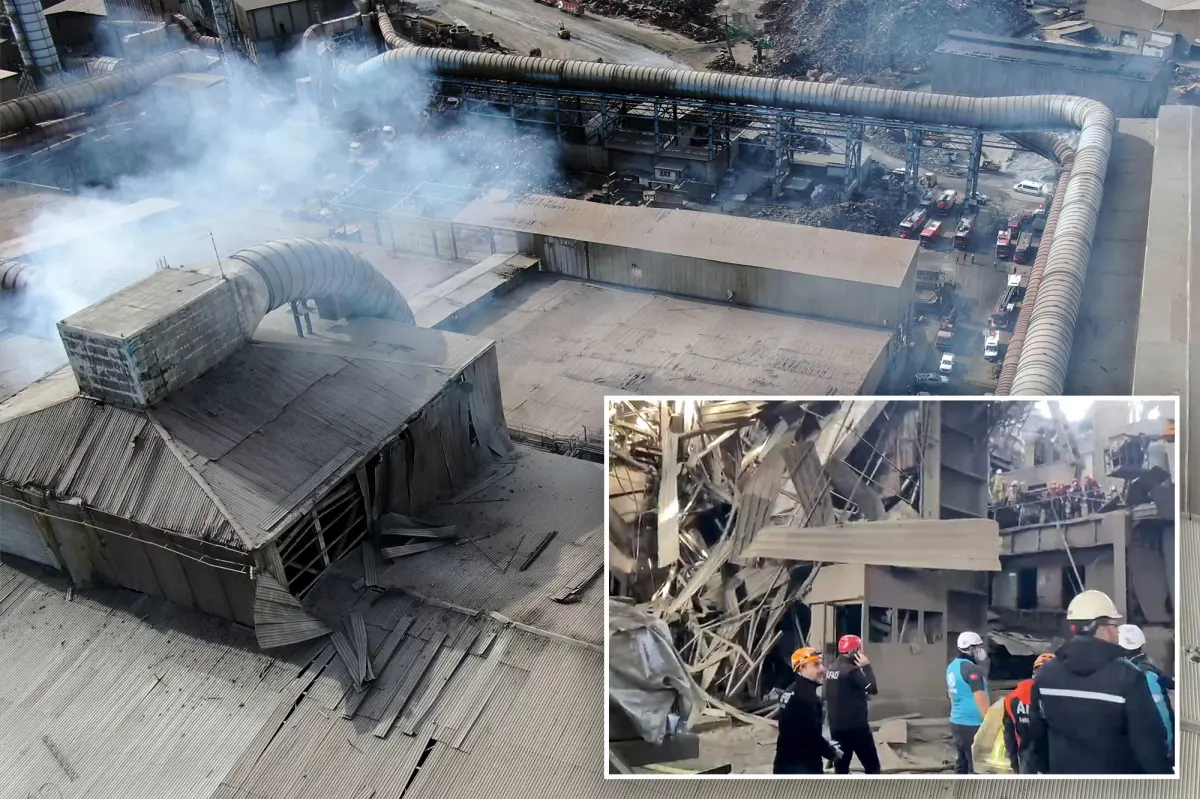
The quiet industrial rhythm of Aliaga, a coastal district in Turkey’s Izmir province, was violently shattered on that fateful Monday afternoon when a catastrophic explosion tore through the HABAS iron and steelworks facility. The blast, which witnesses described as feeling like the very earth itself was breaking apart, sent a towering column of smoke into the sky that could be seen for miles around, a dark harbinger of the tragedy unfolding within the plant’s walls. What began as an ordinary workday, with laborers going about their dangerous but familiar tasks in the sweltering heat of the foundry, quickly transformed into a scene of unimaginable chaos and devastation. The initial shockwave rippled through the surrounding community, leaving residents confused and frightened, many initially convinced that a major earthquake had struck their region. Within moments, emergency sirens began wailing across Aliaga, summoning firefighters, medical teams, and search-and-rescue personnel to what would become one of the deadliest industrial accidents in recent Turkish history.
As the full scope of the disaster began to emerge, Provincial Governor Suleyman Elban delivered a somber televised update that confirmed the worst fears of a anxious nation. The explosion had claimed the lives of ten workers, their lives ended in an instant by the terrifying forces unleashed when heavy machinery met molten metal. Fifteen others had been injured in the blast, with two fighting for their lives in critical condition, their bodies ravaged by burns and trauma that would require extensive medical intervention. But perhaps most agonizing for the families gathered at the plant gates was the fate of four workers who remained unaccounted for, their loved ones clinging to desperate hope while search teams combed through the twisted metal and smoldering debris, knowing that each passing hour diminished the chances of finding survivors. The governor’s earlier statements had painted an even grimmer picture, with initial reports suggesting the death toll might be even higher, though officials cautioned that the true number of casualties could only be confirmed once the dangerous process of clearing the wreckage was complete. Izmir Mayor Cemil Tugay echoed this sentiment, his voice heavy with the weight of the moment, acknowledging that the full extent of the human cost would remain uncertain until the last pieces of debris were lifted and the site could be thoroughly examined.
The eyewitness accounts that emerged in the hours following the blast painted a harrowing picture of the moment when ordinary life turned to catastrophe. Nuri Ali Ulker, who was present at the facility when disaster struck, described the ground shaking with an intensity that defied comprehension, the force of the explosion sending tremors through the earth that seemed to last an eternity. His words, relayed through the state-run Anadolu news agency, captured the sheer terror of that moment, when the familiar sounds of industry were replaced by a deafening roar and the screams of injured colleagues. Deniz Ulker, another witness, offered an even more visceral description, stating that the explosion felt as though the very crust of the earth was shifting beneath their feet, so powerful was the blast that many instinctively believed they were experiencing a major seismic event. These personal testimonies serve as a stark reminder that behind every statistic and official statement, there are real human beings whose lives have been forever altered, workers who went to their jobs that morning expecting to return to their families in the evening, only to find themselves caught in a nightmare of fire and destruction that no one could have anticipated.
The cause of the tragedy, as investigators would later determine, lay in a catastrophic chain of events that unfolded during the delicate and dangerous process of casting liquid steel. According to officials from the governor’s office, the explosion occurred when an overhead crane, a massive piece of machinery designed to handle the immense weights involved in steel production, toppled from its position and plunged into a furnace containing thousands of degrees of molten metal. The collision would have triggered an instantaneous and violent reaction, as the cold steel of the crane met the superheated liquid, causing an explosive vaporization that sent deadly shrapnel and burning metal spraying in all directions. The incident, which occurred around noon local time, has prompted a thorough investigation, with Justice Minister Akin Gurlek announcing that four public prosecutors had been assigned to the case to determine exactly how such a catastrophic failure could have occurred and whether any safety protocols were violated. Interior Minister Mustafa Ciftci, speaking to the nation through social media, assured the public that emergency teams had fought the blaze valiantly while simultaneously conducting search operations for casualties, and that the injured had been rushed to hospitals where their conditions were being closely monitored by medical staff.
The HABAS plant, which has been a fixture of Aliaga’s industrial landscape since its establishment in 1987, represents more than just another factory in Turkey’s thriving steel industry. With an annual production capacity of 4.5 million tons of steel, the facility employs thousands of workers and serves as an economic anchor for the region, supporting countless families and ancillary businesses that have grown up around the steelworks. The company’s presence has shaped the character of Aliaga itself, a town of approximately 90,000 residents that has long been associated with heavy industry, including a substantial port and a controversial shipbreaking sector that has drawn criticism from environmental groups for its impact on the surrounding ecosystem. The disaster at HABAS thus strikes at the very heart of this community, raising difficult questions about the balance between economic development and worker safety, about the true cost of industrial progress, and about whether sufficient protections are in place to prevent such tragedies from occurring again. For the families of the victims, these broader questions offer little comfort in their moment of grief, but they will inevitably shape the discussions and debates that follow in the wake of this terrible event.
The timing of the disaster added an additional layer of poignancy, occurring as it did on the same day that world leaders and environmental activists gathered in Antalya, along Turkey’s Mediterranean coast, for crucial talks on curbing climate change and addressing the environmental challenges facing the planet. The juxtaposition of these two events, one focused on the future of our shared environment and the other a stark reminder of the human costs associated with heavy industry, could not have been more striking. As the search and rescue operations continued into the evening hours, with rescue teams working through the night to locate the four missing workers, the nation began the difficult process of mourning and reflection. The empty chairs at dinner tables across Aliaga that evening served as a silent testament to the fragility of life and the inherent dangers that workers in industrial facilities face every day. In the days and weeks to come, the investigation will seek answers to the questions that haunt the survivors and the families of the victims, while the broader community will grapple with the challenge of honoring the memory of those lost while working to ensure that such a tragedy never occurs again. The steel produced at HABAS has helped build Turkey’s infrastructure, but the cost of that production has now been measured in a far more precious currency, and the nation must decide what changes to its industrial practices should follow.