





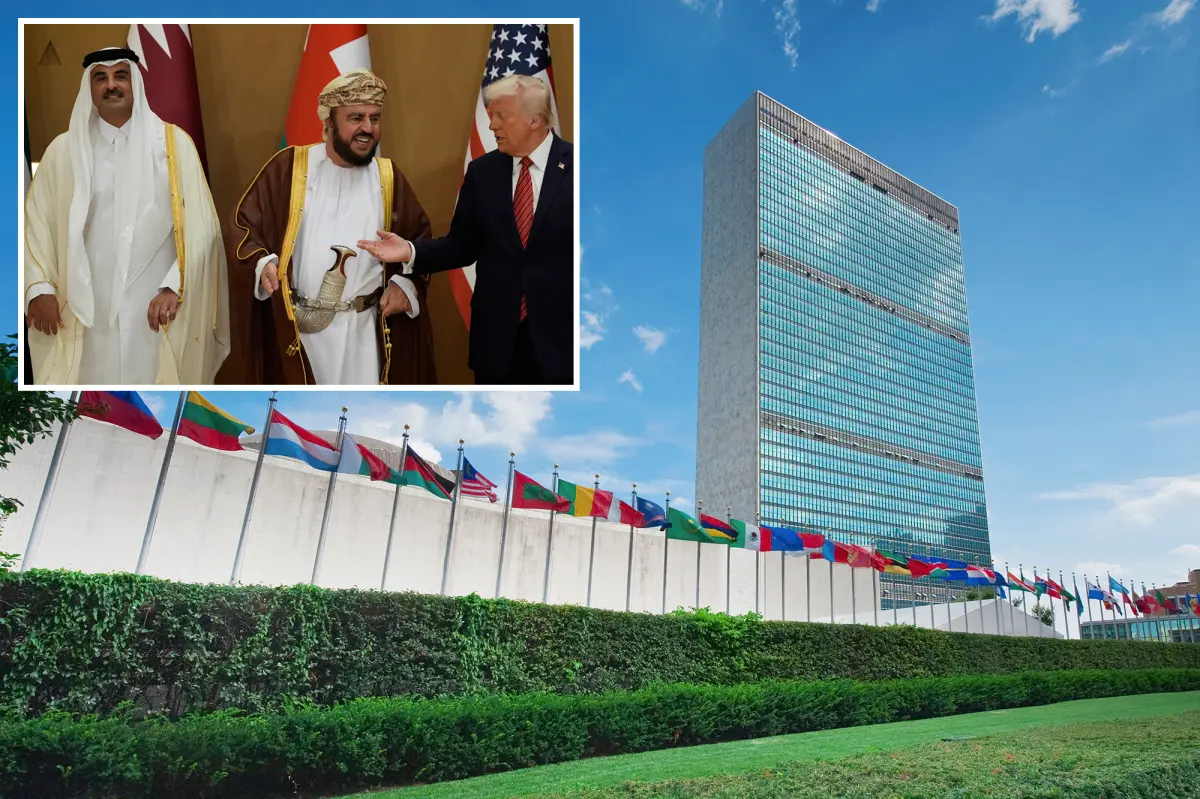
The glass-and-steel canyons of Manhattan are about to play host to a diplomatic gathering steeped in the smoke and pall of a brutal, grinding war. As the world’s leaders converge for the annual United Nations General Assembly, a far more consequential, closed-door meeting is taking shape—one that has nothing to do with climate accords or human rights resolutions, and everything to do with the raw calculus of destruction. President Trump is expected to sit down with the pinnacle of Gulf leadership on the sidelines of this global stage, a summit convened not for ceremony, but for survival. The impending war with Iran, now nearly seven months old, has transformed from a swift, surgical operation into a wearying, costly conflict, and these leaders are not merely political allies; they are the front-line victims of its collateral fallout. The skyscrapers of Doha, Riyadh, and Abu Dhabi have been rattled by the proximity of drone strikes, while the balmy waters of the Persian Gulf have turned into a chokepoint of fear, disrupting the very lifeblood of their economies. This high-level meeting, slated for next Tuesday, is a frantic attempt to lick wounds, assess damage, and plot a trajectory for a region that feels perpetually perched on the edge of a precipice. It is a human scene of tired eyes meeting across mahogany tables, shielded from the journalists outside, where the perfunctory pleasantries are but a thin veneer over the urgent, panicked question: how long can we endure this, and what comes after?
The guest list itself reads like a topographical map of American military might and regional fragility. Foreign ministers or, likely, the monarchs and princes themselves from Saudi Arabia, the United Arab Emirates, Qatar, Bahrain, Kuwait, and Oman are expected to file into the room. Each of these men carries the weight of a specific, acute anxiety. The Emirati leadership, historically focused on diversifying into a global hub of commerce and tourism, now watches as shipping insurance premiums skyrocket and logistics chains shudder. The Qataris, despite their wealth and their giant US airbase at Al Udeid, find themselves walking a diplomatic tightrope, trying to mediate while their own airspace hums with the threat of ballistic missiles. The Saudis, locked in their own regional rivalry with Tehran for decades, see this war not just as a conflict but as an existential reckoning, yet they are hemorrhaging billions in oil revenue as export terminals are targeted. The smaller nations—Bahrain, Kuwait, and Oman—are equally exposed, their populations sandwiched between a desire for security from Washington and a visceral terror of being caught in the crossfire. A source told Axios that the meeting could be expanded to encompass other Arab and Muslim leaders, a testament to the sheer breadth of the crisis. This is not a triumphal victory parade; it is a support group for the scared, where the paper-thin alliances are being stress-tested under the most extreme duress. The human reality behind these nation-states is that their citizens are terrified, their logistics firms are drowning in delays, and every secure phone call from the White House is met with a mixture of hope and dread. The leaders arrive in New York not as conquerors, but as petitioners, seeking clarity from a patron whose rhetoric has been as volatile as the ballistic trajectories threatening their skies.
The physical and economic battering of the Gulf states has been relentless, forming the dark backdrop to this diplomatic scramble. Iran, cornered and defiant, has lashed out with a ferocity that has rattled US military bases, each housed on Gulf soil, as well as the broader civilian infrastructure. For months, the residents of these nations have lived under the constant scream of air-raid sirens and the dull thud of interception systems engaging incoming projectiles. The emotional toll is invisible in the headlines but palpable in the streets. Markets have been roiled, with energy trading becoming a chaotic lottery. The disruption of natural gas and oil exports has sent ripple effects across the global economy, raising energy costs for ordinary families in Berlin, Tokyo, and even distant American suburbs. Yet, for the Gulf leaders, this economic warfare is not just a fiscal matter; it is a personal humiliation. They hold seats on global financial councils, yet they cannot guarantee the safe passage of a single tanker through the Strait of Hormuz without a convoy. The human dimension of this economic warfare is devastating—fishermen in Kuwait are afraid to cast their nets, port workers in Salalah face layoffs as cargo is rerouted, and the massive construction projects that were poised to transform the region are grinding to a halt. The leaders who will meet with Trump carry with them these anecdotes of economic despair, translating the cold statistics of GDP contraction into the stories of lives disrupted. They are seeking a definitive endgame not because they want to see their enemy vanquished entirely, but because they are exhausted, and they fear the economic devastation will outlast the military conflict, turning their gleaming 21st-century cities into hollow shells of prosperity.
Perhaps the most critical—and cynical—element of this impending meeting is the political timetable that binds the Trump administration’s strategy. According to sources, the much-discussed “day-after plan” for Iran will not be finalized until after the November midterm elections. This postponement is a stark admission that domestic politics are inextricably woven into the fabric of foreign war. President Trump has recently taken to promising that the war will conclude shortly after those fall contests, a phrase that speaks volumes about the administration’s desire to control the narrative ahead of the ballot box. Vice President JD Vance has echoed this sentiment, telling The Post that the conflict will enter a “much different phase in a couple of months.” For the Gulf leaders, this is both a threat and a promise. They are being asked to hold the line, to absorb the blows, while waiting for a political season in Washington, D.C., to end so that the true heavy-handed negotiations—or the final crushing blows—can begin. But this wait feels excruciatingly human. Imagine the general on the ground in a Gulf command center, his map covered in enemy threats, knowing that his strategy is currently subordinated to a poll in a swing state. Imagine the Iranian civilian, equally exhausted, wondering if their fate is being decided not by military brilliance but by a Senate race in Ohio. Meanwhile, Israeli Prime Minister Benjamin Netanyahu is looking to huddle with Trump at the UNGA, though a formal meeting has yet to be scheduled. Netanyahu’s presence adds a volatile layer of urgency; his impulse is to degrade Iran’s nuclear program permanently, and he views waiting as a concession. The awkward choreography of trying to get ten minutes on Trump’s schedule amidst the general assembly chaos is a human drama of ego, fear, and desperation, revealing how fragile the coordination between the US and Israel truly is, and how the Gulf states are just bystanders to these clashing agendas.
Looking deeper beyond the geopolitics, this meeting humanizes the fracturing of a regional order that was once built on the quiet expectation of American guarantees. The Gulf leaders are not monolithic autocrats; they are individuals with enormous pressure on their shoulders, facing a generation of their own citizens who are questioning the wisdom of hosting foreign troops. They sit in their palaces, reading intelligence briefs that detail the vulnerability of their own refineries and desalination plants, realizing that the security umbrella extended by Washington has become a lightning rod for attacks. The political economy of these nations is so intertwined with the US military that a withdrawal is unthinkable, yet an escalation is equally terrifying. They have to navigate their public messaging, assuring their own populations that they are not merely vassals of America, while simultaneously pleading with Washington to save them. Trump’s transactional approach to foreign policy—treating alliances as business deals—complicates this further. He may ask them for more money, for normalized relations with Israel, or for a greater share of the reconstruction costs, without offering the kind of mutual, eternal commitment that previous presidents espoused. The human anxiety in the room will be palpable: the Saudi crown prince calculating the nightlife of Riyadh versus the threat from Tehran; the Emirati prince thinking about the next World Expo versus the backlog of cargo ships; the Omani leader, traditionally an intermediary, trying to sell a peace deal while feeling the sting of betrayal from all sides. They are all essentially asking the same heartfelt question: “Are we just pawns in your domestic political game, or are we partners in a shared fate?” The lack of a definitive answer, the White House’s silence in response to queries about the meeting’s agenda, only deepens the sense of uncertainty.
As the UN General Assembly opens, this meeting on Tuesday stands as a stark crossroads. It is a human moment where the fate of a region may be realigned over the span of a few hours. The narrative of the war is reaching a critical inflection point, caught between the promise of a grueling, grinding stalemate and the possibility of a shocking, decisive denouement post-election. The lack of a finalized postwar plan is itself a form of diplomatic horror, hinting that the administration is engaging in a high-stakes gamble of improvising on the fly once the political dust settles. For those waiting in the wings—the exhausted soldiers manning Patriot missile batteries, the Iranian mothers wondering if their sons will be conscripted next, the CEOs of shipping conglomerates watching satellite images—the meeting is a weather forecast for their lives. The potential expansion of the meeting to include other Muslim leaders suggests a desperate attempt to construct a broad consensus against Tehran, a coalition of the wary rather than a coalition of the willing. Yet, the human heart of this summit remains the quiet, private moments between Trump and the anxious princes, the off-the-record asides where they will ask him for his true intentions. Does he intend to bomb the Fordow nuclear facility, or does he intend to lift sanctions in exchange for peace? The silence from the White House is thunderous. The upcoming week in New York will be a test of endurance, patience, and political will. But in the end, the six or seven men meeting in that room, surrounded by the gleaming, symbolic glass towers of the UN, are just individuals trying to navigate a storm of their own making, hoping to steer their nations—and their civilizations—out of the fiery pit of a July war into an August of calm. The entire modern history of the Middle East feels poised in those few hours, waiting to see whether the human capacity for destruction will finally give way to a desperate, weary, and all-too-human reach for peace.