


Under the heavy humidity of a late mid-Atlantic summer, the National Mall in Washington, D.C., was supposed to showcase the shining jewel of the federal government’s preparatory efforts for the nation’s upcoming 250th birthday: a newly renovated, pristine Lincoln Memorial Reflecting Pool. Millions of dollars had been funneled into restoring this historic stretch of water, which sits gracefully between the towering obelisk of the Washington Monument and the solemn marble columns of Abraham Lincoln’s memorial. The centerpiece of this $14 million renovation project, championed enthusiastically by President Donald J. Trump, was a fresh coat of specialized paint at the bottom of the basin, rendered in a custom shade the president proudly designated as “American flag blue.” However, what was intended to be a towering symbol of national pride transformed rapidly into an embarrassing public debacle, characterized by choking clouds of bright green algae blooming under the sweltering sun and large sheets of the expensive blue paint peeling off the concrete floor like wet wallpaper. Tourists and local residents who gathered at the iconic site were greeted not by a mirror-like reflection of the sky, but by a murky, discolored pond of floating debris, transforming the landmark into a popular destination for all the wrong reasons. Acknowledging the rapid and public deterioration of the site, President Trump took to social media late Saturday to reveal that the situation had become so dire that the pool would likely need to be completely or partially drained so that engineers could carry out extensive and necessary repairs. Yet, rather than attributing the failure to poor craftsmanship or hasty execution, the president directed the public’s attention toward a host of alleged saboteurs, claiming that “multiple individuals” had been arrested by federal authorities for maliciously vandalizing the site. This sudden escalation turned a highly criticized municipal infrastructure failure into a high-stakes criminal investigation, leaving onlookers to wonder where the line between civic curiosity and state-level destruction truly lay.
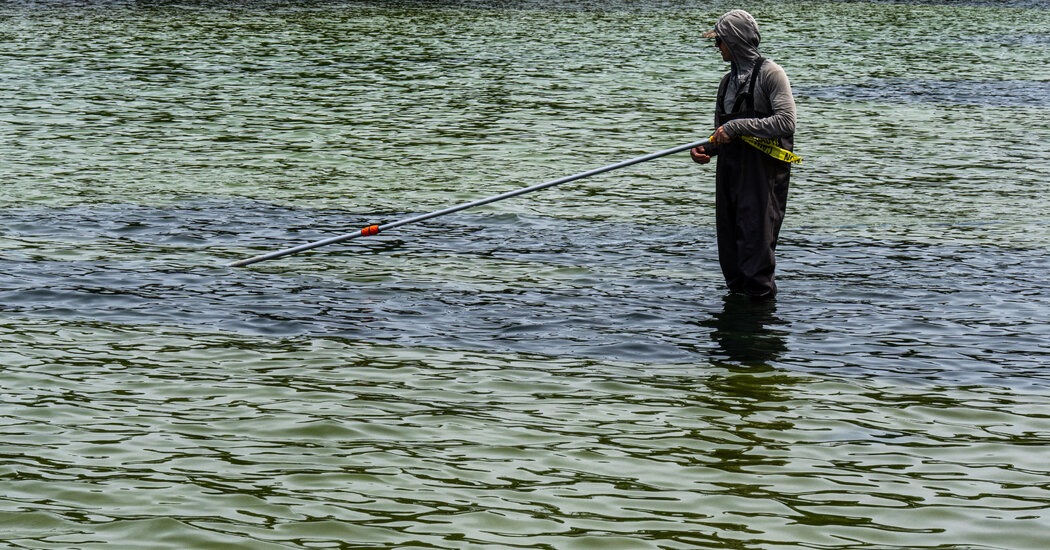
Among those swept up in this unfolding drama was David Carter Hearn, a 67-year-old resident of nearby Bethesda, Maryland, whose quiet life as a retired small-business owner and celebrated local athlete was suddenly upended by the weight of the federal justice system. Hearn is no ordinary tourist; he is a three-time Olympic canoeist who competed at the highest levels of international sport, representing the United States with distinction on the global stage. Having retired eighteen months prior from a successful career running a company that designed and sold custom, high-tech composite materials for whitewater canoes, Hearn possessed a lifelong, professional fascination with polymers, resins, and specialized coatings. On a humid Friday morning, while embarking on a grueling 50-mile bicycle ride through the capital, he decided to take a brief rest near the Lincoln Memorial to observe the widely reported issues plaguing the reflecting pool. Standing at the water’s edge, his professional curiosity was immediately piqued by the bizarre manner in which the bright blue paint was separating from the underlying concrete surface. Describing himself as nothing more than a curious and deeply concerned citizen, Hearn reached down into the shallow, algae-choked water to gently touch a loose, rubbery flap of the blue material that was still partially anchored to the pool’s floor, wanting to understand its physical properties and why the adhesion had failed so spectacularly. In his mind, his innocent action was no different from a recent televised broadcast by ABC News reporter Jonathan Karl, who had openly lifted a detached piece of the peeling paint on camera to demonstrate the structural flaws of the government’s high-priced renovation project. Hearn never imagined that this fleeting moment of scientific curiosity, fueled by a lifetime of working with specialized aquatic materials, would be interpreted by watchful federal authorities as an act of malicious and destructive vandalism against the United States government.
The consequences of his curiosity were both immediate and terrifyingly severe. Within moments of touching the peeling paint, the Olympic athlete was surrounded by officers from the United States Park Police, who took him into custody under the grave accusation of destroying government property. This charge is not a minor misdemeanor; under federal law, the malicious destruction of national property is a felony that carries a potential sentence of up to ten years in a federal penitentiary. Hearn found himself abruptly transitioned from a peaceful cyclist enjoying a morning workout to a high-profile criminal suspect, stripped of his dignity and thrust into the cold gears of the federal justice system. The Park Police transported the 67-year-old veteran Olympian to a secure detention facility located south of the National Mall, where he was held for more than four hours in near-total isolation. During this distressing ordeal, law enforcement officials repeatedly denied his requests to make a phone call to his anxious family or legal counsel, nor did they provide him with any detailed explanation regarding the specific evidence supporting his arrest beyond the broad and sweeping allegation of property damage. As the hours ticked by in the sterile holding facility, the sheer asymmetry of the situation weighed heavily on Hearn, who had spent his youth representing the American flag with pride on the global stage, only to find himself accused of vandalizing a landmark dedicated to the triumph of the union. He sat in disbelief, dressed in his cycling gear, wondering how a simple gesture of material curiosity could be construed as a threat to national security. The stark contrast between his quiet, law-abiding life in Maryland and the aggressive tactics of the federal police highlighted the immense political tension surrounding the administration’s defensive stance on the reflecting pool’s embarrassing architectural failure.
Behind the arresting officers and the domestic headlines lies a deeply controversial infrastructure project that has drawn intense scrutiny from engineers, environmental scientists, and public policy critics alike. The renovation of the Lincoln Memorial Reflecting Pool was rushed through as part of a broader, highly publicized beautification initiative led by the administration to prepare the nation’s capital for the grand celebrations of the United States’ 250th anniversary. Rather than utilizing standard, competitive federal bidding processes designed to ensure cost-efficiency and quality control, the lucrative contract to paint the basin was awarded on a no-bid basis to a private construction company closely tied to President Trump. Many experienced civil engineers and historic preservation experts had warned the administration prior to the project’s commencement that a simple, superficial coat of paint was entirely inadequate to resolve the deep-seated, systemic drainage and biological issues that have plagued the shallow concrete basin for many decades. These warnings went unheeded in the rush to secure a visually striking, patriotic aesthetic in time for summer tourism. The high summer heat and thick humidity of Washington, D.C., quickly created a perfect breeding ground for aggressive algae blooms, which rapidly overwhelmed the pool despite desperate, last-minute interventions by the Interior Department. While government agency workers claimed they had successfully “killed the algae” using chemical treatments, the physical reality on the ground told a far different story. Visitors continued to witness large clumps of dark green residue clinging to the bottom, where National Park Service employees had unsuccessfully attempted to scrub the biological growth away. Worse still, the newly installed blue coating was failing structurally, leaving massive, unsightly gaps—some the size of park benches—where the paint had completely detached, revealing the weathered, grey concrete of the original early-twentieth-century basin underneath.
Rather than acknowledging these compounding engineering blunders and the failure of the contractor’s materials, the administration leaned heavily into a narrative of deliberate sabotage and political malice. President Trump took to his popular social media platform late Friday and throughout Saturday to paint a vivid picture of a coordinated assault on American heritage, asserting that the pristine “inside surface that was just installed” had been ruined by malicious actors rather than improper curing, poor preparation, or material incompatibility. Without offering any empirical evidence, engineering analyses, or official reports to back up his claims, the president asserted in a series of highly charged posts that these unnamed vandals had gone so far as to “pour corrosive and destructive chemicals into the Pool” to deliberately destroy the bright blue finish and embarrass the administration. He warned the public that these accused individuals would face the absolute maximum severity of the law, threatening them with “years in jail” and stiff federal prosecutions for their alleged crimes. These unsubstantiated accusations of chemical warfare on a national monument injected an element of partisan hostility into what many independent experts viewed as a straightforward case of polymeric adhesion failure under intense environmental stress. The extreme official rhetoric left ordinary visitors and Washington residents feeling deeply unsettled, as the simple act of visiting a beloved national monument became fraught with the sudden danger of being misidentified as a political saboteur by overzealous law enforcement. Adding to this atmosphere of confusion and concern, both the White House and the leadership of the U.S. Park Police maintained an absolute silence when contacted repeatedly by journalists and independent investigators seeking clarification on the nature of the vandalism, the specific chemicals allegedly detected, or the identities of the other citizens who had reportedly been arrested alongside the retired Olympian.
In the face of these heavy federal accusations, David Hearn remains remarkably resilient, anchored by the deep support of his local community and fellow athletes who refuse to let his reputation be tarnished by a political storm. Since his release from federal custody, the Bethesda resident has been overwhelmed by a groundswell of solidarity from neighbors, former Olympic teammates, and legal advocates who recognize the absurdity of a 67-year-old cyclist being threatened with a decade in prison for touching a transient piece of peeling paint. Numerous prominent attorneys have already stepped forward to offer him pro bono legal representation to fight the charges, ensuring that he will not have to face the vast resources of the federal government alone. Hearn continues to maintain his absolute innocence, reiterating that he never removed or damaged a single piece of property, but was merely interacting with a material that had already separated from the structure due to the contractor’s own negligence. As the legal battle looms, the Lincoln Memorial Reflecting Pool itself stands as a stark, metaphorical monument to the perils of superficial public works, illustrating how easily grand political gestures can peel away under the harsh light of reality. In the coming weeks, as engineers prepare to drain the massive basin to scrape away the remnants of the ill-fated “American flag blue” paint, the empty, concrete expanse will serve as a quiet reminder of the human cost of political theater. For Hearn and his family, the hope remains that common sense will ultimately prevail over partisan posturing, allowing a decorated American athlete to return to his quiet life of cycling, knowing that true patriotism is measured not by the color of a pool’s floor, but by the fairness of the justice system that protects its citizens from overreach.