




The political temperature in Arizona has long matched its famously blistering desert climate, and Tuesday night’s primary elections proved to be no exception as voters headed to the polls to chart a definitive course for the state’s political future. Once celebrated as a bastion of moderate, independent-minded Western conservatism under political giants like John McCain, the Grand Canyon State has rapidly evolved into one of the nation’s most volatile and closely watched swing states. This election cycle, the state served as a critical national testing ground for two competing political currents: the enduring, kingmaking influence of former President Donald Trump on the right, and a tense ideological battle for the soul of the Democratic Party on the left. As the results trickled in under the neon lights of campaign watch parties across Phoenix, Tucson, and the surrounding suburbs, a clear and dramatic narrative emerged. Trump’s handpicked populist candidates secured resounding victories across several key Republican races, while mainstream Democratic voters fiercely rejected a progressive insurgent challenge from the democratic socialist wing of their party, signaling a collective preference for pragmatic moderation heading into the high-stakes November midterms.
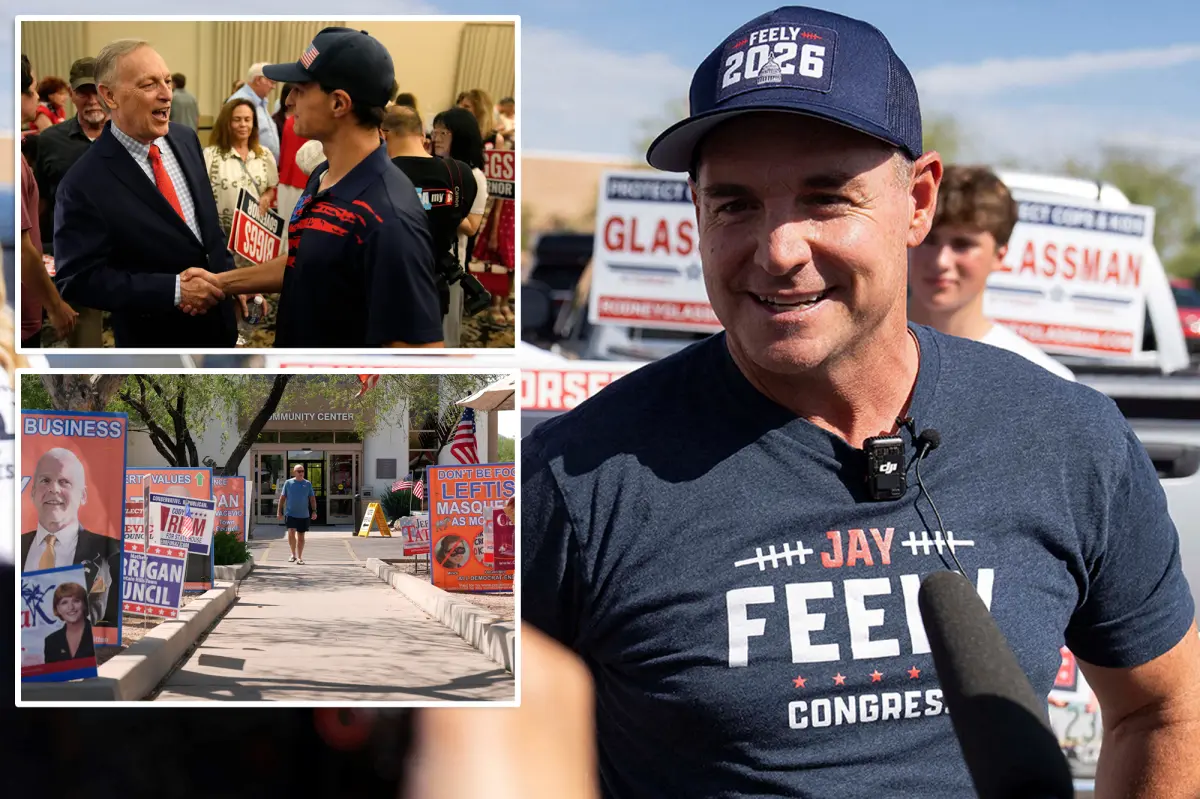
Among the evening’s most captivating narratives was the political ascent of former NFL placekicker Jay Feely in Arizona’s highly competitive 1st Congressional District, proving that the transition from the sports arena to the political coliseum remains a potent path to power. Feely, who spent fourteen grueling seasons in the professional ranks maintaining his composure before roaring stadium crowds for six different franchises, including the New York Jets and the New York Giants, translated his high-pressure athletic experience into a sophisticated and successful political campaign. In a closely watched Republican primary, Feely comfortably defeated former state lawmaker Joseph Chaplik by a convincing margin of 49.4% to 35.2%. The 1st District, currently classified as a critical “toss-up” by the nonpartisan Cook Political Report, was left vacant by Representative David Schweikert, who vacated his seat to pursue a gubernatorial run. Throughout his campaign, Feely leaned heavily on his celebrity status and, most crucially, his deeply personal relationship with Donald Trump, who endorsed him early on in January. Feely frequently used his direct, personal pipeline to Mar-a-Lago as his primary selling point on the campaign trail, famously asserting during a heated primary debate that he possessed the unique ability to call the former president and get him to answer directly—a level of access he argued would give his constituents an unprecedented voice in Washington.
Further south in the newly configured 5th Congressional District, another high-profile, Trump-backed Republican candidate, former Pinal County Sheriff Mark Lamb, secured an equally decisive and anticipated victory. Lamb, a towering figure who has cultivated a massive national following with his signature cowboy hat and unapologetic, straight-shooting demeanor, handily defeated construction contractor Daniel Keenan with a dominant 58.7% to 41.3% of the vote. As a law enforcement officer on the front lines of the border crisis, Lamb rose to prominence by fiercely confronting the heavily armed cartel operatives and complex drug smuggling networks that operate throughout the rugged Arizona desert. This tireless, tough-on-crime persona earned him the enthusiastic and early backing of Donald Trump, who took to Truth Social to praise Lamb’s unwavering commitment to law and order, border security, support for military veterans, and defense of the Second Amendment. Because the 5th District is a solidly conservative stronghold, Lamb’s primary triumph virtually guarantees him a seat in Congress come November, where he has promised to bring his hands-on border-patrol experience directly to the federal legislative process, focusing on curtailing undocumented migration and reducing federal regulations.
The ripple effects of Lamb’s victory were felt deeply in the state’s gubernatorial race, where the 5th District’s departing representative, Andy Biggs, made a calculated and ultimately successful gamble to seek the state’s highest executive office. Backed by a powerful endorsement from Trump, Biggs—a prominent and influential leader within the far-right House Freedom Caucus—secured a landslide victory over his primary opponent, David Schweikert, capturing an overwhelming 71.5% to 15.6% of the vote. In his post-victory statement, Biggs expressed immense gratitude to his supporters, declaring that his campaign had successfully achieved its primary objective of uniting the often-frenched factions of the state’s Republican Party behind a shared conservative vision. However, Biggs’s path to the governor’s mansion remains steep and highly competitive, as he is now set to face off against the incumbent Democratic Governor, Katie Hobbs, in what political analysts predict will be one of the most expensive and bitterly contested gubernatorial races in the country. Recent nonpartisan polling averages compiled by RealClearPolitics show Biggs trailing the pragmatic incumbent governor by about five percentage points, setting up a high-stakes ideological clash over abortion access, public education funding, and voting rights in the upcoming general election.
While the Republican primary underscored the absolute dominance of the populist conservative movement, the Democratic primary in Arizona’s 4th Congressional District offered a starkly different look at the internal dynamics of the political left. Incumbent Democratic Representative Greg Stanton, the former mayor of Phoenix known for his moderate, business-friendly approach to governance, easily staved off a highly publicized primary challenge from progressive activist Kai Newkirk. Newkirk, a prominent member of the Democratic Socialists of America, ran an aggressive grassroots campaign that sought to capitalize on progressive frustration with the party’s establishment, accusing Stanton of favoring large corporations and being too permissive of Israel’s military actions. He also heavily criticized Stanton for crossing party lines to vote in favor of the Republican-led Laken Riley Act, which mandates the detention of undocumented immigrants accused of theft. Despite the intense passion and online organizational strength of the progressive movement, Newkirk’s insurgent campaign suffered a staggering defeat, with Stanton cruising to victory with a landslide 68.1% to 31.9% of the vote, sending a clear signal that mainstream Arizona Democrats prefer a centrist, collaborative legislative approach over polarizing leftist policy proposals.
Ultimately, Tuesday’s primary results in Arizona provide a vivid, highly illustrative preview of the broader ideological forces and strategic calculations that will shape the national political landscape in the months and years to come. The sweeping victories of Trump-aligned candidates like Feely, Lamb, and Biggs demonstrate that the former president’s brand of populist nationalism continues to hold an unbreakable grip on the Republican base, dictating the party’s platform and propelling political newcomers to the national stage. Meanwhile, the decisive rejection of the progressive left in favor of pragmatic, centrist incumbents like Greg Stanton suggests that Arizona Democrats are deliberately positioning themselves to appeal to the vital moderate and independent swing voters who hold the ultimate key to winning statewide office in the desert Southwest. As these victorious candidates pivot toward the general election, their campaigns will serve as a vital national barometer, testing whether the country’s political future lies in the hands of unyielding populist crusaders or pragmatic, institutional consensus builders.