





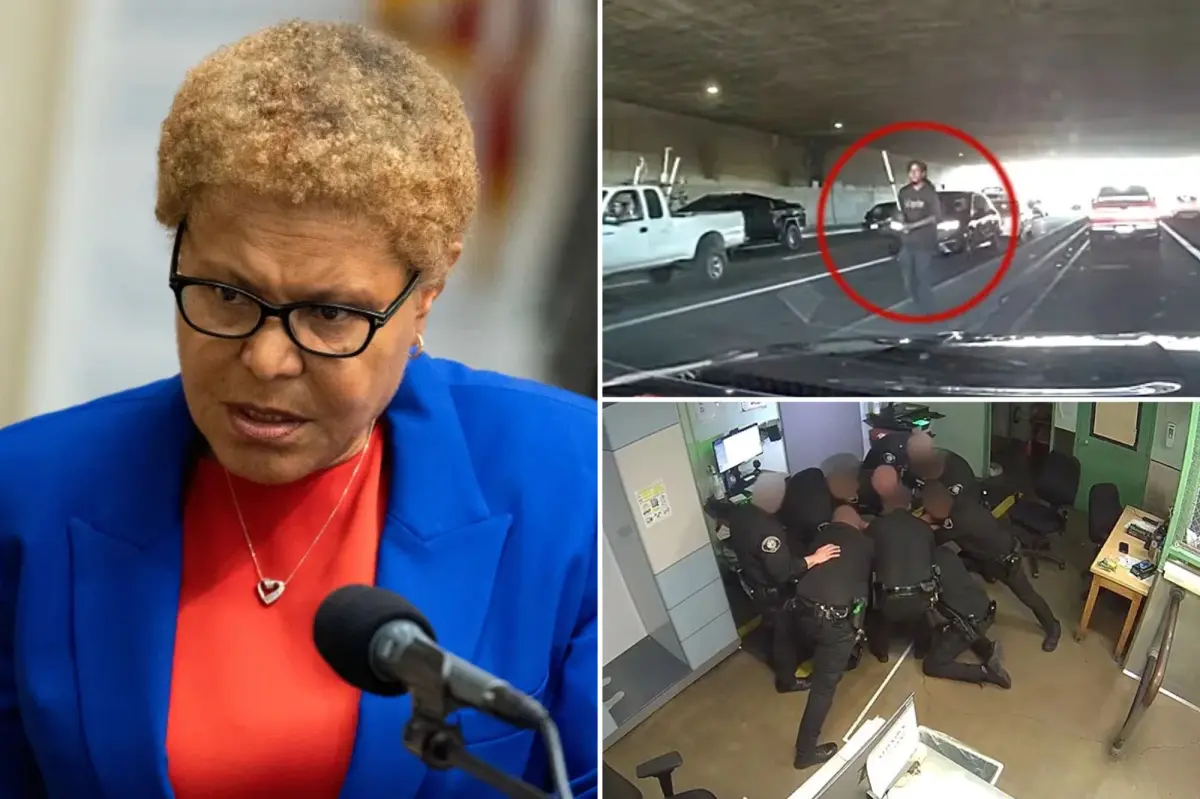
In Los Angeles, the line between public safety and private tragedy is often drawn in the sand, then washed away by the next emergency. But every once in a while, a video forces the city to stop and look. This week, Mayor Karen Bass announced that she is demanding an independent review of two deadly LAPD encounters caught on video. The footage, she said, was “incredibly difficult to watch.” She was careful to acknowledge the context: in both cases, police were called because someone was allegedly behaving in dangerous, violent ways. One involved 59-year-old Jose Carlos Hoyos-Munoz, accused of attacking his mother and brother with a deadly weapon before barricading himself inside a Chatsworth home and enduring an eight-hour standoff. The other involved Alejandro Lopez Garcia, a man allegedly swinging a baseball bat at people and occupied cars beneath the 10 Freeway in South Los Angeles. Both men ended up dead. Bass wants an executive directive that will examine officer-involved deaths and severe injuries, especially those involving people in mental health crisis. She did not offer easy answers or a sound bite to satisfy any one side. Instead, she asked the city to hold two truths at once. Police are sometimes called to protect others from a person in crisis who has become violent. And society has failed those people long before police ever arrive, by underfunding the mental health care that could have prevented the crisis from reaching a deadly point. The videos are hard to watch. The lives behind them are harder. For the families, those videos may be the last record of a loved one’s existence; for the officers, they are moments of fear and pressure that will be scrutinized by people who were not there; for the city, they are an invitation to reflect on whether this is the best Los Angeles can do. The word “independent” matters here. It suggests a process that will not simply be controlled by the LAPD, even though the department will have to cooperate fully. It suggests outside eyes, outside expertise, and a commitment to follow the evidence wherever it leads.
At the center of Bass’s statement is a sorrowful truth: until the United States builds a proper system for caring for people with mental health disorders, police will keep being called to do work they were never meant to do. “The reality is, until society provides the proper care for individuals with mental health disorders, law enforcement will continue to be called upon to respond, especially when those individuals exhibit violent behavior,” she said. This is not an abstract theory. It appears in the panicked 911 calls from a mother whose son is attacking her, in the sidewalk where a man with a bat terrifies strangers, in the emergency room where there are no psychiatric beds, in the jail cells where people with mental illness have become the largest de facto psychiatric population in the country. For decades, Los Angeles and the rest of the country have disinvested in community mental health services. Money went to policing and jails instead of clinics, housing and crisis teams. The consequences are everywhere. People who should be treated are instead managed by law enforcement. Officers are asked to be social workers, medics, negotiators, psychiatrists and judges, all while wearing a badge and a gun. They are not trained for that. They did not enter law enforcement to become first responders to mental health crises. But when a family has no other option, and someone becomes violent, who else is there to call? Bass understands that. She also understands that the deaths of Hoyos-Munoz and Garcia, however different their circumstances, are connected by the same missing safety net. They are not just two police encounters. They are a sign of what happens when a society waits for violence before offering help. Bass’s language was not the language of someone looking to score political points. It was the language of someone who has watched too many of these moments and knows that the next one is already on its way. She spoke of “disinvestment” not as an abstract policy term but as a reality that has had a human cost.
The first case is a slow-moving tragedy, with more questions than answers. Jose Carlos Hoyos-Munoz was 59 years old. On July 13, according to LAPD, he allegedly attacked his mother and brother with a deadly weapon and barricaded himself inside a Chatsworth home. The standoff lasted eight hours. Eventually, SWAT personnel used gas to bring it to an end. Hoyos-Munoz was taken to a hospital, treated for exposure to that gas, and then booked into Van Nuys Regional Jail. But whatever crisis had driven him did not remain outside. Two days later, jail staff removed him from his cell. Police say a “non-categorical use of force” occurred as officers placed him in a five-point restraint chair to take his fingerprints. That phrase, “non-categorical use of force,” is official jargon. Humanized, it describes the moment when a 59-year-old man, already weakened and disoriented by a standoff and chemical exposure, was strapped into a restraint chair so that a routine administrative task could be completed. Later, he was moved to a single-person cell and kept handcuffed briefly. When officers returned, another non-categorical use of force occurred. They placed him face down on his bunk and removed his cuffs. About twenty minutes later, he was found unconscious and not breathing. Despite medical intervention, he was pronounced dead. Three detention officers were also injured during the altercations, with contusions and minor lacerations. This sequence of events demands far more than an internal report. Did anyone check on Hoyos-Munoz after he was placed face down? Was his breathing monitored? Were there warning signs that were missed? Why was it necessary to use that kind of force on a man who was already in custody and in a cell? The LAPD’s clinical language cannot answer those questions. An independent review must, and it must do so with the urgency that a family’s grief deserves. A man who survived an eight-hour standoff should not have died in a jail bed, twenty minutes after force was used on him.
The second case is entirely different in speed and setting, but it raises the same unsettling question: could a different kind of response have saved Alejandro Lopez Garcia? On July 29, Garcia was reportedly armed with a baseball bat beneath the 10 Freeway near Normandie Avenue and Washington Boulevard in West Adams, an area of South Los Angeles. According to LAPD, he was swinging the bat at people and occupied cars. Officers arrived shortly before 6:30 p.m. and found him still wielding the bat—including, police said, at officers and bystanders. Someone made a decision, and the officers opened fire. Garcia was killed. In a sense, this is the most traditional kind of police shooting: a person with a weapon, in public, presenting an immediate danger. But even that familiar pattern begins to feel different when you recall that Garcia, too, was likely in the grip of a mental health crisis. What was going through his mind? Was he afraid of something we cannot see? Had anyone tried to speak to him calmly, to build trust, to give him a reason to lower the bat? A baseball bat in traffic is a threat, yes. But it is also a sign of someone whose fear or despair may have overwhelmed any sense of reality. Officers are trained to stop threats. They are not always trained to spot the difference between a criminal intending harm and a suffering human being who cannot stop. The video of this encounter will be reviewed by analysts, lawyers and the public. They will ask whether there was time, distance, or less-lethal options. But underneath all of that is a deeper question: Why was there no one else available to answer this call? Why does a city with millions of people rely on armed officers as the first and often only response to someone in crisis? Garcia’s death, like Hoyos-Munoz’s, is not merely a moment to be judged. Already, there is a tendency to sort these cases into two boxes: police violence or public safety. But real life does not arrange itself into boxes. A person can be both a threat and a victim. An officer can be both a protector and a source of harm. A city can be both saddened and responsible. If the review is honest, it will resist the urge to make everything simple, because the truth is not simple.
Bass’s planned independent review is not meant to be a rubber-stamp defense of the LAPD. It is directed at policies, training, tactics, supervision and accountability. The order also makes room for something often forgotten: the mental health support of officers themselves after critical incidents. That may be one of the most important pieces of the directive. Police officers who are involved in a fatal shooting or a violent jail-cell struggle do not simply clock out and leave the trauma behind. They replay it. Some are haunted by it. Some suffer silently, afraid that asking for help will make them look weak. If the city expects officers to respond to the next crisis with calm and compassion, it must help them heal from the last one. The review also points toward a different future. Bass called for expanded civilian crisis-response and co-response programs, which would pair mental health professionals with officers—or send unarmed specialists to calls involving people who have not become violent. As Bass put it, LAPD officers do not enter the force to become first responders to mental health crises, and they are not equipped with the proper training to do so. This approach has already shown that it can reduce emergency room visits, jail time, and violence. It is not naive. It is practical. “Public safety cannot be achieved through law enforcement alone,” Bass said. That sentence is at the heart of the change. For decades, Los Angeles has tried to police its way out of a mental health emergency, and these two deaths are the result. The review cannot undo them. It can, however, point the city toward a system that responds to mental illness with care, not just with force. It can also remind every Angeleno that the officer who is called to a crisis is not the enemy. The enemy is decades of neglect that left everyone with no better options. The review should also look at whether officers have access to de-escalation tools, crisis intervention training, and mental health professionals in the field. Bass has said repeatedly that police should not be the first and only answer. But until the city builds what she called a “continuum of care,” officers will remain on the front lines. The least the city can do is train them for that reality and hold them accountable when something goes wrong.
Ultimately, no announcement can bring back Jose Carlos Hoyos-Munoz or Alejandro Lopez Garcia. No executive directive can erase the images their families cannot stop seeing. But accountability is not the same as punishment, and reform is not the same as blame. By stepping forward and demanding an independent review, Mayor Bass has acknowledged that the city must ask hard questions of itself. That is a significant change from the usual post-incident routine of issuing a statement and waiting for the next tragedy. It is also a recognition that mental health care is not a niche issue or a luxury. It is a matter of life and death. The two men whose lives ended in these encounters were not abstract statistics. They were somebody’s loved one. They were people who may have been acting out in terrifying ways, but they were also people who needed help that never arrived. Their deaths—and the deaths of too many others—should force Los Angeles to reimagine what public safety really means. It is more than responding to force with force. It is making sure that people who are suffering have somewhere to go. It is training officers not just to protect themselves, but to recognize when someone is in crisis and to call on the right help. It is providing options for families exhausted by the burden of caring for a loved one who has lost their grip on reality. The city may never be able to prevent every tragedy, but it can stop making the same choices that lead to them. It can look at the videos and decide to see human beings, not just threats. That is the work ahead. During this difficult moment, any Angeleno who is struggling has somewhere to turn. Help is available, free and confidential. Call or text 988, or chat at 988lifeline.org to reach the Suicide & Crisis Lifeline. That lifeline is one small example of what a caring system can look like: someone who answers, someone who listens, someone who helps before a moment becomes an emergency. No one has to face this alone.