






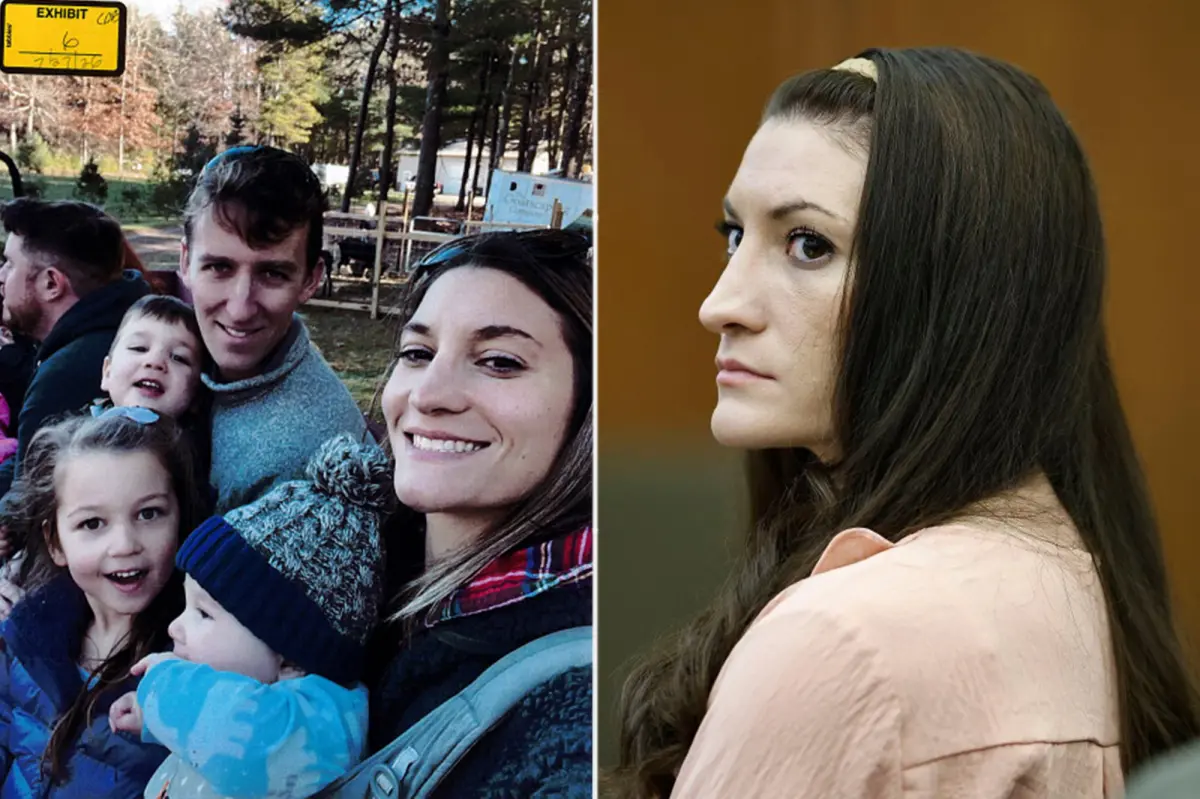
In a Plymouth County courtroom, the air felt thick with the weight of an impossible story. For more than ten hours across Thursday afternoon and Friday, the jury of nine women and three men sat together, trying to decide what justice could possibly mean in a case that had already broken so many hearts. Their only question during all that time was a simple request: they asked to see a knife and some prescription pill bottles. These were not just pieces of evidence. They were the haunting remnants of a day that changed everything. The knife was the one Lindsay Clancy used to cut her own wrists and neck after she was accused of strangling her three children. The pill bottles were the medication that was supposed to help her, the powerful psychiatric drugs that filled her final months with confusion and despair. The jury’s request suggests that they are not rushing to a conclusion. They are holding the objects, perhaps trying to understand how a mother could be both the person who gives life and the person who takes it away. As they were sent home for the weekend with no verdict, the pause felt appropriate. Some decisions cannot be made in haste, especially when every possible answer leaves behind grief. The jurors will return on Monday morning, carrying the weight of those objects in their minds, and the weight of three small children whose names are now forever tied to this tragedy. The whole case had become a mirror for a community and a country, forcing everyone who hears it to ask: how much can any person endure before their mind breaks, and if it does, who is responsible for what that broken mind does?
The central story is one of unimaginable loss. Lindsay Clancy, a 36-year-old mother from Duxbury, Massachusetts, is accused of murdering her three children on January 24, 2023. Prosecutors say she waited for her husband to leave the house to run errands, then used exercise bands to strangle five-year-old Cora, three-year-old Dawson, and eight-month-old Callan. It is difficult to even write those words. The ages, the names, the smallness of those lives, all of it pushes against the edges of what most of us can comprehend. Immediately after the deaths, Clancy is said to have cut her own wrists and neck, taken an overdose of her medication, and thrown herself from a second-floor window. That fall paralyzed her, and she now sits in a wheelchair in the courtroom, a woman whose life is already defined by the horror she is accused of causing. The prosecution tells a story of planning and intention, arguing that she wanted to escape the exhausting demands of caring for three young children and did not want to leave them behind after she took her own life. In this version, the case is not about mental illness but about a deliberate, calculated choice—a mother who convinced herself that killing her children was better than leaving them alone in the world. But even as the prosecution presents this narrative, the human reality underneath it is painfully messy. A father went to run errands and came home to find his family gone. He had been sent away, prosecutors believe, so that the act could happen without him. His grief is a private thing, but it is part of the atmosphere in that courtroom, surrounding every piece of evidence, every question, and every pause in testimony.
Lindsay Clancy’s defense lawyers ask the jury to see the same facts through a completely different lens. They say she was not a criminal acting out of malice, but a mother in the grip of severe postpartum psychosis—a rare and terrifying mental health condition that can make a woman hear voices, see things that are not real, and lose the ability to distinguish between her own thoughts and an outside command. According to the defense, Clancy heard a voice telling her to kill her children and herself, and she obeyed that voice because her mind was no longer her own. The months before the tragedy support a picture of a woman desperately trying to save herself. She was suffering from debilitating insomnia, anxiety, and depression. She had terrifying intrusive thoughts of harming her children, thoughts that she found so horrifying that she did exactly what people are told to do in such situations: she reached out for help. She went to a psychiatrist. She entered a perinatal clinic, a place designed specifically to help women with mental health struggles related to pregnancy and childbirth. She even checked herself into a mental health facility for five days, hoping that professionals could contain the darkness that was flooding through her. This is not the story of a mother who hid her suffering or pretended everything was fine. This is the story of a woman who knew something was wrong and tried to fix it. The defense argues that her illness progressed beyond what a five-day stay could treat, and that by the time her mind finally shattered, she was not acting as Lindsay—she was acting as a prisoner of psychosis. The jury has to decide whether that means she is not criminally responsible for what happened, and whether institutionalizing her in a mental health facility is the right outcome rather than prison.
If there is one detail that captures the tragedy more than any other, it is the medication. In the months leading up to the deaths, Clancy was prescribed thirteen powerful psychiatric medications. She came to believe that these medications were making her mental health struggle worse. It is a heartbreaking detail because it reveals how fragile the whole situation was. She was trying to heal, but the very tools meant to help her may have been feeding the confusion and despair that eventually overwhelmed her. Psychiatric medication is not a simple thing. For some people, it is a lifeline. For others, it causes side effects that deepen the fog, blunt emotions, or introduce new terrors. Clancy was taking thirteen different drugs, and somewhere in that pharmaceutical fog, she began to lose faith in her own recovery. The pill bottles the jury asked to see are symbols of a medical system that tried, and also failed, to protect her. The knife is another symbol, not only of violence but of self-hatred, of a mind turning against its own body. To humanize this case means acknowledging that Clancy is not a monster who woke up one morning and decided to destroy her children. She was a woman who had been struggling for months, who had asked for help, who had done the things she was supposed to do, and who still slipped through the cracks. This does not excuse the deaths, and nothing can ever excuse them. But it asks us to see the difference between an evil person and a sick person, between an act of cruelty and an act of madness. The distinction matters, not just for Lindsay Clancy, but for all mothers who suffer silently, who hear terrible things inside their heads, and who are too afraid or too ashamed to tell anyone.
The legal stakes in this case are enormous. If the jury finds Clancy guilty of murder, she faces a mandatory sentence of life in prison. If they accept the defense’s argument that she was not criminally responsible because of postpartum psychosis, she will not go free—instead, she would be committed indefinitely to a mental health institution, treated as a patient rather than a prisoner. In both scenarios, her life is permanently shattered. She is already paralyzed and wheelchair-bound, and she will never again be the mother she once was. The jury’s task is not to decide whether a tragedy occurred, because there is no dispute about that. The question is more philosophical, more painful: at the moment she took her children’s lives, was Lindsay Clancy truly present in her own mind? Or was she so completely overtaken by a mental illness that she was legally not responsible for her actions? It is the kind of question that keeps philosophers awake at night, and now twelve ordinary people have been asked to answer it with a simple word: guilty, or not guilty. The fact that they have deliberated for more than ten hours without reaching a verdict shows that they are struggling honestly with the question. Their request to see the knife and the pill bottles again feels like a search for physical truth, for something real they can hold onto in a case that feels surreal and unbearable. They know that their decision will not restore the three children who were lost. It will not comfort the father who is left behind. But it will say something about how this society understands mental illness, motherhood, and the limits of criminal responsibility.
In the end, the Lindsay Clancy case is not just a courtroom drama. It is a heartbreaking window into the fragile nature of the human mind and the quiet struggles of mothers who are expected to be everything to everyone while their own mental health collapses. It forces a painful question: how do we tell the difference between someone who chooses evil and someone who is consumed by illness? The answer is not always clear, and that is precisely why this case is so difficult. But beyond the legal arguments, there is a deeper human lesson. We must pay attention to the mothers around us—the ones who are not sleeping, who seem anxious, who are frightened by their own thoughts, who are desperately trying to appear normal while feeling like they are falling apart. Postpartum depression and postpartum psychosis are real, they are treatable, and they are often hidden behind closed doors. Lindsay Clancy did try to reach out, but the help was not enough, and the tragedy happened anyway. The jury will return on Monday and deliver a verdict that will define the rest of her life, but no verdict can ever heal the wound left by the three children who no longer exist. All that is left is the search for understanding, which is perhaps the most human thing of all. We want to believe that mothers are safe, that the people who bring us into the world will never be the ones to take us out. When that belief is shattered, we cling to the hope that there must be an explanation, that the mind must have been broken, that this cannot be ordinary. Lindsay Clancy’s case asks us to hold both grief and mercy in the same breath, and to recognize that sometimes the most compassionate justice is not punishment, but care.