





Black-crowned night herons are, in many biological and cultural ways, the quintessential New Yorkers: stylishly understated, nocturnal by choice, and endlessly adaptable to the chaotic, fast-paced rhythm of the metropolis. With their muted grey-and-black plumage, stout frames, and elegant, flowing white crown feathers that catch the city breeze, these two-foot-tall birds carry themselves with a distinct, confident elegance. “They are fashionable, they stay out late, and they love exploring new places,” points out Dustin Partridge, the director of conservation and science at the NYC Bird Alliance. Throughout the five boroughs, these charismatic birds have carved out a unique ecological niche, making themselves entirely at home in the quiet green spaces of Harlem, along the bustling East River waterfront in Queens, and tucked away in the vibrant, concrete neighborhoods of Manhattan’s Lower East Side, where they are rumored to have developed a very local taste for the city’s notorious rats. For regular commuters and nature lovers, these birds represent a comforting, slow-paced counterweight to the relentless speed of urban life. High school teacher Valerie Wald fondly describes spotting them during her morning walks through Central Park, taking immense joy in watching their characteristic behavior of doing absolutely nothing more than standing still. Yet, despite their hearty nature, sharp hunting skills, and apparent comfort around human activity, a dark cloud looms over these beloved feathered residents. Straddling a delicate line between survival and erasure, a startling new study co-authored by the NYC Bird Alliance, the Cornell Lab of Ornithology, and Rutgers University warns that these iconic birds could completely vanish from New York City’s landscape in a mere eleven years. If this dramatic projection holds true, the loss of the black-crowned night heron will mark a tragic, silent farewell to a species that has long defined the wilder corners of the metropolis, echoing the historic and devastating loss of the passenger pigeon.
The mysterious and accelerated decline of these herons is not an isolated incident but a striking, localized symptom of a much larger continental crisis. Across North America, bird populations have suffered a staggering net loss of nearly three billion individuals since the 1970s, a quiet ecological unwinding that is now playing out with painful clarity in the New York and New Jersey Harbor. This harbor area, historically celebrated as the most robust nesting sanctuary for herons, egrets, and other wading birds in the entire Northeast, is experiencing an alarming 27 percent decline in nesting wading birds between the years 2000 and 2022. Alarmingly, research reveals that this steep downturn is almost entirely driven by the precipitous, heartbreaking nosedive of its most common resident, the black-crowned night heron. As detailed in the scientific journal Conservation Science and Practice, the potential disappearance of these local birds could trigger a massive, unpredictable ecosystem shift with cascading environmental consequences. Because these herons operate as the dominant water bird in the harbor—holding nearly half of all wading bird nests in recent decades—their health serves as a vital barometer for the entire region. Scientists refer to them as an “indicator species,” or an environmental canary in the coal mine, meaning their struggle indicates that the surrounding water, air, and food supply are becoming deeply compromised. This ecological warning extends far beyond wildlife conservation; as Amanda Rodewald, a prominent ornithologist at Cornell, emphasized in the 2025 “State of the Birds” report, when local conditions deteriorate to the point where they can no longer sustain bird populations, they are inevitably becoming unsafe for humans as well, highlighting the profound connection between avian survival and human public health.
To fully understand the gravity of this impending loss, one must look back at the resilient history of the New York/New Jersey Harbor and the remarkable revival of its urban waterways. During the height of the Industrial Revolution, heavy manufacturing, unchecked pollution, and rampant habitat destruction drove sensitive water birds away from these urban estuaries. However, the landmark passage of the Clean Water Act in 1972 sparked a miraculous environmental renaissance, cleaning the waters and inviting the birds to return in droves; by the late 1990s, the harbor had transformed into a thriving biological gem, hosting nearly 23 percent of all nesting wading birds along the entire Atlantic coast from Maine to Virginia. Today, the herons’ complex lives are deeply intertwined with the geography of New York City, utilizing a hidden network of twenty small, uninhabited islands scattered across the city’s waterways—ranging from Goose Island in the South Bronx to Canarsie Pol in Brooklyn’s Jamaica Bay. During the spring breeding season, these rocky, overgrown sanctuaries become bustling nurseries where adult herons tenderly raise their young before commuting across the city to forage. These mature birds are tough, pragmatic hunters, using their heavy, dagger-like beaks to spear fish, frogs, and rodents, standing their ground with a hunched, stoic posture that makes them look like miniature, feathered versions of Alfred Hitchcock. The thought that such resilient, stoic creatures could be driven out of the very harbor they successfully reclaimed is a sobering reminder of how easily hard-won environmental victories can be undone by modern pressures.
The vulnerability of these magnificent birds is most acute during their nesting period, when they are subjected to a complex, compounding cocktail of urban and environmental threats. The fragile, wild islands they depend on are increasingly battered by the harsh realities of climate change, including rising sea levels that erode valuable nesting shorelines, as well as illegal human intrusion by curious urban explorers who inadvertently terrify the nesting parents, driving them to abandon their eggs. On the ground, the herons face fierce competition for prime nesting real estate from aggressive double-crested cormorants, alongside the highly disruptive antics of wild raccoons, whose clever and hungry nature leads them to raid nests and consume vulnerable eggs. Upon learning that raccoons were acting as major predators, high school teacher Valerie Wald lamented the conflict between her local favorites, stating, “Oh no, my favorite mammal in Morningside Park is attacking one of my favorite birds.” Beyond these visible, physical dangers, there is a quieter, much more insidious chemical threat lurking beneath the surface of the harbor’s water. Scientists suspect a buildup of dangerous chemical pollutants, including agricultural pesticides, toxic heavy metals like lead and mercury, and lingering synthetic PCBs. As the city’s coastal salt marshes continue to disintegrate due to development and sea-level rise, locked-away contaminants are being re-released into the marine food chain, poisoning the fish and organisms that the herons rely on for sustenance, creating a toxic environment that researchers are working tirelessly to dissect.
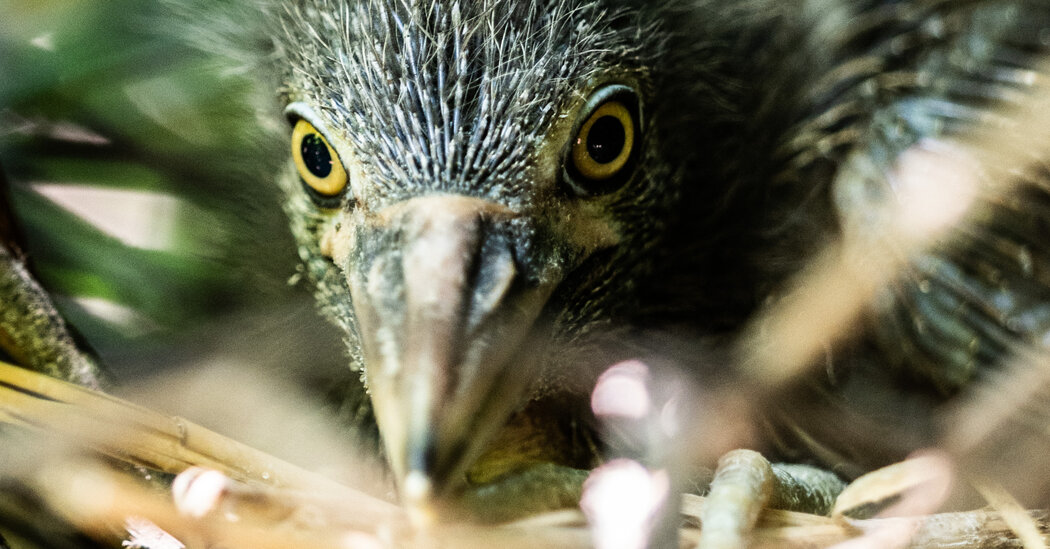
Unraveling the complex mystery of the heron’s decline requires intensive, often grueling fieldwork, which has become increasingly challenging in recent years due to unpredictable global patterns and climate shifts. During the final weeks of May—the brief, critical window when scientists must count newborn chicks before they grow strong enough to leave their nests—researchers from the NYC Bird Alliance and partner organizations face an uphill battle against disease and extreme weather. Last year’s count had to be completely abandoned due to a devastating outbreak of highly contagious avian influenza, and this year’s operations were immediately disrupted when temperatures unexpectedly spiked to a grueling ninety degrees Fahrenheit in late May, a heatwave that threatened the safety of both the researchers and the delicate chicks. Undeterred by the sweltering conditions, the conservation team pivoted to conducting critical wellness checks, wading through dense, wild networks of poison ivy and painful thorn bushes on the scattered nesting islands. Though they were unable to perform an exact census, their rough observations confirmed their deepest fears: the number of nesting black-crowned night herons appeared critically low, save for a few glimpses of grumpy-looking, fuzzy chicks peering through the thick branches. In a bid to gather more precise data, representatives from the American Bird Conservancy began mounting sensitive acoustic recording devices to island trees, hoping to capture vocalizations and unravel the auditory secrets of what is distressing these elusive birds during the night.
As scientists work tirelessly on the ground, the path forward for the black-crowned night heron lies in swift, decisive policy intervention and community-driven conservation efforts. Because these herons enjoy a vast global distribution, they do not qualify for protection under the federal Endangered Species Act, which is reserved exclusively for species facing worldwide extinction; therefore, the responsibility of saving this local population falls squarely on the shoulders of individual state governments. The NYC Bird Alliance’s study strongly urges New York State to officially classify the black-crowned night heron as “threatened” or “endangered,” an important legislative step already taken by neighboring states like Maine, New Jersey, and Pennsylvania to unlock vital conservation funding and habitat protections. There is also an ongoing push in Congress to amend federal wildlife laws, which would grant states more resources to manage species that migrate across state borders and do not recognize artificial political boundaries. “State policies and conservation efforts could have a disproportionately larger role for species that don’t recognize state borders,” remarks Dr. Partridge, who remains resolutely optimistic about the future of these birds. He emphasizes that the discovery of this sharp decline is not a final death sentence, but rather a powerful, timely call to action, offering a rare and valuable window of opportunity to intervene. By implementing strict island management, controlling invasive predators, reducing urban runoff, and raising public awareness, New Yorkers can protect their unique neighbors and ensure that the distinctive, stoic silhouette of the black-crowned night heron remains a permanent, beloved fixture of the city’s skyline for generations to come.