




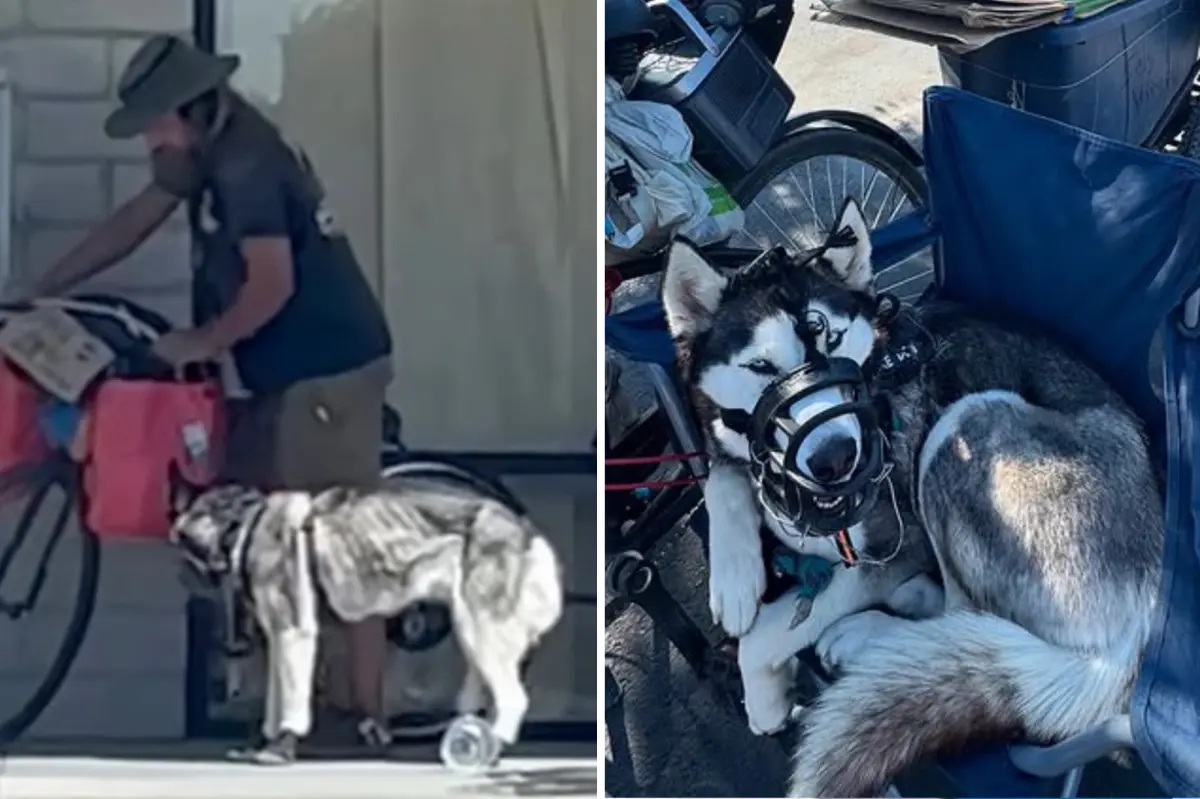
In the oppressive, unrelenting heat of California’s Central Valley, where summer temperatures routinely turn sidewalks into griddles and asphalt into a searing obstacle course, a story of profound cruelty and touching resilience has gripped the city of Merced. The tale revolves around a Siberian Husky named Sweetie, a breed whose thick double coat and arctic ancestry render them profoundly ill-suited for the scorching climate of the region. Yet, Sweetie was not just left to wander the sweltering streets; she was allegedly being subjected to a daily ordeal that would break the spirit of even the most enduring creature. According to a resident who spoke with ABC30 Action News, the heartbreaking scene unfolded last week when a homeless man, who claimed ownership of the husky, was seen riding a bicycle while mercilessly dragging Sweetie behind him across the hot pavement. The image is a stark tableau of agony: the desperate scrabbling of claws against burning ground, the frantic, wide-eyed gaze of a dog confused and hurt by the only human she knows, and the callous indifference of the man pedaling forward, oblivious to the physical torment he is inflicting. It is a stark contrast to the idyllic image of a husky pulling a sled through crisp snow, replaced instead by a desperate struggle for survival on melting asphalt, an incident that serves as the grim capstone to months of mounting concern.
This latest incident, however, was not an isolated flash of anger but rather the culmination of a long, agonizing pattern of alleged abuse that has been reported to authorities for over a year. As the story of the pavement dragging began to circulate among the concerned citizens of Merced, a more horrifying portrait of Sweetie’s life began to emerge. The president of the local SPCA, a woman who has dedicated her life to the welfare of animals, provided a chilling eyewitness account to the same local news outlet. She recounted witnessing a separate, visceral act of violence where the homeless man picked up the defenseless husky by the scruff of her neck and slammed her forcefully to the ground. This was not a disciplinary correction; it was a blatant act of physical aggression that could have caused lasting spinal damage or internal injury. Compounding the physical violence was a state of chronic neglect that was visually chronicled in photographs which subsequently went viral online. The images showed Sweetie struggling desperately to remove a tight, unforgiving muzzle that had been clamped onto her snout. For a husky, a breed that relies heavily on panting to regulate its body temperature, a muzzle is not merely an inconvenience—it is an instrument of torture. In the blazing heat, with her primary cooling mechanism effectively sealed shut, Sweetie was left to suffer in silent, breathless distress, her eyes pleading for relief that would not come. Further video evidence surfaced showing the man yanking viciously on her collar, eliciting high-pitched, agonizing yelps as she recoiled in fear, her tail tucked tightly between her legs—a universal canine gesture of terror and submission.
In response to the escalating outcry and the damning evidence, the Merced Police Department began a methodical and painstaking investigation into the allegations of animal cruelty. Lieutenant Kalvin Haygood acknowledged that officers had been diligently collecting evidence of the abuse and neglect for weeks prior to the public explosion of the story. Their goal was to compile an airtight, comprehensive case file to submit to the Merced County District Attorney’s Office. The prosecutors would then be tasked with the legal evaluation of the evidence to determine whether formal criminal charges should be filed against the dog’s owner. However, the path to justice has been fraught with legal hurdles and bureaucratic caution. In a move that deeply frustrated animal rights advocates and the general public, police had actually taken Sweetie to a veterinarian on August 6th—just one day before the most recent alleged incident—to be evaluated for signs of neglect or abuse. Despite the mounting evidence of mistreatment, authorities made the controversial decision to return the dog to her owner after a vet determined that she was in “good enough” health to be released. This decision highlights the frustrating reality of animal cruelty investigations: the legal threshold for seizing an animal without a warrant is often high, requiring proof of imminent danger or severe, immediate injury. While the police understood the community’s anguish, they were bound by the meticulous—and often maddeningly slow—requirements of due process, needing to build a case robust enough to survive scrutiny in a court of law rather than acting on emotional impulse.
The fragile equilibrium of the investigation was shattered the very next day, on August 7th, when yet another abuse incident was reported, this time occurring outside a local Taco Bell restaurant. The details of that encounter remain under investigation, but it was the final, irrefutable straw that convinced authorities that immediate action was necessary to ensure the husky’s safety. For the second time in just a few days, Sweetie was seized by police and taken into protective custody, this time with the full intention of keeping her there. The transition from the chaotic, dangerous streets to the sterile, quiet confines of an animal shelter cell was, paradoxically, a massive relief for those who had been advocating on her behalf. Although a kennel is not a substitute for a loving home, it represented a space where she would not be subjected to being dragged, slammed, or muzzled. She would have water, food, and safety. The decision was immediately welcomed by a chorus of Merced residents who had rallied for weeks, organizing online and speaking to local media, demanding that the city step in and rescue the dog. However, even as the relief washed over the community, a palpable sense of frustration remained. Many residents expressed that the police response, while ultimately effective, was far too slow, questioning why it had taken multiple video recordings, countless witness reports, and months of suffering for law enforcement to finally intervene and remove a clearly distressed animal from a dangerous situation.
The community’s reaction underscores a deep-seated emotional resonance that animal cruelty cases often evoke. Sweetie became more than just a dog; she became a symbol of vulnerability and the struggle against indifference. The viral photographs and videos did not merely document abuse; they humanized her suffering in a way that written reports could not. Seeing her struggle against the muzzle, hearing her pained yelps, and witnessing her body being dragged across the pavement bypassed intellectual debate and struck a raw, visceral nerve in the collective psyche of the public. For animal lovers, the slow pace of the police investigation felt like a betrayal of the dog’s trust. But Lieutenant Haygood defended the department’s approach, explaining to ABC30, “It does take time to build these cases. And we’re hoping that someone out there has the evidence that we’re looking for.” His plea highlights the necessity of building a solid legal foundation to ensure a successful prosecution, preventing the abuser from slipping through a procedural loophole. It is a delicate dance between swift justice and guaranteed conviction. The community, while impatient, largely understood that a rushed case might end in a dismissal, leaving Sweetie unprotected and the abuser free to harm another animal. The advocacy displayed by the citizens of Merced—from constant calls to the police department to posting reminders on social media—demonstrated the powerful force of collective mercy in the face of wanton cruelty.
As the legal machinery grinds forward, the case file is being prepared for submission to the District Attorney’s office, where a careful legal analysis will determine the fate of Sweetie’s alleged abuser. Potential charges could range from misdemeanor animal cruelty to felony charges, depending on the severity and the prior report history. While the immediate danger has passed since Sweetie is now under the protection of the authorities, her future remains uncertain. The investigation is still active, and police are desperately seeking any additional witnesses or footage of the alleged abuse that could bolster the prosecution’s case. For now, Sweetie rests in a safe, secure location, far from the burning pavement and the tight grip of a muzzle, beginning the long physical and emotional recovery from her trauma. Her story, however, serves as a stark and unsettling reminder of the hidden suffering that exists in our communities. It forces a reflection on the silent guardianship we owe to the animals that depend entirely on our mercy. Sweetie’s ordeal is a testament to the resilience of animals, but even more so, it is a testament to the power of community vigilance and the refusal to look away. While we await the outcome of the legal proceedings, the image of that husky, likely bewildered but finally safe, stands as a poignant reminder that justice is often a slow and arduous process, but one that must be pursued relentlessly for those who cannot speak for themselves, ensuring that no creature is left to be dragged down the metaphorical and literal hot pavement of life without someone fighting to lift them up.