


A Quiet Commute Turned to Chaos: Passengers Recall Spanish High-Speed Train Collision
Survivors describe the terrifying seconds when an AVE service slammed into the back of another train, raising new questions about high-speed rail safety in Spain.
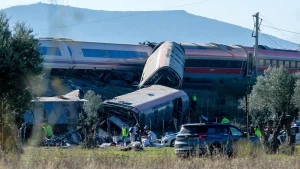
Wednesday morning began like any other for the hundreds of travelers packed into two AVE high-speed trains slicing across the Spanish countryside. Coffee cups balanced on fold-down trays. Laptops open and glowing. Suitcases tucked neatly into overhead racks. Then came the sound — a low, metallic groan that swelled into a deafening collision — and the easy calm of Spain’s flagship rail service vanished in an instant. For the passengers on the rear train, the terrifying reality set in just seconds before impact: the high-speed train ahead had slowed sharply, and there was nowhere to go. “I saw the back of the other train filling the whole window,” one traveler told local radio shortly after escaping the carriage. “I grabbed the seat in front of me and I just prayed.” That instinctive reaction likely prevented even more serious injuries on Wednesday, when a high-speed passenger train rear-ended another on a busy route in Spain, sending shockwaves through a country that prides itself on railway excellence. The collision, which left a number of passengers injured and sent emergency crews racing to the tracks in the northeast of the country, immediately reignited public concern about safety on one of Europe’s most sophisticated rail networks. Emergency services described the scene as chaotic but not catastrophic, with no immediate reports of fatalities despite grinding steel, twisted luggage racks and shattered windows. Still, for many of the witnesses and passengers, the crash was a jarring reminder of how quickly modern travel can turn fragile — and how a routine journey can become a matter of chance, timing and fate in the blink of an eye.
According to state rail operator Renfe, the collision occurred on one of Spain’s high-speed rail arteries, a corridor that carries thousands of passengers every day between the capital, Madrid, and the country’s northeastern cities. The leading train had reportedly reduced speed because of a signaling irregularity on the track ahead. It was during that moment of caution that the second AVE train caught up with it, a sequence of events that should have been impossible under normal safety protocols. High-speed trains in Spain rely on an intricate mix of onboard computers, track-side sensors and automatic braking systems designed to keep moving trains at safe distances. The fact that one train nonetheless slammed into the back of another offers a deeply concerning puzzle for investigators, who are already working to determine whether the collision was the result of technical failure, human error or a combination of factors. Officials have not confirmed whether the second train was running in automatic mode, whether the driver had received a braking signal, or why the rear train’s control systems apparently failed to prevent the impact. Dozens of ambulances, fire engines and Guardia Civil patrols converged on the scene, where the two high-speed trains blocked the rails for several hours. Police set up a wide perimeter as rescue teams used hydraulic equipment to free one passenger whose leg had become trapped in the wreckage. Another passenger, a woman seated in the final carriage, suffered a broken wrist and was carefully evacuated on a stretcher. At a temporary medical station set up near the tracks, medics treated passengers with cuts, bruises and signs of shock while psychologists moved among the survivors, offering blankets and quiet words.
Among those who walked away from the wreckage was José Manuel Álvarez, a 47-year-old procurement manager from Madrid, who said he had been traveling to a business meeting when the impact came. He described the collision as “a sudden snap of physics” that threw his upper body forward with violent force. “There was no warning siren, no screeching brakes — at least none that I heard,” he said. “The train just slammed into something, and then everything was sliding, falling, twisting. People were screaming. In those seconds, I truly thought the whole carriage was going to fold.” Laura Gómez, a nursery school teacher traveling with her six-year-old daughter, remembered watching the landscape turn into a blur as the train raced along. When the impact came, she said, her daughter was lifted from her seat and thrown forward. “I heard a sound I can’t forget — like an enormous metal fist hitting a wall,” she told reporters after being treated for minor cuts and bruises. Eyewitness accounts like these have now become central to the official investigation. Many passengers sitting in the rear train said they felt a sudden deceleration, followed by a hard jolt that lasted no more than two or three seconds. Others said the emergency alarms sounded almost exactly at the moment of impact, as if they were part of the collision itself. One passenger traveling in the front train said she had felt a lighter bump and then noticed fellow travelers gathering at the back of her carriage, peering through windows that were suddenly crowded with images of a crumpled train nose. “We realized something had hit us,” she said. “There was a crunch, and then the train stopped so hard that bags flew down the aisle.” These recollections, raw and immediate, are providing investigators with a detailed timeline of the final seconds before contact — and a painful reminder that no amount of automation can entirely remove the human experience of fear.
Within an hour of the crash, the area around the tracks had become a vast emergency staging ground. Several passengers were taken to nearby hospitals, two of them with moderate injuries, according to regional health authorities. The rest were evacuated along the railroad bed, many of them walking stiffly, gripping their mobile phones and contacting worried relatives. Rescuers went through both trains twice to make sure no one had been left behind, and a second sweep with dogs was conducted in the afternoon as a precaution. Spain’s transport minister appeared on national television Wednesday evening, offering a message of solidarity with those affected and promising a “thorough and transparent” investigation. “Spain’s high-speed network is one of our greatest modern engineering achievements,” she said. “But days like today are a sobering reminder that vigilance can never be relaxed.” Renfe, for its part, issued a statement expressing regret for what happened and confirming that it would cooperate fully with the Spanish Railway Accident Investigation Commission. The operator also announced that high-speed rail services on the affected corridor would be suspended through Thursday to allow forensic teams to examine the track, signaling equipment and damaged carriages. Ultimately, the aim is nothing less than a complete reconstruction of the event, millisecond by millisecond, from the first warning to the final collision. For the general public, the disruption was immediate and inconvenient. At major stations along the route, hundreds of passengers found their plans upended, as departure boards flickered with cancellations, rerouted connections and long delays. Renfe arranged alternative buses and offered refunds, but the frustration on the faces of travelers spoke to a broader sense of unease — a rare moment of uncertainty in what had always been regarded as an exceptionally safe way to move.
The crash has inevitably raised difficult questions for a rail network that has long worn its safety record as a badge of honor. Since the first AVE service opened in 1992, Spain’s high-speed system has expanded to become the second-longest in the world, behind only China’s. That expansion, however, has brought complexity, and investigators will now scrutinize every element of the line’s safety architecture, from the ERTMS signaling system — designed to stop trains automatically if a signal is missed — to driver training, shift length and maintenance schedules. Official statistics show that high-speed rail remains one of the safest modes of transport in Europe, and no fatal crash has ever occurred on Spain’s high-speed network. Yet Wednesday’s rear-end collision is a sharp reminder that safety is not guaranteed, just as the 2013 derailment of a high-speed capable train outside Santiago de Compostela killed 79 people and exposed deep shortcomings in safety culture, oversight and emergency communication. “This is not a signal that high-speed rail is unsafe,” said one transport safety analyst who has studied Spain’s rail system for more than two decades. “But the margin for error in these systems is incredibly thin. When something goes wrong, it goes wrong very quickly, and the difference between a near-miss and a catastrophe can be a single second.” The investigation is expected to focus on the rear train’s automatic warning systems, the distance between the two convoys, and the behavior of the signals on the line. Investigators will also look into whether the leading train was given adequate protection once it slowed, and whether the rear train’s driver had enough time to brake manually. In the meantime, Spain’s rail agency has ordered additional inspections of trains and signal installations along the same corridor, a move that may cause further delays on a route already known for its high frequency and tight scheduling. With global attention now fixed on the incident, the pressure to produce answers has intensified, because the very idea of a modern high-speed train colliding with another seems to contradict the technological sophistication on which the country’s railway reputation is built.
By Thursday morning, technicians had begun clearing the last of the wreckage, and the task of repairing the line — and repairing public confidence — had only just begun. The collision will be studied for weeks, likely months, as investigators comb through data recorders, video footage, signaling logs and passenger statements. But for the people who lived through the collision, the aftermath is not abstract. Some said they would not board a train again for a long time. Others, perhaps more remarkably, insisted the experience had not weakened their trust in rail travel. In a country where high-speed trains have transformed the way people work, study and love — connecting distant cities in ways that once seemed impossible — Wednesday’s crash is a rare brush with vulnerability on a network normally celebrated for its speed. The railway has long been a symbol of Spanish modernity, a gleaming example of what infrastructure can achieve when ambition meets engineering. But as passengers shared their stories on the platforms and in the streets near the crash site, the emotional reality of that morning took center stage. “You always think it happens to someone else,” Laura Gómez said, her daughter asleep in her arms as she waited for a friend to pick her up. “Then suddenly you are inside it, and the speed becomes terrifying. I am grateful to be alive.” Her words, repeated in different ways by many survivors, stand as a fitting testimony to a day when a routine journey nearly ended in catastrophe. While investigators search for a technical explanation, the memories of that morning will stay with the passengers far longer than any report. Spain’s high-speed trains will run again, no doubt on time and at full velocity. The deeper journey — restoring the quiet assurance that travelers feel before the doors close and the train surges forward — will take considerably longer.